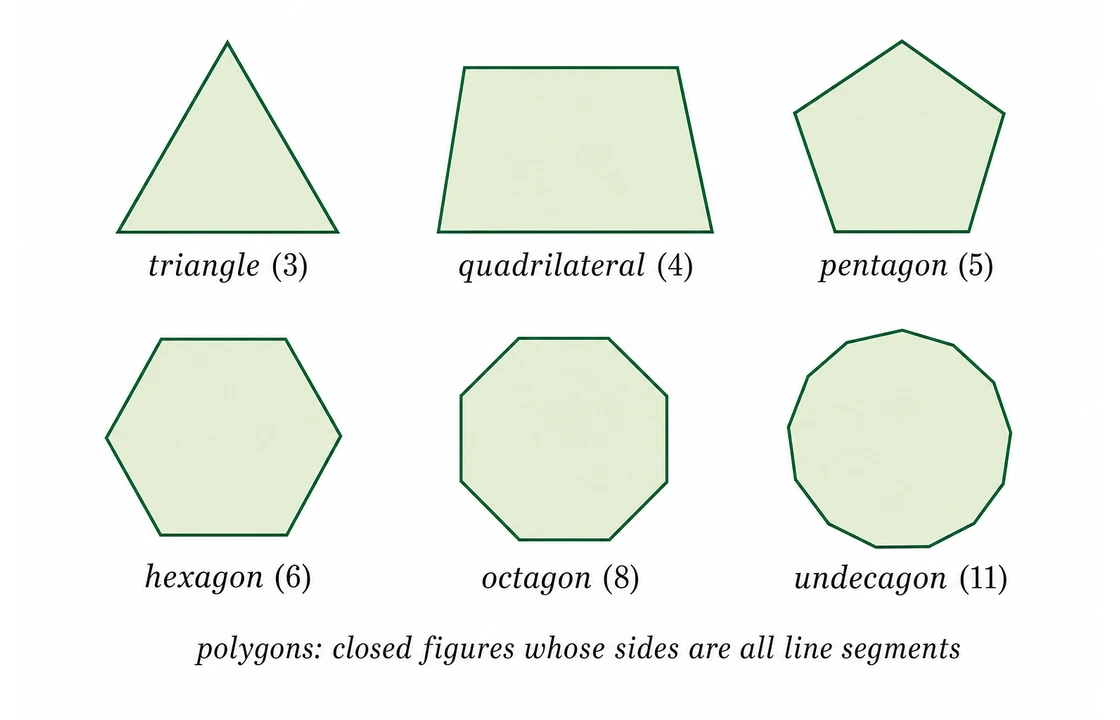
n = Number of sides (and also the number of angles)
Worked Example
Problem: Find the sum of the interior angles of a hexagon, and determine the measure of each interior angle if the hexagon is regular.
Step 1: Identify the number of sides. A hexagon has 6 sides, so n = 6.
n=6
Step 2: Apply the interior angle sum formula.
S=(6−2)×180°=4×180°=720°
Step 3: For a regular hexagon, all six angles are equal. Divide the total by the number of angles.
Each angle=6720°=120°
Answer: The sum of interior angles of a hexagon is 720°. If the hexagon is regular, each interior angle measures 120°.
Another Example
Problem: A regular polygon has interior angles that each measure 140°. How many sides does it have?
Step 1: In a regular polygon, each interior angle equals the total sum divided by the number of sides. Set up the equation.
n(n−2)×180°=140°
Step 2: Multiply both sides by n to clear the fraction.
(n−2)×180=140n
Step 3: Distribute and solve for n.
180n−360=140n
Step 4: Subtract 140n from both sides and solve.
40n=360⟹n=9
Answer: The polygon has 9 sides, so it is a nonagon.
Frequently Asked Questions
Is a circle a polygon?
No. A polygon must be made entirely of straight line segments. A circle is a curved figure with no straight sides, so it does not meet the definition of a polygon.
What is the difference between a regular polygon and an irregular polygon?
A regular polygon has all sides the same length and all interior angles the same measure. An irregular polygon has sides or angles (or both) that differ in size. For instance, a square is a regular quadrilateral, while a rectangle with unequal side lengths is an irregular quadrilateral.
Convex polygon vs. Concave polygon
A convex polygon has all interior angles less than 180°, meaning no part of the shape "dents" inward. Every line segment connecting two interior points stays inside the figure. A concave polygon has at least one interior angle greater than 180° (a reflex angle), creating an inward dent. Both are valid polygons, but many standard formulas (like the simple interior angle formula for regular polygons) assume convex shapes.
Why It Matters
Polygons are the foundation of geometry. Nearly every flat shape you encounter—floor tiles, road signs, building footprints—is a polygon or can be approximated by one. Understanding polygons also leads directly to computing area, perimeter, and angle measures, which are essential skills in architecture, engineering, computer graphics, and everyday problem-solving.
Common Mistakes
Mistake: Thinking that any closed shape is a polygon.
Correction: A polygon must have only straight sides. Shapes with curves, like circles or ovals, are not polygons.
Mistake: Confusing the number of sides with the number of diagonals.
Correction: An n-sided polygon has n sides but n(n − 3)/2 diagonals. For example, a hexagon has 6 sides but 9 diagonals. These are different counts.