
Dodecagon — Definition, Formula & Examples
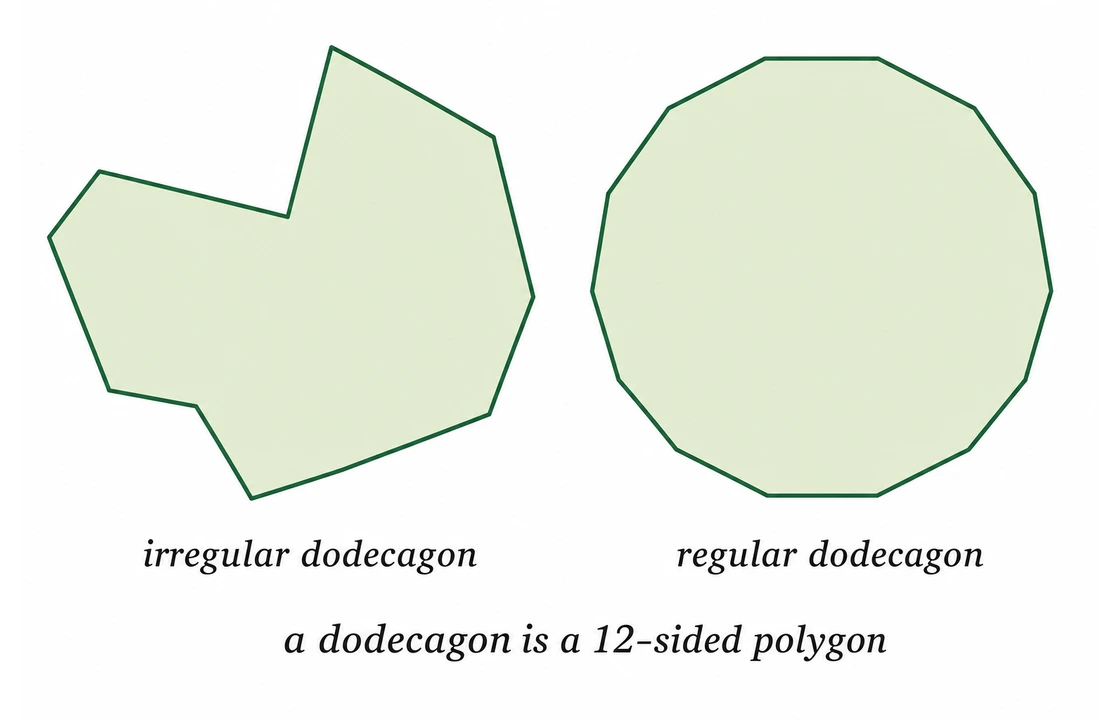
Key Formula
A=3(2+3)s2
Where:
- A = Area of a regular dodecagon
- s = Length of one side
Worked Example
Problem: Find the area and the sum of interior angles of a regular dodecagon with side length 4 cm.
Step 1: Find the sum of interior angles. For any polygon with n sides, the sum is (n − 2) × 180°. A dodecagon has n = 12.
S=(12−2)×180°=10×180°=1800°
Step 2: Since it is regular, each interior angle is the sum divided by 12.
Each angle=121800°=150°
Step 3: Use the area formula for a regular dodecagon with s = 4 cm.
A=3(2+3)(4)2=3(2+3)(16)=48(2+3)
Step 4: Evaluate the numerical result using √3 ≈ 1.732.
A≈48(2+1.732)=48×3.732≈179.14 cm2
Answer: The sum of interior angles is 1800°, each interior angle measures 150°, and the area is approximately 179.14 cm².
Another Example
Problem: A regular dodecagon has a perimeter of 60 cm. Find the length of one side and the number of diagonals.
Step 1: A regular dodecagon has 12 equal sides, so divide the perimeter by 12.
s=1260=5 cm
Step 2: Use the diagonal formula for a polygon with n sides: D = n(n − 3)/2.
D=212(12−3)=212×9=54
Answer: Each side is 5 cm, and a dodecagon has 54 diagonals.
Frequently Asked Questions
How many sides, angles, and diagonals does a dodecagon have?
A dodecagon has 12 sides, 12 vertices, and 12 interior angles. Using the formula n(n − 3)/2, it has 12(9)/2 = 54 diagonals.
What does each interior angle of a regular dodecagon measure?
Each interior angle of a regular dodecagon measures 150°. This comes from the sum of interior angles (1800°) divided by 12. Each exterior angle therefore measures 30°.
Dodecagon (12 sides) vs. Decagon (10 sides)
A dodecagon has 12 sides, 54 diagonals, and interior angles summing to 1800°. A decagon has 10 sides, 35 diagonals, and interior angles summing to 1440°. Students sometimes confuse the two because the prefixes 'dodeca-' (12) and 'deca-' (10) sound similar. Remember that 'deca-' means 10 and 'dodeca-' means 12.
Why It Matters
The regular dodecagon appears in everyday life on many clock faces, where the 12 hour markers form its vertices. It is also found in architecture, tiling patterns, and coin shapes — for example, the British one-pound coin is a dodecagon. Understanding dodecagons reinforces general polygon formulas for angle sums, area, and diagonals that apply to any n-sided shape.
Common Mistakes
Mistake: Confusing a dodecagon (12 sides) with a decagon (10 sides) because the names sound alike.
Correction: The prefix 'dodeca-' comes from Greek for twelve, while 'deca-' means ten. A dodecagon always has exactly 12 sides.
Mistake: Using the regular dodecagon area formula for an irregular dodecagon.
Correction: The formula A = 3(2 + √3)s² only works when all 12 sides and all 12 angles are equal. For irregular dodecagons, you need to break the shape into simpler pieces or use coordinate methods.
Related Terms
- Polygon — General term for any closed multi-sided shape
- Regular Polygon — Polygon with all sides and angles equal
- Side of a Polygon — Each line segment forming the polygon
- Decagon — 10-sided polygon, commonly confused with dodecagon
- Hexagon — 6-sided polygon; dodecagon has twice as many sides
- Diagonal — Segment connecting non-adjacent vertices
- Interior Angle — Angle inside the polygon at each vertex