
Octagon — Definition, Properties & Examples
Key Formula
S=(n−2)×180∘=(8−2)×180∘=1080∘
A=2(1+2)s2
Where:
- S = Sum of the interior angles of an octagon
- n = Number of sides (8 for an octagon)
- A = Area of a regular octagon
- s = Side length of the regular octagon
Worked Example
Problem: A regular octagon has a side length of 5 cm. Find (a) each interior angle and (b) the area.
Step 1: Find the sum of interior angles using the polygon angle formula with n = 8.
S=(8−2)×180∘=6×180∘=1080∘
Step 2: Since a regular octagon has all equal angles, divide the total by 8 to find one interior angle.
Each angle=81080∘=135∘
Step 3: Use the regular octagon area formula with s = 5 cm.
A=2(1+2)(5)2=2(1+1.4142)(25)
Step 4: Evaluate the expression.
A=2(2.4142)(25)=50×2.4142≈120.71 cm2
Answer: Each interior angle is 135°, and the area is approximately 120.71 cm².
Another Example
Problem: How many diagonals does an octagon have?
Step 1: The number of diagonals of any polygon with n sides is given by the formula:
d=2n(n−3)
Step 2: Substitute n = 8.
d=28(8−3)=28×5=240=20
Answer: An octagon has 20 diagonals.
Frequently Asked Questions
How many sides does an octagon have?
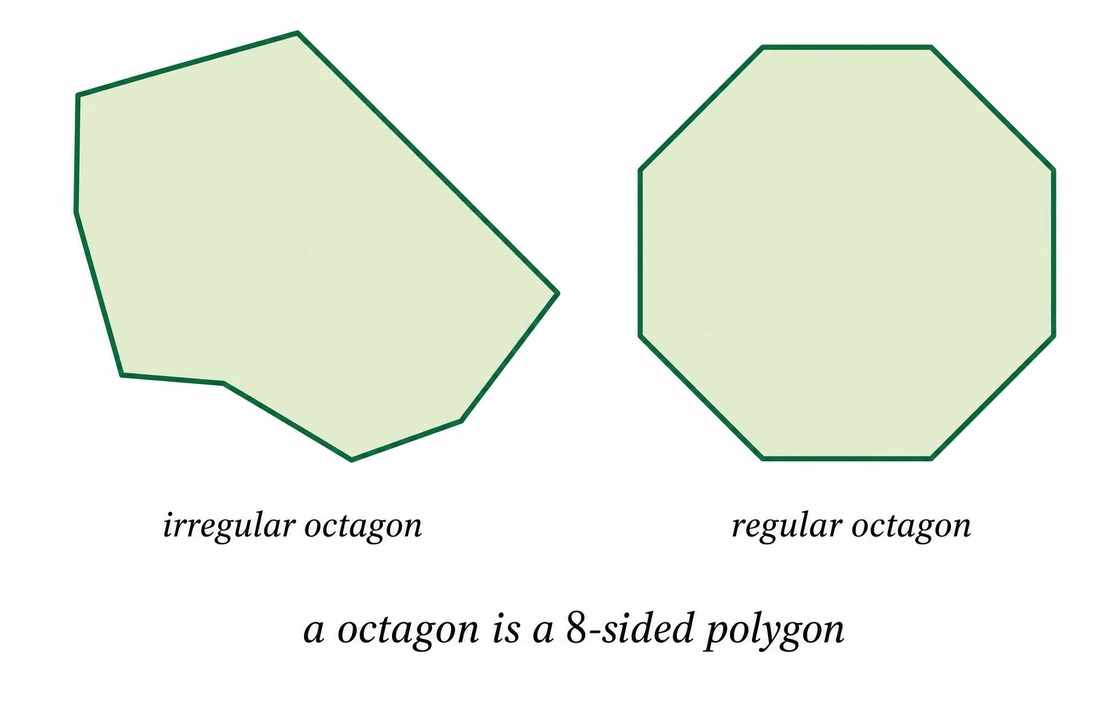
An octagon has exactly 8 sides. The prefix "octa-" comes from Greek and means eight. A regular octagon has all 8 sides the same length, while an irregular octagon can have sides of different lengths.
What is the interior angle of a regular octagon?
Each interior angle of a regular octagon measures 135°. You can find this by computing the total sum of interior angles, (8 − 2) × 180° = 1080°, and then dividing by 8. Each exterior angle is 180° − 135° = 45°.
Octagon (8 sides) vs. Hexagon (6 sides)
An octagon has 8 sides and an interior angle sum of 1080°, while a hexagon has 6 sides and an interior angle sum of 720°. In a regular hexagon each interior angle is 120°; in a regular octagon each interior angle is 135°. Both are common in tiling patterns, but only regular hexagons can tile a plane by themselves — regular octagons require squares to fill the gaps.
Why It Matters
The regular octagon is one of the most recognizable shapes in everyday life — stop signs worldwide use it. In architecture and design, octagonal floor plans appear in buildings, gazebos, and decorative tiles. Understanding octagon geometry also builds skill with the general polygon angle formula, which applies to any shape with n sides.
Common Mistakes
Mistake: Confusing octagons with hexagons, thinking both have the same number of sides.
Correction: "Hexa-" means six and "octa-" means eight. A hexagon has 6 sides; an octagon has 8. Remembering the Greek prefixes helps keep them straight.
Mistake: Using 180° × n instead of (n − 2) × 180° for the sum of interior angles.
Correction: The correct formula subtracts 2 from n first. For an octagon: (8 − 2) × 180° = 1080°, not 8 × 180° = 1440°.
Related Terms
- Polygon — General term for any closed many-sided shape
- Side of a Polygon — Each of the 8 line segments forming an octagon
- Regular Polygon — A polygon with all sides and angles equal
- Hexagon — A 6-sided polygon, often compared to an octagon
- Pentagon — A 5-sided polygon in the polygon family
- Interior Angle — Each angle inside the octagon measures 135°
- Diagonal — An octagon has 20 diagonals