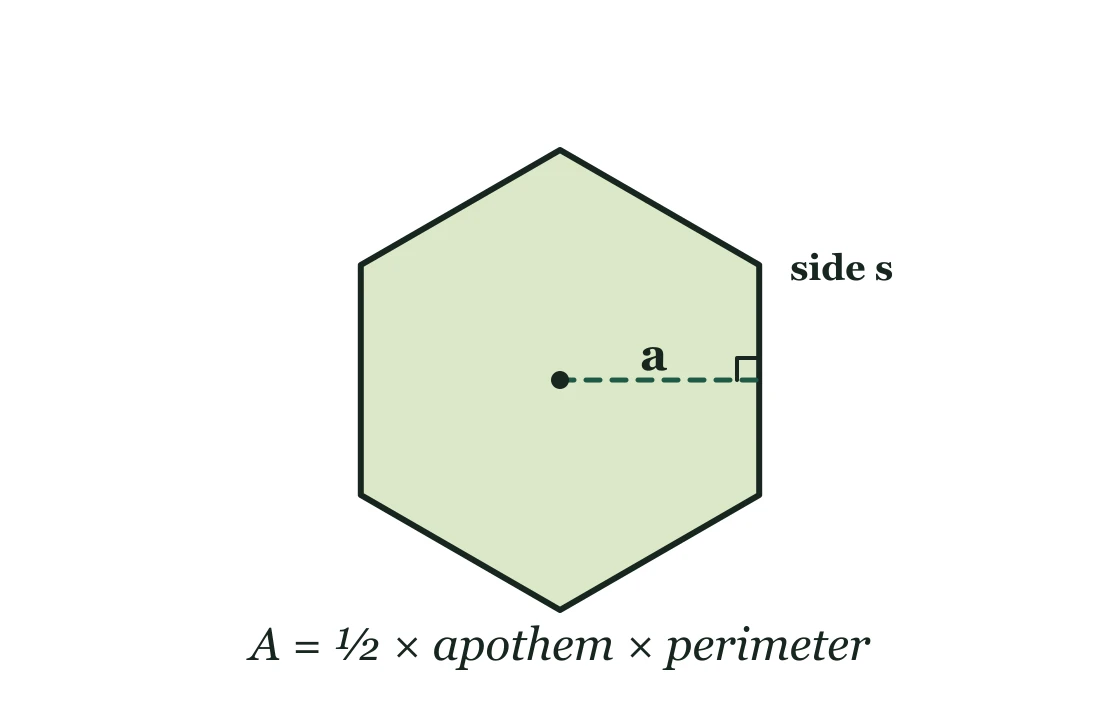
a = Apothem — the distance from the center of the polygon to the midpoint of any side (also called the radius of the inscribed circle)
P = Perimeter of the polygon, equal to n × s
n = Number of sides
s = Length of one side
Worked Example
Problem: Find the area of a regular hexagon with a side length of 6 cm.
Step 1: Identify the number of sides and the side length. A hexagon has 6 sides, and each side is 6 cm.
n=6,s=6 cm
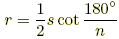
Step 2: Calculate the apothem. For a regular polygon, the apothem can be found using the formula a = s / (2 tan(π/n)).
a=2tan(6π)6=2×316=326=263=33≈5.196 cm
Step 3: Calculate the perimeter.
P=n×s=6×6=36 cm
Step 4: Apply the area formula.
A=21×a×P=21×33×36=543≈93.53 cm2
Answer: The area of the regular hexagon is 54√3 ≈ 93.53 cm².
Another Example
This example differs because the apothem is given directly, so there is no need to compute it from the side length using trigonometry. Many textbook problems provide the apothem, making the calculation straightforward multiplication.
Problem: A regular pentagon has an apothem of 5.5 cm and a side length of 8 cm. Find its area.
Step 1: Identify the given values. The pentagon has 5 sides, an apothem of 5.5 cm, and a side length of 8 cm.
n=5,a=5.5 cm,s=8 cm
Step 2: Calculate the perimeter.
P=5×8=40 cm
Step 3: Plug the apothem and perimeter into the area formula.
A=21×5.5×40=21×220=110 cm2
Answer: The area of the regular pentagon is 110 cm².
Frequently Asked Questions
How do you find the apothem if only the side length is given?
Use the formula a = s / (2 tan(π/n)), where s is the side length and n is the number of sides. This formula comes from the right triangle formed by the center, the midpoint of a side, and a vertex. For example, a regular octagon with side length 10 has an apothem of 10 / (2 tan(π/8)) ≈ 12.07.
Can you find the area of a regular polygon using only the radius of the circumscribed circle?
Yes. If you know the circumradius R and the number of sides n, the area is A = ½ n R² sin(2π/n). This works because each of the n isosceles triangles formed from the center to two adjacent vertices has area ½ R² sin(2π/n).
Why does the area formula use ½ × apothem × perimeter?
A regular polygon can be divided into n congruent isosceles triangles, each with a base equal to one side (s) and a height equal to the apothem (a). Each triangle has area ½ × s × a. Adding up all n triangles gives ½ × a × (n × s) = ½ × a × P, which is the full formula.
Area of a Regular Polygon vs. Area of an Irregular Polygon
Area of a Regular Polygon
Area of an Irregular Polygon
Definition
A polygon with all sides and angles equal
A polygon with sides or angles that are not all equal
Formula
A = ½ × apothem × perimeter
No single formula; use the Shoelace formula, triangulation, or divide into simpler shapes
Information needed
Number of sides plus either the side length, apothem, or circumradius
Coordinates of all vertices, or enough measurements to decompose the shape
When to use
When the polygon is explicitly stated to be regular
When sides or angles differ, or when vertex coordinates are given
Why It Matters
You encounter regular polygon area calculations in geometry courses, standardized tests (SAT, ACT), and real-world contexts like designing tiles, hex grids, stop-sign dimensions, and architectural floor plans. Understanding the formula also reinforces how composite shapes can be broken into triangles — a strategy that extends to calculus and engineering. Many competition math problems test whether you can connect the apothem, perimeter, and trigonometric relationships quickly.
Common Mistakes
Mistake: Confusing the apothem with the circumradius (the distance from the center to a vertex).
Correction: The apothem goes from the center to the midpoint of a side and is always shorter than the circumradius. Using the circumradius in the standard formula will give a larger, incorrect answer. If you have the circumradius R, use A = ½ n R² sin(2π/n) instead.
Mistake: Forgetting to multiply by ½ in the formula, effectively doubling the area.
Correction: Remember the formula comes from adding up triangles, each with area ½ × base × height. The factor of ½ is essential. A quick check: for a square with side 4 and apothem 2, A = ½ × 2 × 16 = 16, which matches 4² = 16.
Related Terms
Regular Polygon — The shape whose area this formula calculates
Apothem — Key measurement from center to midpoint of a side
Perimeter — Total distance around the polygon, used in the formula
Circumcircle — Circle passing through all vertices; its radius gives an alternate formula
Inscribed Circle — Circle tangent to every side; its radius equals the apothem
Interior Angle — Each angle of the polygon, used to derive the apothem