
Hexagon — Definition, Properties & Examples
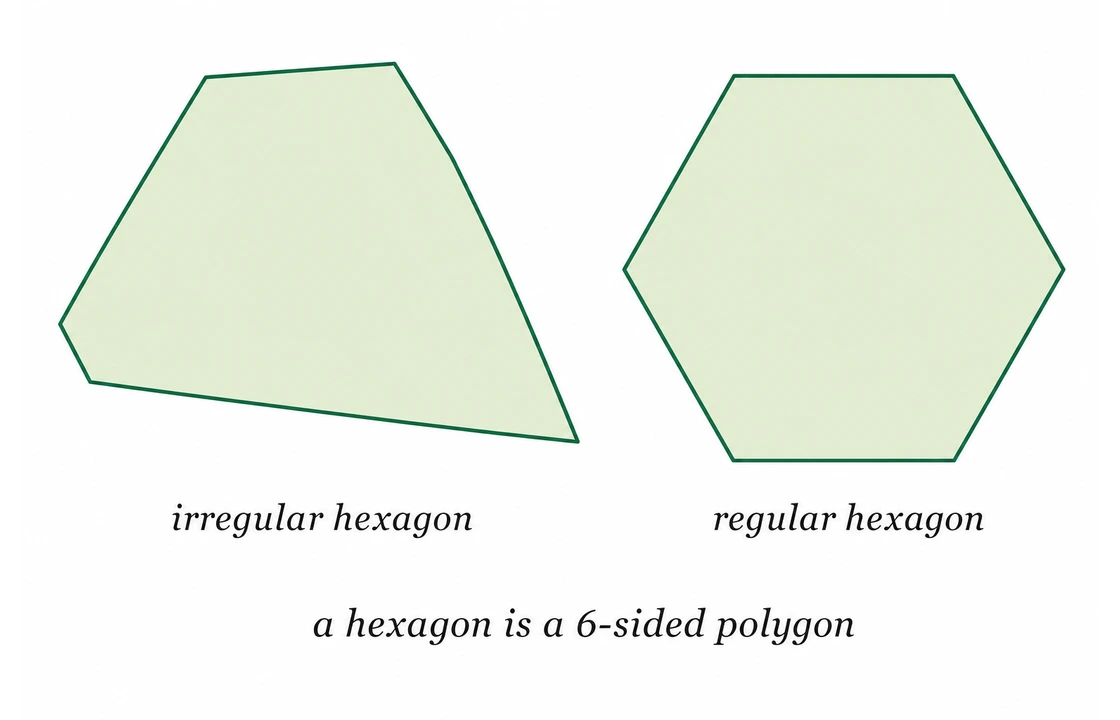
Key Formula
S=(n−2)×180°where n=6⇒S=720°
Where:
- S = Sum of the interior angles of the hexagon
- n = Number of sides (6 for a hexagon)
Worked Example
Problem: A regular hexagon has a side length of 10 cm. Find the perimeter, each interior angle, and the area.
Step 1: Find the perimeter. A regular hexagon has 6 equal sides, so multiply the side length by 6.
P=6×10=60 cm
Step 2: Find each interior angle. The sum of interior angles is 720°. In a regular hexagon every angle is the same, so divide by 6.
Each angle=6720°=120°
Step 3: Find the area using the regular-hexagon area formula. A regular hexagon can be split into 6 equilateral triangles.
A=233s2=233×102=233×100=1503
Step 4: Approximate the area to a decimal value.
A≈150×1.732=259.8 cm2
Answer: The perimeter is 60 cm, each interior angle is 120°, and the area is approximately 259.8 cm².
Another Example
Problem: Three angles of an irregular hexagon measure 100°, 130°, and 140°. The remaining three angles are all equal. Find the measure of each remaining angle.
Step 1: Use the interior angle sum formula for a hexagon.
S=(6−2)×180°=720°
Step 2: Add the three known angles.
100°+130°+140°=370°
Step 3: Subtract from 720° to find the total of the three unknown angles.
720°−370°=350°
Step 4: Since the three remaining angles are equal, divide by 3.
3350°≈116.67°
Answer: Each of the three remaining angles measures approximately 116.67° (or exactly 350°/3).
Frequently Asked Questions
How many diagonals does a hexagon have?
A hexagon has 9 diagonals. You can calculate this with the diagonal formula: D = n(n − 3)/2 = 6(6 − 3)/2 = 9.
Why are hexagons so common in nature?
Regular hexagons tile a flat surface with no gaps while enclosing the most area for a given perimeter among tilings. This is why honeybees build hexagonal cells — it is the most material-efficient way to divide a surface into equal areas. Basalt columns and bubble rafts also naturally form hexagonal patterns for similar efficiency reasons.
Hexagon (6 sides) vs. Pentagon (5 sides)
A hexagon has 6 sides with an interior angle sum of 720°, while a pentagon has 5 sides with an interior angle sum of 540°. In their regular forms, each interior angle of a hexagon is 120° and each interior angle of a pentagon is 108°. Regular hexagons can perfectly tessellate a plane; regular pentagons cannot.
Why It Matters
Hexagons appear throughout science and engineering. Honeycomb structures use hexagonal cells for maximum strength with minimum material, a principle applied in aerospace panels and packaging. In chemistry, the benzene ring — a hexagonal arrangement of carbon atoms — is foundational to organic chemistry. Hex grids are also widely used in game design and geographic mapping.
Common Mistakes
Mistake: Using 180° × 6 = 1080° for the interior angle sum instead of the correct formula (n − 2) × 180°.
Correction: Always subtract 2 from the number of sides first: (6 − 2) × 180° = 720°. The formula accounts for the fact that a polygon can be divided into (n − 2) triangles.
Mistake: Assuming all hexagons are regular (equal sides and equal angles).
Correction: A hexagon only needs six sides. The sides can have different lengths and the angles can differ, as long as the angles still sum to 720°. Only a regular hexagon has all sides and all angles equal.
Related Terms
- Polygon — General term for any closed multi-sided figure
- Side of a Polygon — Each straight segment forming the hexagon
- Regular Polygon — A polygon with all sides and angles equal
- Pentagon — The five-sided polygon, one fewer side
- Octagon — The eight-sided polygon, two more sides
- Interior Angle — Each angle inside the hexagon at a vertex
- Tessellation — Regular hexagons tile a plane with no gaps