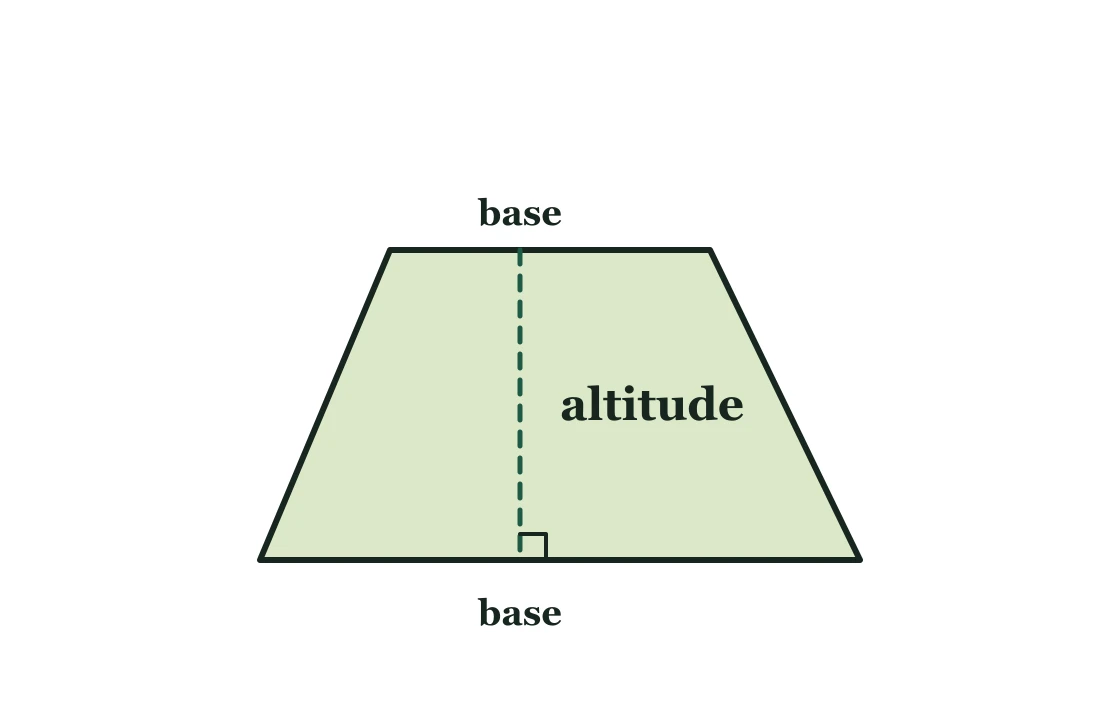
Altitude of a Trapezoid (Height): Definition & Formula
Altitude of a Trapezoid
Height of a Trapezoid
The
distance between the two bases of a trapezoid. Formally,
the shortest line segment between the bases. Altitude also refers
to the length
of this
segment.
h = Altitude (height) — the perpendicular distance between the two bases
Worked Example
Problem: A trapezoid has bases of length 8 cm and 14 cm and an area of 88 cm². Find the altitude of the trapezoid.
Step 1: Write down the area formula for a trapezoid.
A=21(b1+b2)⋅h
Step 2: Substitute the known values into the formula.
88=21(8+14)⋅h
Step 3: Simplify the sum of the bases.
88=21(22)⋅h=11h
Step 4: Solve for h by dividing both sides by 11.
h=1188=8
Answer: The altitude of the trapezoid is 8 cm.
Another Example
Problem: A right trapezoid has bases of 6 m and 10 m. One of its non-parallel sides (a leg) is perpendicular to the bases and measures 5 m. Find the area.
Step 1: In a right trapezoid, the perpendicular leg IS the altitude. So the altitude is 5 m.
h=5
Step 2: Apply the area formula using the two bases and the altitude.
A=21(6+10)⋅5
Step 3: Simplify.
A=21(16)⋅5=8⋅5=40
Answer: The area of the right trapezoid is 40 m².
Frequently Asked Questions
Is the altitude of a trapezoid the same as the length of its leg (non-parallel side)?
Not usually. The altitude is the perpendicular distance between the two bases, while the legs are the non-parallel sides that connect the bases. The leg equals the altitude only in a right trapezoid, where one leg is already perpendicular to both bases. In all other trapezoids, the legs are slanted, so they are longer than the altitude.
How do you find the altitude of a trapezoid if you only know the sides?
If you know both bases and both legs, you can drop a perpendicular from one end of the shorter base to the longer base, creating a right triangle on one or both sides. Then use the Pythagorean theorem on that right triangle to solve for the height. For example, if the bases are 6 and 12 and the trapezoid is isosceles with legs of 5, each right triangle has a base of 3 and a hypotenuse of 5, giving an altitude of 4.
Altitude of a Trapezoid vs. Leg of a Trapezoid
The altitude is always measured perpendicular to the two bases, representing the shortest distance between them. A leg is a non-parallel side of the trapezoid that connects one base to the other at an angle. The leg is equal to the altitude only in a right trapezoid where that leg forms a 90° angle with both bases. In every other case, the leg is longer than the altitude because it runs at a slant.
Why It Matters
The altitude is essential for calculating the area of a trapezoid — without it, the area formula cannot be applied. It also appears in coordinate geometry problems where you need the distance between two parallel lines. Understanding the altitude helps you connect trapezoid problems to broader concepts like perpendicular distance and the Pythagorean theorem.
Common Mistakes
Mistake: Using the length of a slanted leg as the altitude.
Correction: The altitude must be perpendicular to both bases. Unless the trapezoid is a right trapezoid with that leg at 90°, the leg is longer than the altitude. Always check that the measurement forms a right angle with the bases.
Mistake: Thinking the altitude can only be drawn inside the trapezoid.
Correction: For most trapezoids the altitude falls inside the figure, but the perpendicular segment from one base to the line containing the other base is the altitude regardless of where it lands. The concept is the perpendicular distance between the two base lines.