
Decagon — Definition, Formula & Examples
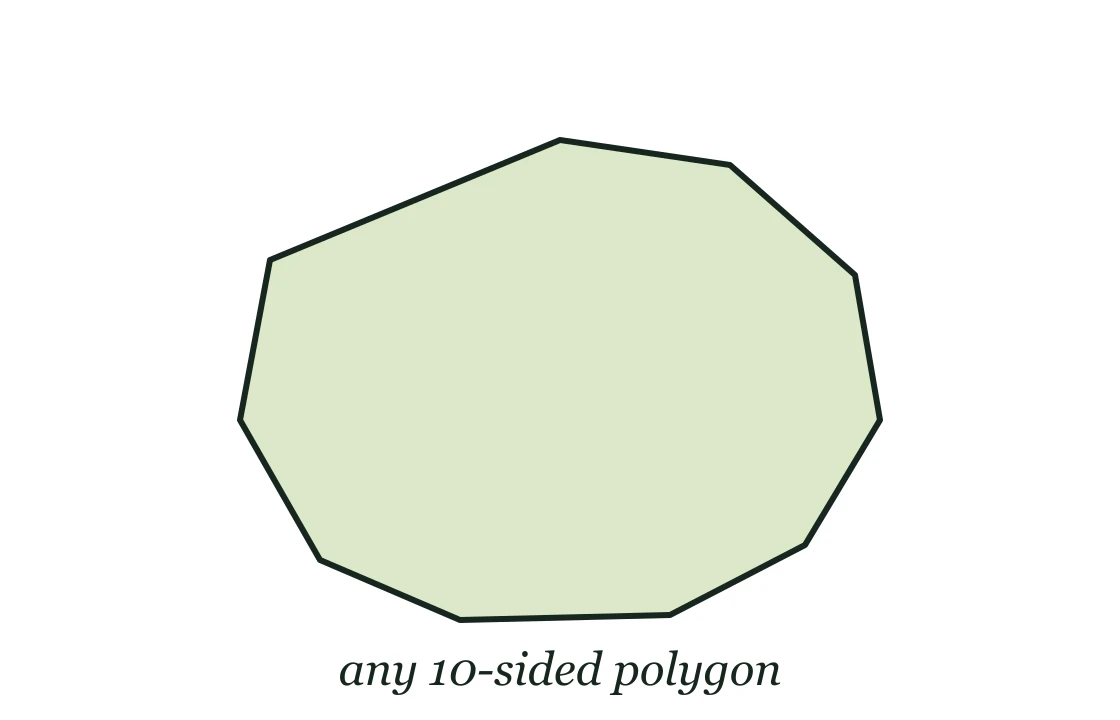
Key Formula
S=(n−2)×180∘where n=10,S=1440∘
Where:
- S = Sum of the interior angles of the decagon
- n = Number of sides (10 for a decagon)
Worked Example
Problem: A regular decagon has a side length of 8 cm. Find the measure of each interior angle and calculate the perimeter.
Step 1: Find the sum of all interior angles using the polygon angle-sum formula.
S=(10−2)×180∘=8×180∘=1440∘
Step 2: Since the decagon is regular, all ten interior angles are equal. Divide the total by 10.
Each angle=101440∘=144∘
Step 3: Find the perimeter by multiplying the side length by the number of sides.
P=10×8=80 cm
Answer: Each interior angle of the regular decagon measures 144°, and the perimeter is 80 cm.
Another Example
Problem: Find the measure of each exterior angle of a regular decagon.
Step 1: The exterior angles of any convex polygon always sum to 360°.
Sum of exterior angles=360∘
Step 2: For a regular decagon, all exterior angles are equal. Divide 360° by 10.
Each exterior angle=10360∘=36∘
Step 3: Verify: each interior angle plus its exterior angle should equal 180°.
144∘+36∘=180∘✓
Answer: Each exterior angle of a regular decagon measures 36°.
Frequently Asked Questions
How many diagonals does a decagon have?
A decagon has 35 diagonals. You can find this using the formula d=2n(n−3), which gives 210(10−3)=270=35.
What does a regular decagon look like?
A regular decagon looks like a slightly rounded ten-sided shape, almost approaching a circle. All ten sides are the same length, and every interior angle is exactly 144°. You can see this shape on some coins, like the Australian 50-cent coin.
Decagon (10 sides) vs. Dodecagon (12 sides)
Why It Matters
Decagons appear in architecture, tiling patterns, and coin designs around the world. Understanding their angle properties helps you work with any polygon, since the same angle-sum formula applies to shapes with any number of sides. The regular decagon also has a deep connection to the golden ratio — the ratio of its diagonal to its side equals the golden ratio ϕ≈1.618.
Common Mistakes
Mistake: Confusing a decagon (10 sides) with a dodecagon (12 sides) or a nonagon (9 sides).
Correction: Remember that the prefix "deca-" means ten (as in "decade" = ten years). A dodecagon has 12 sides, and a nonagon has 9.
Mistake: Assuming that every decagon has equal sides and angles.
Correction: Only a regular decagon has all sides and all angles equal. An irregular decagon can have sides and angles of different sizes, as long as it still has exactly ten sides.
Related Terms
- Polygon — General term for any closed multi-sided shape
- Side of a Polygon — Each of the ten line segments of a decagon
- Regular Polygon — A polygon with all sides and angles equal
- Hexagon — A polygon with six sides
- Octagon — A polygon with eight sides
- Interior Angle — Each angle inside a decagon measures 144° if regular
- Diagonal — A decagon has 35 diagonals