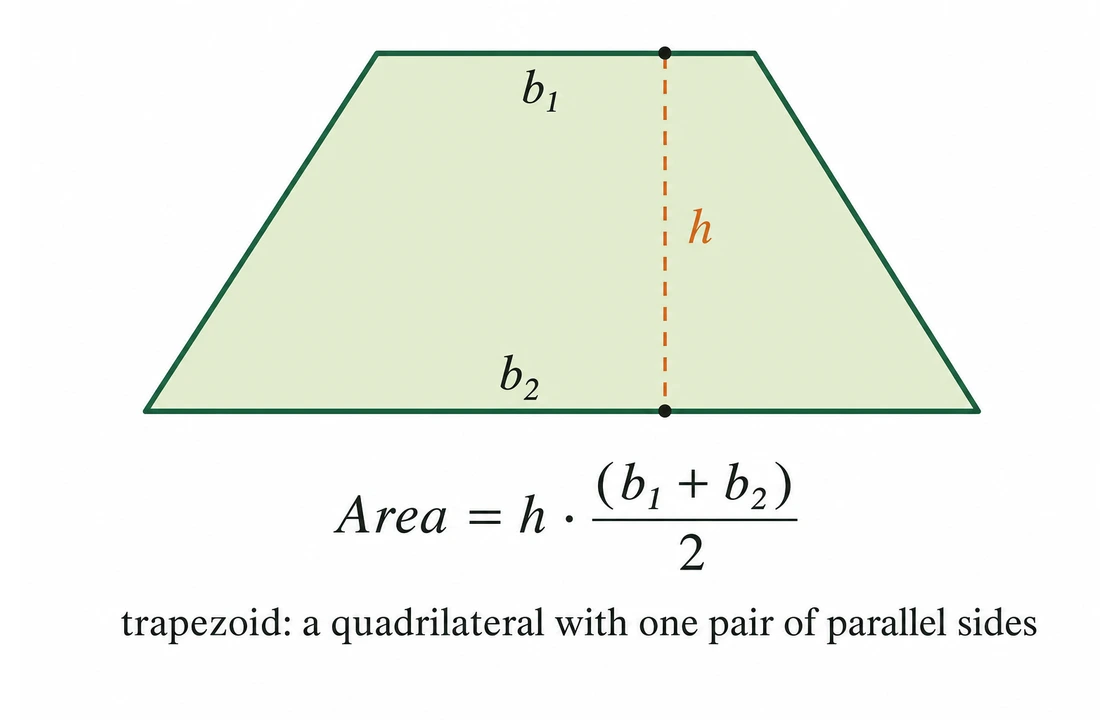
Trapezoid: Definition, Area = ½(b₁+b₂)h & Examples
Trapezoid
US usage, definition 1: A quadrilateral which has a pair of opposite
sides which are parallel. The parallel sides are called the bases,
and the other two sides are called the legs.
US usage, definition 2: A quadrilateral which has one parallel pair of opposite sides and one non-parallel pair of opposite sides. The parallel sides are called the bases, and the other two sides are called the legs.
UK usage: The same as the US word trapezium. The UK word trapezium means the same as the US word trapezoid, and vice-versa.
Commentary: Under US definition 1, a parallelogram is a type of trapezoid. Under US definition 2, a parallelogram is not a type of trapezoid. Regardless of which definition you prefer, the trapezoid area formula can be used to find the area of a parallelogram.
b1 = Length of the first base (one of the parallel sides)
b2 = Length of the second base (the other parallel side)
h = Height (the perpendicular distance between the two bases)
Worked Example
Problem: A trapezoid has bases of length 8 cm and 14 cm, and a height of 6 cm. Find its area.
Step 1: Identify the two bases and the height.
b1=8 cm,b2=14 cm,h=6 cm
Step 2: Add the two bases together.
b1+b2=8+14=22 cm
Step 3: Multiply the sum of the bases by the height.
(b1+b2)⋅h=22×6=132 cm2
Step 4: Multiply by one-half to get the area.
A=21×132=66 cm2
Answer: The area of the trapezoid is 66 cm².
Another Example
This example features a right trapezoid (one leg perpendicular to the bases) and shows how to find a missing leg length using the Pythagorean theorem.
Problem: A trapezoid has bases of length 5 m and 11 m. One leg is 7 m long and meets the longer base at a right angle. Find the area and the length of the other leg.
Step 1: Since one leg is perpendicular to the bases, that leg is the height of the trapezoid.
h=7 m
Step 2: Compute the area using the trapezoid formula.
A=21(5+11)×7=21(16)×7=56 m2
Step 3: To find the other leg, notice the longer base extends beyond the shorter base by 11 − 5 = 6 m on the non-right-angle side. The other leg is the hypotenuse of a right triangle with legs 7 m (height) and 6 m (horizontal difference).
leg2=72+62=49+36=85≈9.22 m
Answer: The area is 56 m², and the other leg is approximately 9.22 m.
Frequently Asked Questions
What is the difference between a trapezoid and a parallelogram?
A parallelogram has two pairs of parallel sides, while a trapezoid (under the most common US definition) has exactly one pair of parallel sides. Under an inclusive definition, a parallelogram counts as a special type of trapezoid because it has at least one pair of parallel sides. Either way, the trapezoid area formula works for both shapes.
What is the difference between a trapezoid and a trapezium?
It depends on which country you are in. In the US, a trapezoid has at least one pair of parallel sides, while a trapezium has no parallel sides. In the UK, the meanings are reversed: a trapezium has one pair of parallel sides, and a trapezoid has none. Be aware of this when reading different textbooks.
How do you find the height of a trapezoid if it is not given?
If you know the area and both bases, rearrange the area formula to get h=b1+b22A. If you know a leg length and enough information about the shape (such as a right angle or an isosceles trapezoid), you can use the Pythagorean theorem to calculate the height from a right triangle formed by the leg, the height, and a horizontal segment along the base.
Trapezoid vs. Parallelogram
Trapezoid
Parallelogram
Parallel sides
Exactly one pair (exclusive definition) or at least one pair (inclusive definition)
Exactly two pairs of parallel sides
Area formula
A = ½(b₁ + b₂) · h
A = b · h (which is a special case where b₁ = b₂)
Opposite sides
Only the bases are parallel; legs are generally not equal or parallel
Both pairs of opposite sides are parallel and equal in length
Special types
Isosceles trapezoid, right trapezoid
Rectangle, rhombus, square
Why It Matters
Trapezoids appear frequently in geometry courses, standardized tests, and real-world applications such as calculating the cross-sectional area of channels, ramps, and architectural features. The trapezoid area formula is also the foundation of the trapezoid rule (trapezoidal rule) used in calculus to approximate definite integrals. Understanding trapezoid properties helps you classify quadrilaterals and connect concepts across algebra and geometry.
Common Mistakes
Mistake: Using a leg length as the height instead of the perpendicular distance between the bases.
Correction: The height must be measured perpendicular to both bases. Unless the trapezoid is a right trapezoid (where one leg is already perpendicular), you need to draw or calculate the altitude separately.
Mistake: Confusing the US and UK meanings of trapezoid and trapezium.
Correction: In the US, a trapezoid has parallel sides; in the UK, the word for the same shape is trapezium. Check which convention your textbook uses before answering classification questions.
Related Terms
Quadrilateral — A trapezoid is a type of quadrilateral