
Trapezium — Definition, Formula & Examples
Trapezium
US usage: A quadrilateral with no parallel sides.
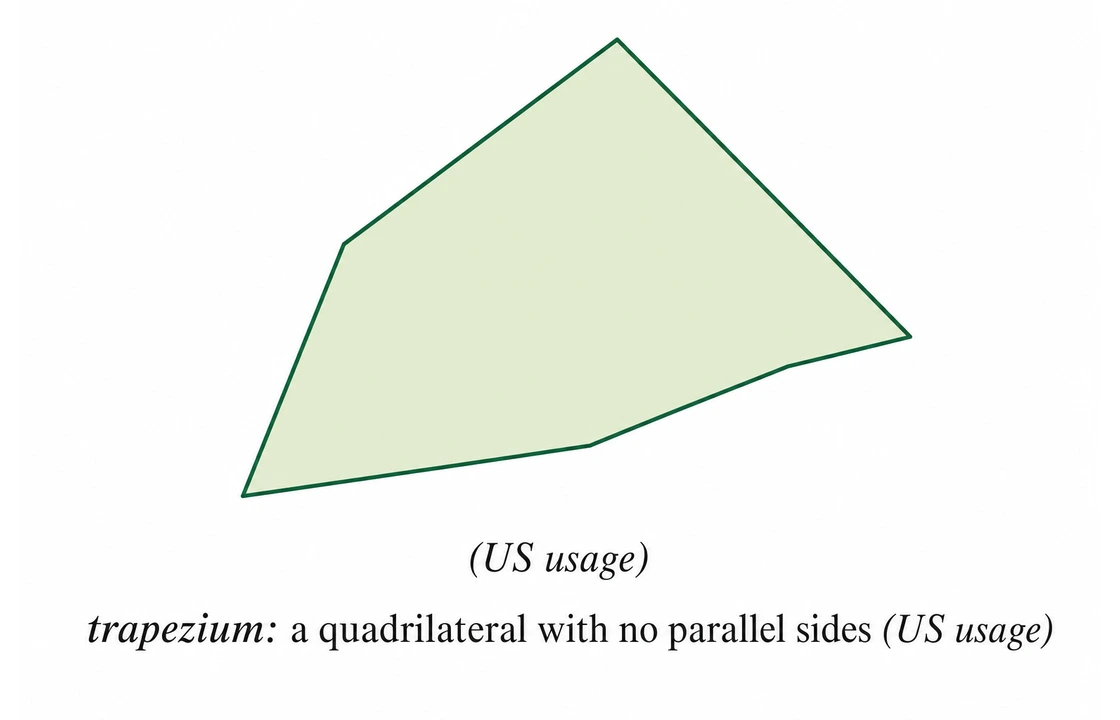
UK usage: The same as the US word trapezoid. The UK word trapezoid means the same as the US word trapezium, and vice-versa.
Key Formula
A=21(a+b)h
Where:
- A = Area of the trapezium (UK usage, i.e., a quadrilateral with one pair of parallel sides)
- a = Length of one parallel side
- b = Length of the other parallel side
- h = Perpendicular height (the distance between the two parallel sides)
Worked Example
Problem: A trapezium (UK usage) has parallel sides of length 8 cm and 12 cm, and a perpendicular height of 5 cm. Find its area.
Step 1: Identify the parallel sides and the height.
a=8 cm,b=12 cm,h=5 cm
Step 2: Add the two parallel sides together.
a+b=8+12=20 cm
Step 3: Multiply the sum by the height.
(a+b)×h=20×5=100 cm2
Step 4: Divide by 2 to get the area.
A=21×100=50 cm2
Answer: The area of the trapezium is 50 cm².
Another Example
This example differs because the height is not given directly. You must calculate it from the leg lengths using the Pythagorean theorem, which is a common situation in exam problems involving isosceles trapeziums.
Problem: A trapezium (UK usage) has parallel sides of 6 m and 10 m. The non-parallel sides (legs) are 5 m each, making it an isosceles trapezium. Find the area.
Step 1: Identify the known values. The parallel sides are 6 m and 10 m, and both legs are 5 m.
a=6 m,b=10 m,legs=5 m each
Step 2: Find the height. Drop a perpendicular from one end of the shorter parallel side to the longer one. The horizontal distance from the foot of the perpendicular to the nearest end of the longer side is half the difference of the parallel sides.
d=2b−a=210−6=2 m
Step 3: Use the Pythagorean theorem on the right triangle formed by the leg, the height, and the horizontal distance.
h=52−22=25−4=21≈4.58 m
Step 4: Apply the area formula.
A=21(6+10)×21=21×16×21=821≈36.7 m2
Answer: The area is 821≈36.7 m².
Frequently Asked Questions
What is the difference between a trapezium and a trapezoid?
The two words swap meanings depending on the country. In the US, a trapezoid has exactly one pair of parallel sides, while a trapezium has no parallel sides. In the UK, it is the reverse: a trapezium has one pair of parallel sides and a trapezoid has none. Always check which convention your textbook or exam uses.
How do you find the area of a trapezium?
For the UK trapezium (one pair of parallel sides), use the formula A=21(a+b)h, where a and b are the parallel sides and h is the perpendicular distance between them. For the US trapezium (no parallel sides), there is no single standard formula—you would typically divide it into triangles and sum their areas.
Is a parallelogram a trapezium?
Under the UK definition (one pair of parallel sides), it depends on whether you use an inclusive or exclusive definition. The exclusive definition requires exactly one pair of parallel sides, so a parallelogram would not count. Most UK school syllabuses use the exclusive definition, treating parallelograms as a separate category.
Trapezium (UK) / Trapezoid (US) vs. Trapezium (US) / Trapezoid (UK)
| Trapezium (UK) / Trapezoid (US) | Trapezium (US) / Trapezoid (UK) | |
|---|---|---|
| Definition | A quadrilateral with exactly one pair of parallel sides | A quadrilateral with no parallel sides |
| Area formula | A = ½(a + b)h | No standard formula; split into triangles |
| Also called | Trapezoid in the US, trapezium in the UK | Trapezium in the US, trapezoid in the UK |
| Number of parallel side pairs | Exactly 1 | 0 |
| Common in exams | Very common (area and perimeter questions) | Rarely tested directly |
Why It Matters
The trapezium (UK sense) appears frequently in GCSE and IGCSE exams, where you are asked to calculate areas of compound shapes that include trapezia. Understanding which definition your curriculum uses is essential because getting the US and UK meanings confused can lead to applying the wrong formula. The area formula also shows up in coordinate geometry when you compute the area under a line segment between two points at different heights.
Common Mistakes
Mistake: Confusing the US and UK definitions, then using the area formula on a shape with no parallel sides.
Correction: The formula A = ½(a + b)h only works when the shape has one pair of parallel sides. If your shape has no parallel sides (US trapezium), you must use a different method such as dividing it into triangles.
Mistake: Using a slanted side length instead of the perpendicular height in the area formula.
Correction: The variable h in the formula must be the perpendicular distance between the two parallel sides, not the length of a non-parallel side (leg). If only the leg length is given, use the Pythagorean theorem to find the perpendicular height first.
Related Terms
- Quadrilateral — A trapezium is a type of quadrilateral
- Trapezoid — Swapped meaning with trapezium across US/UK
- Parallel Lines — Defines whether sides are parallel
- Side of a Polygon — The parallel and non-parallel edges of a trapezium
- Parallelogram — Has two pairs of parallel sides, unlike a trapezium
- Area — The trapezium area formula is a key application
- Perimeter — Sum of all four sides of the trapezium