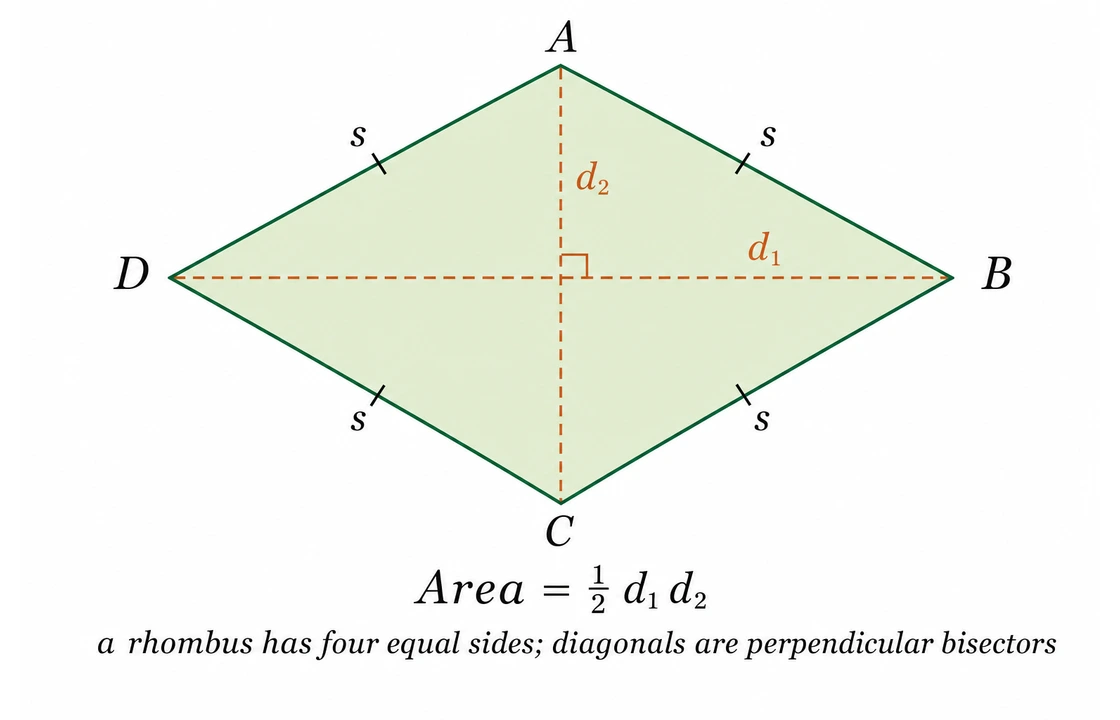
A = Area of the rhombus (also used as an interior angle label in the sine formulas)
s = Side length of the rhombus (all four sides are equal)
h = Height (altitude) of the rhombus — the perpendicular distance between two parallel sides
d1 = Length of the longer diagonal
d2 = Length of the shorter diagonal
sinA,sinB = Sine of either interior angle; since consecutive angles are supplementary, sin A = sin B
Worked Example
Problem: A rhombus has diagonals of length 10 cm and 24 cm. Find its area and side length.
Step 1: Use the diagonal formula to find the area.
A=21d1d2=21(24)(10)=120 cm2
Step 2: Recall that the diagonals of a rhombus bisect each other at right angles. This creates four right triangles, each with legs half the length of each diagonal.
Half-diagonals: 224=12 cm,210=5 cm
Step 3: Apply the Pythagorean theorem to one of these right triangles to find the side length.
s=122+52=144+25=169=13 cm
Answer: The area is 120 cm² and the side length is 13 cm.
Another Example
This example uses the angle-based area formula instead of the diagonal formula, and shows how to find diagonal lengths from the side and angle — a common exam variation.
Problem: A rhombus has a side length of 10 cm and one interior angle of 60°. Find its area and the length of each diagonal.
Step 1: Use the sine formula to find the area.
A=s2sin(60°)=102⋅23=100⋅23=503≈86.6 cm2
Step 2: The diagonals bisect the interior angles. The 60° angle is split into two 30° angles, and the opposite 120° angle is split into two 60° angles. In the right triangle formed at the center, the legs are s sin 30° and s cos 30°, which give half of each diagonal.
Step 3: Double each half-diagonal to get the full diagonal lengths.
d1=103≈17.32 cm,d2=10 cm
Step 4: Verify with the diagonal area formula.
21d1d2=21(103)(10)=503≈86.6 cm2✓
Answer:The area is 503≈86.6 cm². The diagonals are 103≈17.32 cm and 10 cm.
Frequently Asked Questions
What is the difference between a rhombus and a square?
A square is a special type of rhombus where all four interior angles are 90°. Every square is a rhombus, but a rhombus is only a square when its angles are all right angles. In a general rhombus, opposite angles are equal but not necessarily 90°.
Are the diagonals of a rhombus equal?
No. The diagonals of a rhombus are perpendicular bisectors of each other, but they are generally different lengths. They are equal only when the rhombus is also a square. The longer diagonal connects the two obtuse-angle vertices, and the shorter diagonal connects the two acute-angle vertices.
Is every rhombus a parallelogram?
Yes. A rhombus has two pairs of parallel sides, so it satisfies the definition of a parallelogram. It inherits all parallelogram properties: opposite sides are parallel and equal, opposite angles are equal, and the diagonals bisect each other. The rhombus adds the extra condition that all four sides are equal.
Rhombus vs. Rectangle
Rhombus
Rectangle
Sides
All four sides are congruent
Opposite sides are congruent (adjacent sides may differ)
Angles
Opposite angles are equal; consecutive angles are supplementary (not necessarily 90°)
All four angles are 90°
Diagonals
Perpendicular but generally unequal in length
Equal in length but generally not perpendicular
Area formula
s2sinA or 21d1d2
length × width
Special overlap
A rhombus that is also a rectangle is a square
A rectangle that is also a rhombus is a square
Why It Matters
Rhombuses appear frequently in geometry courses when studying quadrilateral classification, coordinate proofs, and area problems. Many standardized tests ask you to distinguish a rhombus from other parallelograms or to compute its area using diagonals. The perpendicular-diagonal property is also essential in constructions and in understanding kite geometry, since every rhombus is a kite.
Common Mistakes
Mistake: Assuming the diagonals of a rhombus are equal in length.
Correction: The diagonals are perpendicular bisectors of each other, but they have different lengths unless the rhombus is a square. Always check whether the problem states equal diagonals before treating them as such.
Mistake: Using base × height with the slant side as the height.
Correction: The height h is the perpendicular distance between two parallel sides, not the side length itself. Area = s × h only when h is the altitude. If you know an angle instead, use Area = s² sin A.
Related Terms
Parallelogram — A rhombus is a special parallelogram
Square — A square is a rhombus with all right angles