
Trapezoid Area Formula: A = ½(b₁+b₂)h — Examples & Calculator
Area of a Trapezoid
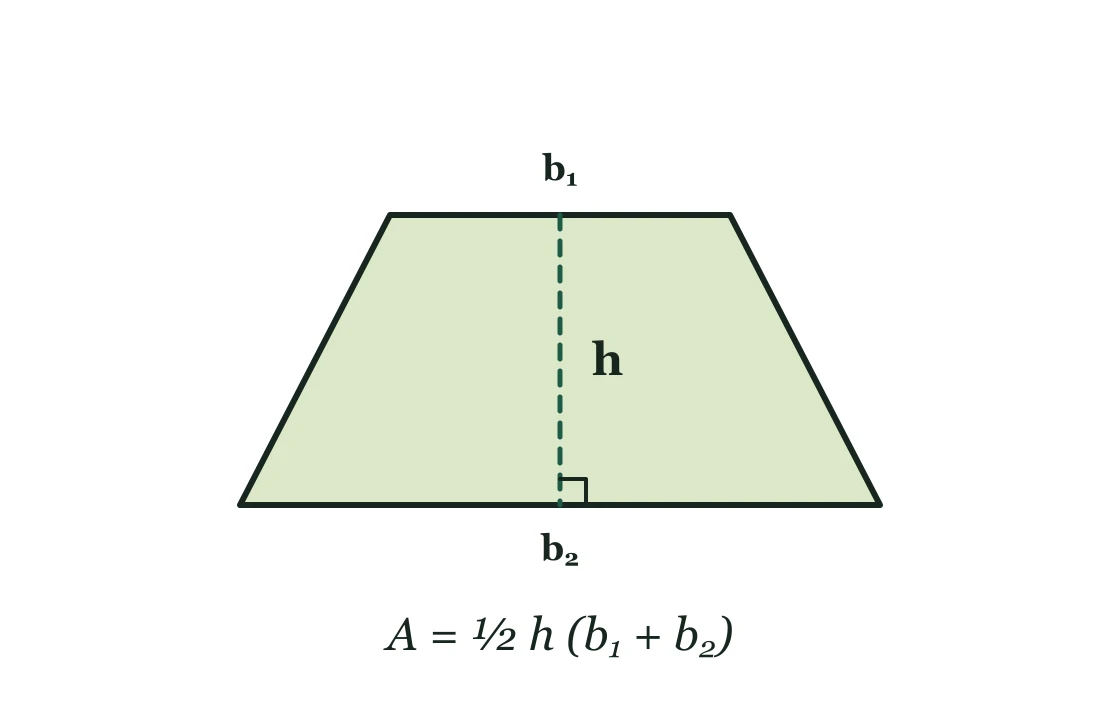
The formula is given below.
See also
Key Formula
A=21(b1+b2)⋅h
Where:
- A = Area of the trapezoid
- b1 = Length of the first base (one of the two parallel sides)
- b2 = Length of the second base (the other parallel side)
- h = Height (the perpendicular distance between the two bases)
Worked Example
Problem: Find the area of a trapezoid with bases of 8 cm and 12 cm and a height of 5 cm.
Step 1: Write down the formula for the area of a trapezoid.
A=21(b1+b2)⋅h
Step 2: Substitute the given values: b₁ = 8, b₂ = 12, and h = 5.
A=21(8+12)⋅5
Step 3: Add the two bases together.
8+12=20
Step 4: Multiply by one-half and by the height.
A=21⋅20⋅5=10⋅5=50
Answer: The area of the trapezoid is 50 cm².
Another Example
This example works the formula in reverse, solving for a missing base when the area is already known. It also highlights the edge case where both bases are equal.
Problem: A trapezoid has an area of 42 m², one base of 6 m, and a height of 7 m. Find the length of the other base.
Step 1: Start with the area formula and substitute the known values: A = 42, b₁ = 6, and h = 7.
42=21(6+b2)⋅7
Step 2: Multiply both sides by 2 to eliminate the fraction.
84=(6+b2)⋅7
Step 3: Divide both sides by 7 to isolate the expression with b₂.
12=6+b2
Step 4: Subtract 6 from both sides to solve for b₂.
b2=12−6=6
Answer: The other base is 6 m. (Notice that both bases are equal, making this trapezoid actually a rectangle — a special case.)
Frequently Asked Questions
Why do you add the two bases in the trapezoid area formula?
Adding the two bases and dividing by 2 gives you their average length. You can think of the trapezoid as being equivalent to a rectangle whose width equals that average. Multiplying the average base by the height then gives the correct area, which accounts for the shape tapering from one base to the other.
What is the difference between height and side length in a trapezoid?
The height (altitude) is the perpendicular distance between the two parallel bases — measured at a right angle. The non-parallel sides (legs) are slanted and are generally longer than the height. You must use the perpendicular height, not a leg length, in the area formula.
Does the trapezoid area formula work for a parallelogram or rectangle?
Yes. A parallelogram is a special trapezoid where both bases are equal. Substituting b₁ = b₂ = b into the formula gives A = ½(b + b)h = b·h, which is the standard parallelogram area formula. Similarly, a rectangle is a parallelogram with right angles, so the same simplification applies.
Area of a Trapezoid vs. Area of a Parallelogram
| Area of a Trapezoid | Area of a Parallelogram | |
|---|---|---|
| Shape requirement | Exactly one pair of parallel sides (or more) | Two pairs of parallel sides |
| Formula | A = ½(b₁ + b₂) · h | A = b · h |
| Bases used | Two bases of different lengths | One base (both bases are equal) |
| Relationship | General formula — reduces to parallelogram when b₁ = b₂ | Special case of the trapezoid formula |
Why It Matters
The trapezoid area formula appears frequently in geometry courses and standardized tests, often in problems involving composite shapes where irregular regions are broken into trapezoids. Beyond the classroom, it is essential in real-world applications like calculating the cross-sectional area of ditches, ramps, and architectural features. Understanding this formula also deepens your grasp of how averaging parallel sides generalizes the simpler rectangle and parallelogram area formulas.
Common Mistakes
Mistake: Using a slanted leg length instead of the perpendicular height.
Correction: The height h must be measured at a 90° angle to both bases. If you are given only the leg length and an angle, use trigonometry (h = leg · sin θ) or the Pythagorean theorem to find the true perpendicular height first.
Mistake: Forgetting to multiply by ½ (or dividing by 2).
Correction: Without the factor of ½, you are computing the area of a parallelogram with width (b₁ + b₂), which is double the trapezoid's area. Always remember: the formula averages the two bases, so the ½ is essential.
Related Terms
- Trapezoid — The shape whose area this formula calculates
- Base of a Trapezoid — The two parallel sides used in the formula
- Altitude of a Trapezoid — The perpendicular height between the bases
- Formula — General concept of mathematical formulas
- Area — The general concept of measuring enclosed space
- Parallelogram — Special case where both bases are equal
- Area of a Parallelogram — Simplified formula when b₁ = b₂
- Area of a Triangle — Special case when one base shrinks to zero