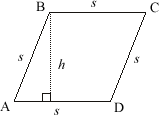
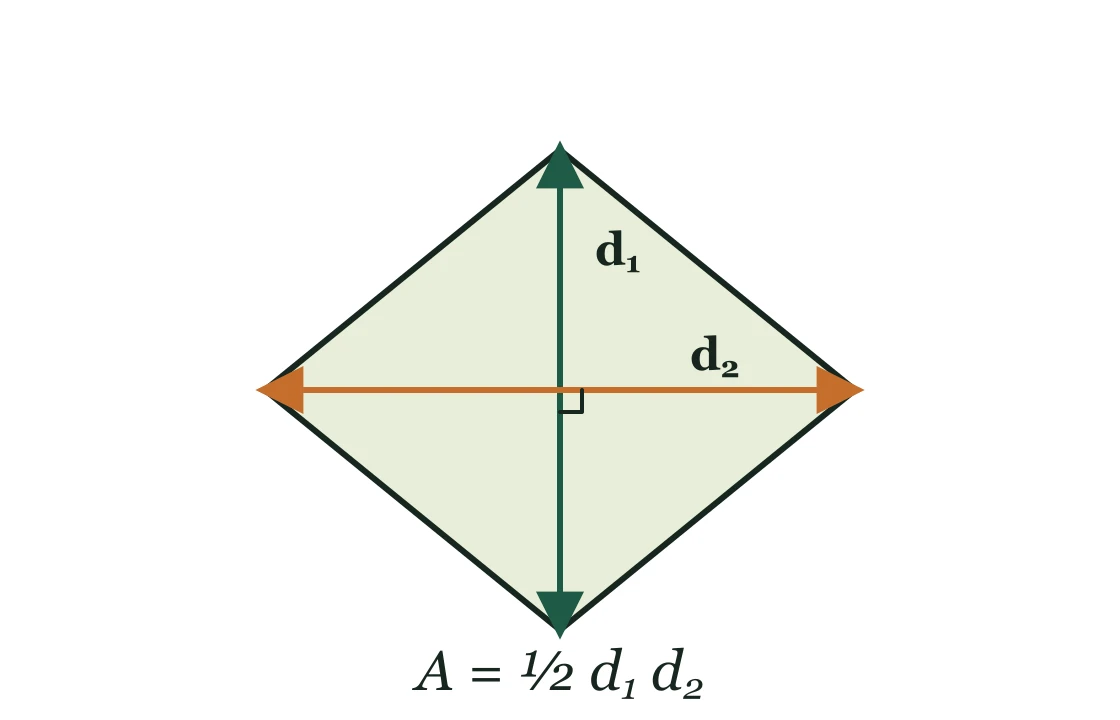
s = Side length of the rhombus (all four sides are equal)
h = Height (perpendicular distance between two parallel sides)
d1 = Length of one diagonal
d2 = Length of the other diagonal
∠A,∠B = Any interior angle of the rhombus (A and B are supplementary)
Worked Example
Problem: A rhombus has diagonals of length 10 cm and 24 cm. Find its area.
Step 1: Identify the formula that uses diagonals.
A=21d1d2
Step 2: Substitute the given diagonal lengths.
A=21(10)(24)
Step 3: Multiply the diagonals first.
10×24=240
Step 4: Take half of that product.
A=21×240=120 cm2
Answer: The area of the rhombus is 120 cm².
Another Example
This example uses the side-and-angle formula instead of diagonals, showing how to find the area when diagonal lengths are not given.
Problem: A rhombus has sides of length 10 cm and one interior angle of 30°. Find its area.
Step 1: Choose the sine-based formula since you know a side and an angle.
A=s2sinA
Step 2: Substitute the known values.
A=102sin30°
Step 3: Evaluate the square and the sine.
102=100,sin30°=0.5
Step 4: Multiply to get the area.
A=100×0.5=50 cm2
Answer: The area of the rhombus is 50 cm².
Frequently Asked Questions
What is the difference between the area of a rhombus and the area of a parallelogram?
A rhombus is a special type of parallelogram where all four sides are equal, so every rhombus area formula is a special case of the parallelogram formula (base × height). However, the diagonal formula A = ½ d₁d₂ works only for a rhombus (and kites) because it relies on the diagonals being perpendicular, which is not true for a general parallelogram.
Why does the diagonal formula for a rhombus use ½?
The two perpendicular diagonals divide the rhombus into four right triangles. Each pair of opposite triangles forms a rectangle whose area is (d₁/2)(d₂/2). Since there are four such triangles, the total area is 4 × ½ × (d₁/2)(d₂/2) = ½ d₁d₂. The factor of ½ accounts for the fact that the diagonals span twice the base and height of each triangle.
Can you use sin of either angle in the rhombus area formula?
Yes. Adjacent angles in a rhombus are supplementary (they add to 180°), and sin A = sin(180° − A). So sin A = sin B, meaning both angles give the same area. You can use whichever angle you know.
Area of a Rhombus vs. Area of a Kite
Area of a Rhombus
Area of a Kite
Shape properties
All four sides equal; diagonals bisect each other at right angles
Two pairs of consecutive equal sides; diagonals are perpendicular but only one is bisected
Diagonal formula
A = ½ d₁ d₂
A = ½ d₁ d₂
Alternative formulas
A = s²sin θ or A = base × height
No simple base × height formula because a kite is not a parallelogram
When to use
When working with a quadrilateral whose four sides are equal
When working with a quadrilateral with two distinct pairs of adjacent equal sides
Why It Matters
The area of a rhombus appears frequently in geometry courses when studying quadrilaterals and their properties, and it is a common topic on standardized tests. Understanding the diagonal formula also prepares you for coordinate geometry, where you can compute diagonal lengths from vertex coordinates and then quickly find the area. In real-world contexts, rhombus-shaped tiles, signs, and structures require area calculations for material estimation.
Common Mistakes
Mistake: Multiplying the diagonals without dividing by 2.
Correction: The correct diagonal formula is A = ½ d₁d₂, not d₁d₂. Forgetting the ½ gives you twice the actual area.
Mistake: Using the cosine of the angle instead of the sine in the formula A = s² sin θ.
Correction: The formula requires sine, not cosine. Sine gives the perpendicular component of the height, which is what determines the area.
Related Terms
Rhombus — The shape whose area is being calculated