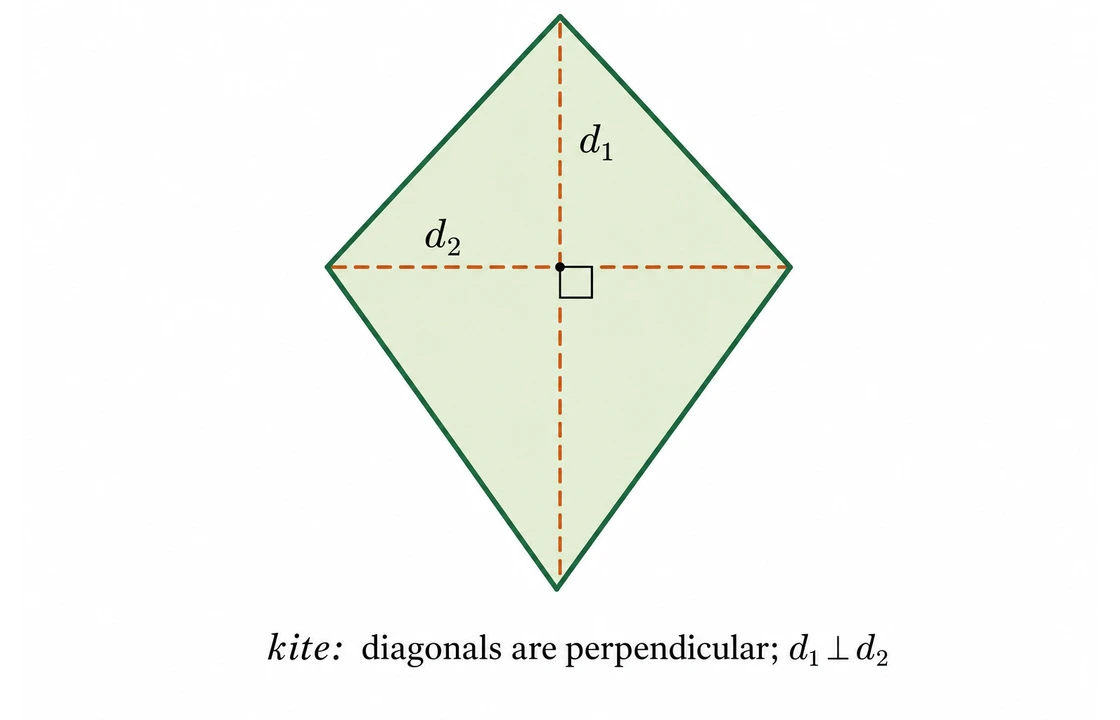
Problem: A kite has diagonals of length 10 cm and 6 cm. Find the area of the kite.
Step 1: Identify the two diagonals. Here, the longer diagonal is 10 cm and the shorter diagonal is 6 cm.
d1=10 cm,d2=6 cm
Step 2: Write the area formula for a kite.
A=21d1⋅d2
Step 3: Substitute the values into the formula.
A=21(10)(6)
Step 4: Multiply to get the area.
A=21(60)=30 cm2
Answer: The area of the kite is 30 cm².
Another Example
This example shows how the perpendicular diagonals of a kite can create right triangles. Once the missing diagonal is found, the area formula A = ½d₁d₂ can be used.
Problem: A kite has side lengths of 10 cm and 17 cm. Its symmetry diagonal is 21 cm. Find the shorter diagonal and the area of the kite.
Step 1: Let the symmetry diagonal be split into two parts, p and q, by the shorter diagonal. Let x be half of the shorter diagonal.
p+q=21
Step 2: The diagonals of a kite are perpendicular, so the side lengths form two right triangles.
p2+x2=102,q2+x2=172
Step 3: Subtract the first equation from the second to eliminate x².
q2−p2=172−102=189
Step 4: Use the difference of squares and p + q = 21.
(q−p)(q+p)=189,21(q−p)=189
Step 5: Solve for p and q.
q−p=9,q+p=21⟹q=15,p=6
Step 6: Find half of the shorter diagonal, then double it.
x2=102−62=64,x=8,d2=2x=16 cm
Step 7: Use the kite area formula.
A=21×21×16=168 cm2
Answer: The shorter diagonal is 16 cm, and the area of the kite is 168 cm².
Frequently Asked Questions
What is the difference between a kite and a rhombus?
A kite has two distinct pairs of adjacent congruent sides, whereas a rhombus has all four sides congruent. Every rhombus is technically a special case of a kite (where the two pairs happen to be equal), but most kites are not rhombuses. Both shapes have perpendicular diagonals, so they share the same area formula: A = ½ d₁ d₂.
Are the diagonals of a kite always perpendicular?
Yes. One of the defining properties of a kite is that its diagonals always intersect at right angles (90°). Additionally, the longer diagonal bisects the shorter diagonal, but the shorter diagonal does not necessarily bisect the longer one.
Can a kite have two right angles?
Yes. In many kites, the two angles where the unequal sides meet are not right angles, but a kite can have exactly two right angles. These right angles occur at the endpoints of the shorter diagonal. A square is a special kite that has four right angles.
Kite vs. Rhombus
Kite
Rhombus
Definition
Quadrilateral with two pairs of adjacent congruent sides (pairs can differ in length)
Quadrilateral with all four sides congruent
Diagonals
Perpendicular; longer diagonal bisects the shorter one
Perpendicular; each diagonal bisects the other
Area formula
A = ½ d₁ d₂
A = ½ d₁ d₂
Symmetry
One line of symmetry (along the longer diagonal)
Two lines of symmetry (along each diagonal)
Relationship
A rhombus is a special type of kite
A rhombus is also a parallelogram; a kite generally is not
Why It Matters
Kites appear frequently in geometry courses when studying properties of quadrilaterals, diagonal relationships, and area formulas. Standardized tests often give you the diagonals of a kite and ask for the area, so knowing the formula A = ½ d₁ d₂ is essential. The perpendicular-diagonal property also makes kites a useful context for applying the Pythagorean theorem.
Common Mistakes
Mistake: Confusing adjacent congruent sides with opposite congruent sides.
Correction: In a kite, the two congruent sides in each pair are next to each other (adjacent), not across from each other. A quadrilateral with opposite sides congruent is a parallelogram, not a kite.
Mistake: Assuming both diagonals are bisected by the other.
Correction: Only the shorter diagonal is bisected by the longer one. The longer diagonal is not bisected by the shorter diagonal unless the kite is also a rhombus.