
Interior — Definition, Meaning & Examples
Interior
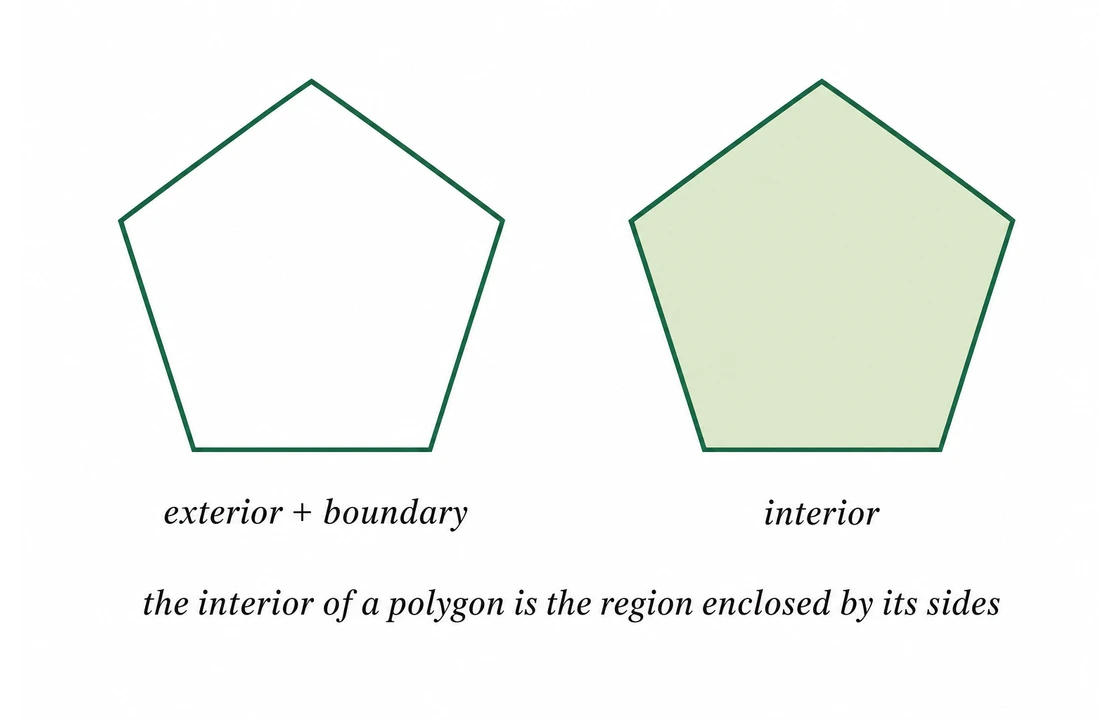
The points enclosed by a geometric figure.
Note: Interior points cannot be vertices or lie on a figure's sides, circumference, edges, faces, or surface.
See also
Key Formula
P is an interior point of figure F⟺P is enclosed by F and P∈/∂F
Where:
- P = A point being tested
- F = A geometric figure (polygon, circle, polyhedron, etc.)
- ∂F = The boundary of F — its sides, edges, vertices, circumference, faces, or surface
Worked Example
Problem: A triangle has vertices at A(0, 0), B(6, 0), and C(3, 6). Determine whether the point P(3, 2) is in the interior of the triangle.
Step 1: Compute the area of triangle ABC using the coordinate formula.
AreaABC=21∣xA(yB−yC)+xB(yC−yA)+xC(yA−yB)∣=21∣0(0−6)+6(6−0)+3(0−0)∣=21∣0+36+0∣=18
Step 2: Compute the areas of the three sub-triangles formed by P and each pair of vertices: triangles PAB, PBC, and PCA.
AreaPAB=21∣3(0−0)+0(0−2)+6(2−0)∣=21∣0+0+12∣=6
Step 3: Continue with the other two sub-triangles.
AreaPBC=21∣3(0−6)+6(6−2)+3(2−0)∣=21∣−18+24+6∣=6 AreaPCA=21∣3(6−0)+3(0−2)+0(2−6)∣=21∣18−6+0∣=6
Step 4: Add the three sub-triangle areas and compare to the total area.
6+6+6=18=AreaABC
Step 5: Because the sum equals the total area and none of the three sub-triangle areas is zero, P does not lie on any side or vertex. Therefore P is an interior point.
Answer: P(3, 2) is in the interior of triangle ABC.
Another Example
This example uses a circle instead of a polygon, showing how 'interior' applies to curved figures and illustrating the key distinction between boundary and interior points.
Problem: A circle has center O(0, 0) and radius r = 5. Determine whether the points Q(3, 4) and R(1, 2) are interior points, boundary points, or exterior points.
Step 1: For any point, compute its distance from the center and compare it to the radius. A point is interior if d < r, on the boundary if d = r, and exterior if d > r.
Step 2: Find the distance from O to Q.
dQ=32+42=9+16=25=5
Step 3: Since d_Q = r = 5, point Q lies exactly on the circumference. It is a boundary point, NOT an interior point.
Step 4: Find the distance from O to R.
dR=12+22=1+4=5≈2.24
Step 5: Since d_R ≈ 2.24 < 5 = r, point R is strictly inside the circle and is an interior point.
Answer: Q(3, 4) is on the boundary (not interior). R(1, 2) is an interior point of the circle.
Frequently Asked Questions
What is the difference between interior and boundary of a shape?
The boundary consists of the points that form the figure's outline — vertices, sides, edges, circumference, or surface. The interior consists of all points enclosed by that boundary, none of which touch it. Together, the boundary and interior make up the closed region of a figure.
Is a vertex an interior point?
No. A vertex is a corner point where two or more sides or edges meet, so it is part of the boundary. By definition, interior points cannot be vertices or lie on any side, edge, face, or surface of the figure.
How do you tell if a point is in the interior of a polygon?
One common method is the sub-area test: divide the polygon into triangles using the test point and each edge. If the sum of the sub-triangle areas equals the polygon's total area and no sub-area is zero, the point is interior. Another method is the ray-casting test: draw a ray from the point in any direction and count how many times it crosses the polygon's boundary. An odd count means the point is inside.
Interior vs. Boundary
| Interior | Boundary | |
|---|---|---|
| Definition | All points strictly enclosed by a figure | All points forming the outline of a figure (sides, edges, vertices, surface) |
| Includes vertices? | No | Yes |
| Includes points on sides/edges? | No | Yes |
| Circle example | Points with distance < r from center | Points with distance = r from center (the circumference) |
| Notation (topology) | int(F) or F° | ∂F |
Why It Matters
Understanding interior points is essential when working with area, volume, and inequalities in coordinate geometry. Many geometry problems ask you to determine whether a point falls inside, outside, or on a figure — classifying it as interior, exterior, or boundary. The concept also extends to higher math: in topology and real analysis, the interior of a set is a foundational idea used to define open sets.
Common Mistakes
Mistake: Counting points on the boundary (vertices, sides, or circumference) as interior points.
Correction: Interior points are strictly inside the figure. Any point on a side, edge, vertex, or surface is a boundary point, not an interior point.
Mistake: Confusing 'interior' of a figure with 'interior angles' of a polygon.
Correction: The interior of a figure refers to the enclosed region of points. An interior angle is the angle formed between two adjacent sides, measured inside the polygon. These are related but distinct concepts.
Related Terms
- Point — The fundamental object being classified as interior or not
- Geometric Figure — The shape whose interior is being identified
- Vertex — A boundary point, excluded from the interior
- Side of a Polygon — Part of the boundary enclosing the interior
- Polygon Interior — Interior concept applied specifically to polygons
- Disk — A circle's interior together with its boundary
- Circumference — The boundary of a circle, not part of its interior
- Edge of a Polyhedron — Part of the boundary of a 3D figure