
Edge of a Polyhedron — Definition, Examples & Properties
Edge of a Polyhedron
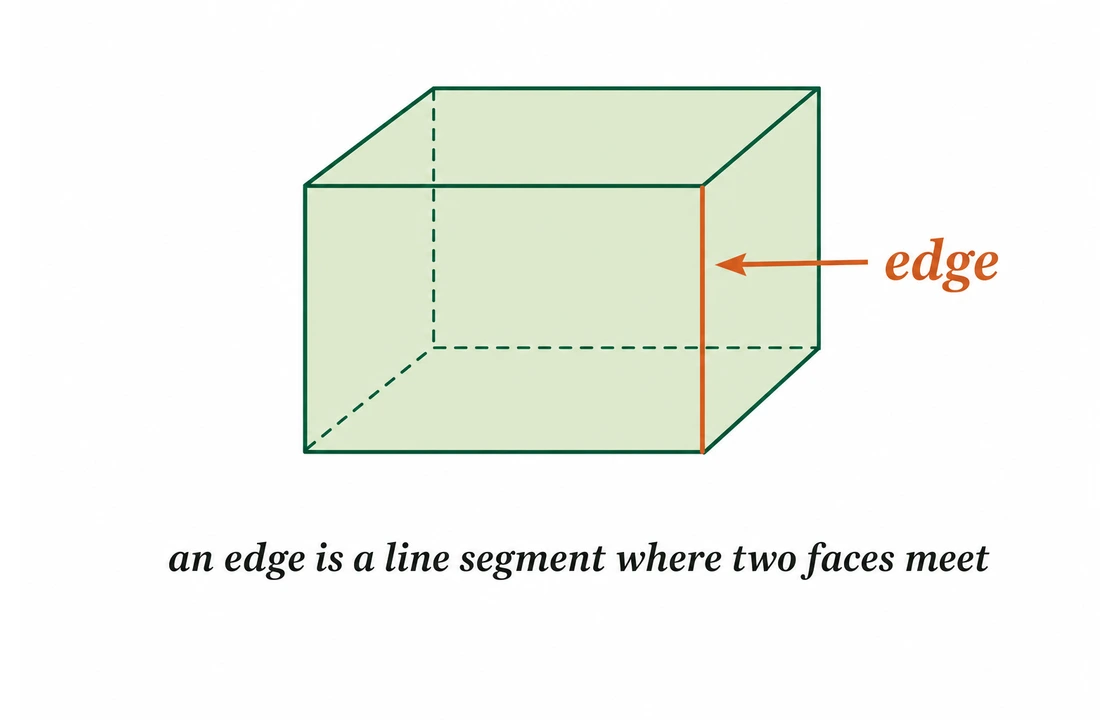
One of the line segments making up the framework of a polyhedron. The edges are where the faces intersect each other.
Key Formula
V−E+F=2
Where:
- V = Number of vertices (corners) of the polyhedron
- E = Number of edges of the polyhedron
- F = Number of faces of the polyhedron
Worked Example
Problem: Count the edges of a rectangular box (rectangular prism) and verify Euler's formula.
Step 1: Identify the faces. A rectangular box has 6 flat rectangular faces: top, bottom, front, back, left, and right.
F=6
Step 2: Identify the vertices. A rectangular box has 8 corners — 4 on the top face and 4 on the bottom face.
V=8
Step 3: Count the edges. The top face has 4 edges, the bottom face has 4 edges, and there are 4 vertical edges connecting the top corners to the bottom corners.
E=4+4+4=12
Step 4: Verify with Euler's formula for polyhedra.
V−E+F=8−12+6=2✓
Answer: A rectangular box has 12 edges. The result satisfies Euler's formula, confirming the count is correct.
Another Example
Problem: A triangular pyramid (tetrahedron) is made from 4 triangular faces. How many edges does it have?
Step 1: Each triangular face has 3 sides. With 4 faces, the total number of face-sides is 4 × 3 = 12. But each edge is shared by exactly 2 faces.
E=24×3=6
Step 2: Verify with Euler's formula. A tetrahedron has 4 vertices and 4 faces.
V−E+F=4−6+4=2✓
Answer: A tetrahedron has 6 edges.
Frequently Asked Questions
How do you count the edges of a polyhedron?
You can count edges directly by tracing each line segment where two faces meet. A useful shortcut: multiply the number of faces by the number of sides per face, then divide by 2 (since every edge is shared by exactly two faces). You can also rearrange Euler's formula to get E = V + F − 2 if you already know the vertex and face counts.
What is the difference between an edge, a face, and a vertex of a polyhedron?
A face is a flat polygonal surface of the polyhedron. An edge is a line segment where exactly two faces meet. A vertex is a point where three or more edges come together. Together, faces, edges, and vertices are the three basic parts of every polyhedron.
Edge vs. Face
An edge is a one-dimensional line segment forming part of the boundary between two faces. A face is a two-dimensional flat polygon that forms one of the surfaces of the polyhedron. Each edge belongs to exactly two faces, and each face is bounded by three or more edges.
Why It Matters
Edges define the shape and structure of any polyhedron — without them, the faces would not connect. Counting edges is essential in geometry problems involving Euler's formula, surface area calculations, and building physical models or 3D structures. In fields like architecture, engineering, and computer graphics, understanding how edges connect faces is fundamental to constructing and rendering solid shapes.
Common Mistakes
Mistake: Double-counting edges when counting face by face.
Correction: Every edge is shared by exactly two faces. If you count the sides of each face individually, you must divide the total by 2 to get the correct edge count.
Mistake: Confusing edges with diagonals drawn across a face.
Correction: An edge is only a line segment along the boundary where two faces meet. A diagonal connecting non-adjacent vertices across a face is not an edge of the polyhedron.
Related Terms
- Line Segment — Each edge is a line segment
- Polyhedron — The solid shape bounded by edges and faces
- Face of a Polyhedron — Flat surfaces that meet at edges
- Vertex — Point where three or more edges meet
- Euler's Formula — Relates vertices, edges, and faces
- Prism — Common polyhedron with parallel faces and edges
- Pyramid — Polyhedron with triangular lateral edges