
Alternate Exterior Angles — Definition, Diagram & Theorem
Alternate Exterior Angles
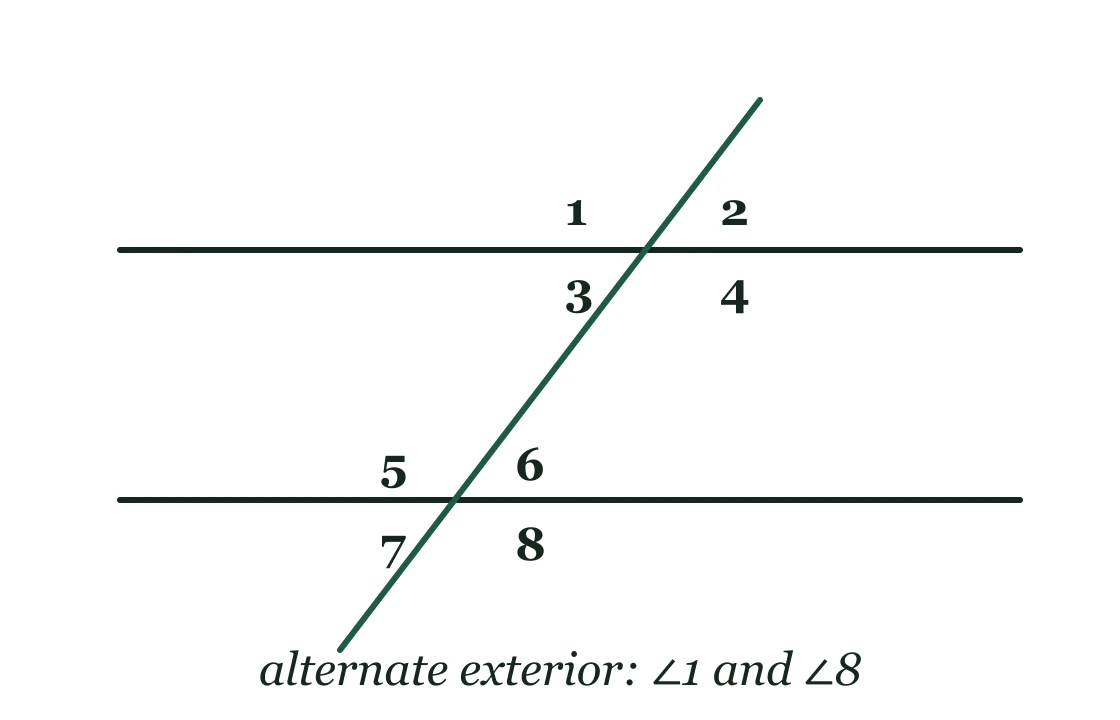
In the drawing below, angles 1 and 8 are alternate exterior angles, as are angles 2 and 7. Alternate exterior angles are congruent. Formally, alternate exterior angles are defined as two exterior angles on opposite sides of a transversal which lie on different parallel lines.
Worked Example
Problem: Two parallel lines are cut by a transversal. One of the alternate exterior angles measures 130°. Find the measure of the other alternate exterior angle and the angle adjacent to it on the same side.
Step 1: Identify the angle pair. The two angles are alternate exterior angles because they are outside the parallel lines and on opposite sides of the transversal.
Step 2: Apply the Alternate Exterior Angles Theorem. Since the lines are parallel, alternate exterior angles are congruent.
∠1=∠8=130°
Step 3: Find the adjacent exterior angle. Angle 1 and angle 2 form a linear pair (they sit on a straight line), so they are supplementary.
∠2=180°−130°=50°
Answer: The other alternate exterior angle measures 130°, and the angle adjacent to it on the same side measures 50°.
Another Example
Problem: Two parallel lines are cut by a transversal. One alternate exterior angle is expressed as (3x + 10)° and the other as (5x − 30)°. Find the value of x and the measure of each angle.
Step 1: Since the lines are parallel, alternate exterior angles are congruent. Set the expressions equal to each other.
3x+10=5x−30
Step 2: Solve for x by subtracting 3x from both sides.
10=2x−30
Step 3: Add 30 to both sides and divide by 2.
40=2x⟹x=20
Step 4: Substitute x = 20 back into either expression to find the angle measure.
3(20)+10=70°
Answer: x = 20, and each alternate exterior angle measures 70°.
Frequently Asked Questions
Are alternate exterior angles always congruent?
Alternate exterior angles are congruent only when the two lines cut by the transversal are parallel. If the lines are not parallel, the angles still exist as a pair, but they will not be equal in measure. In fact, you can use this property in reverse: if alternate exterior angles are congruent, the lines must be parallel.
What is the difference between alternate exterior angles and co-interior (consecutive interior) angles?
Alternate exterior angles are outside the parallel lines on opposite sides of the transversal, and they are congruent. Consecutive interior angles (also called co-interior or same-side interior angles) are between the parallel lines on the same side of the transversal, and they are supplementary (they add up to 180°).
Alternate Exterior Angles vs. Alternate Interior Angles
Both are pairs of angles on opposite sides of a transversal that are congruent when lines are parallel. The key difference is position: alternate exterior angles lie outside the two parallel lines, while alternate interior angles lie between them. For example, if angles 1, 2 are above the top line and angles 7, 8 are below the bottom line, then 1 & 8 are alternate exterior, whereas angles 3 & 6 (between the lines) are alternate interior.
Why It Matters
Alternate exterior angles are essential in geometry proofs involving parallel lines. They appear frequently in standardized tests and real-world applications such as engineering and architecture, where parallel beams or supports are crossed by diagonal bracing. Understanding this angle relationship also lets you prove that two lines are parallel — if the alternate exterior angles formed by a transversal are congruent, the lines must be parallel.
Common Mistakes
Mistake: Confusing alternate exterior angles with co-exterior (same-side exterior) angles.
Correction: Alternate exterior angles are on opposite sides of the transversal and are congruent. Same-side exterior angles (also called co-exterior or consecutive exterior angles) are on the same side and are supplementary (sum to 180°). Always check which side of the transversal each angle is on.
Mistake: Assuming alternate exterior angles are congruent even when the lines are not parallel.
Correction: The congruence property only holds when the two lines are parallel. If you are not told the lines are parallel, you cannot assume the angles are equal. Conversely, if a problem asks you to prove lines are parallel, showing that alternate exterior angles are congruent is one valid method.
Related Terms
- Alternate Interior Angles — Congruent angle pair between parallel lines
- Consecutive Interior Angles — Supplementary angle pair on same side
- Transversal — Line that crosses two or more lines
- Parallel Lines — Lines that never intersect, key requirement
- Congruent — Equal in measure, the key relationship
- Angle — Fundamental concept formed by two rays
- Exterior Angle of a Polygon — Related exterior angle concept in polygons