
Face of a Polyhedron — Definition, Examples & Table
Face of a Polyhedron
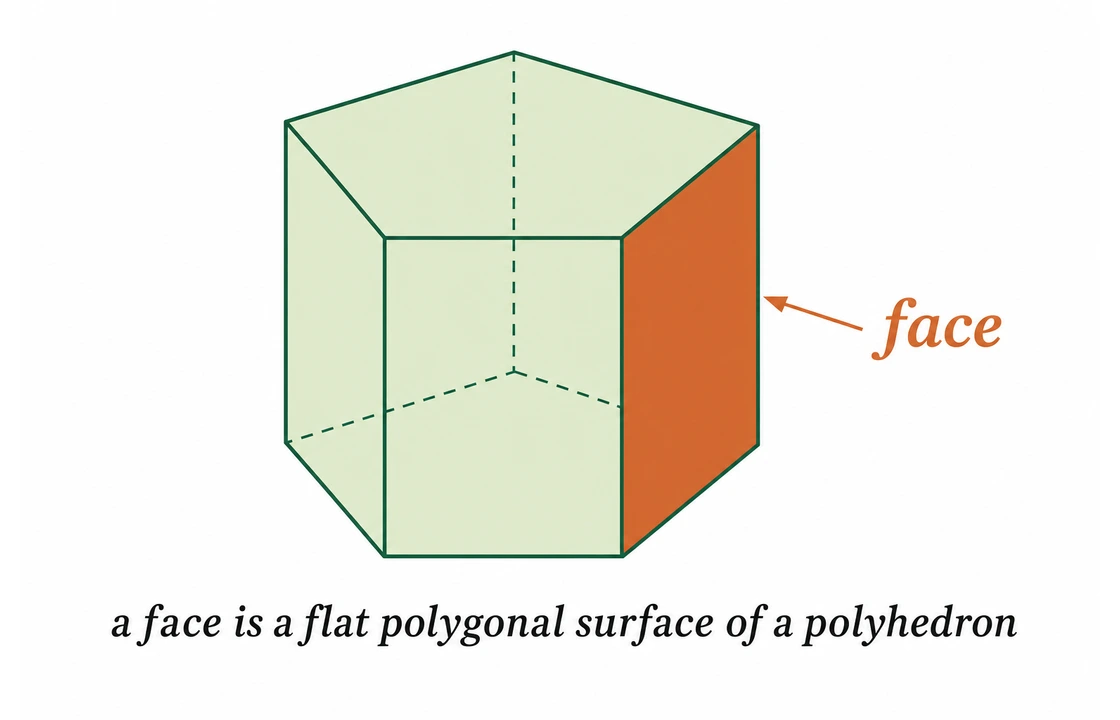
One of the flat surfaces making up a polyhedron. Note: The faces of a polyhedron are all polygons.
See also
Key Formula
V−E+F=2
Where:
- V = Number of vertices (corner points) of the polyhedron
- E = Number of edges of the polyhedron
- F = Number of faces of the polyhedron
Worked Example
Problem: A rectangular prism (box) has dimensions 4 cm × 3 cm × 5 cm. How many faces does it have, and what is the total surface area?
Step 1: Identify the faces. A rectangular prism has 6 rectangular faces: a top and bottom, a front and back, and a left and right side.
F=6
Step 2: Find the area of each pair of opposite faces. The top and bottom faces each measure 4 cm × 3 cm.
2×(4×3)=2×12=24 cm2
Step 3: The front and back faces each measure 4 cm × 5 cm.
2×(4×5)=2×20=40 cm2
Step 4: The left and right faces each measure 3 cm × 5 cm.
2×(3×5)=2×15=30 cm2
Step 5: Add all face areas to get the total surface area.
Surface Area=24+40+30=94 cm2
Answer: A rectangular prism has 6 faces, and for this box the total surface area is 94 cm².
Another Example
This example uses Euler's formula to verify the face count of a non-rectangular polyhedron, showing how V, E, and F relate rather than computing surface area.
Problem: A triangular prism has 5 faces. It has 9 edges and 6 vertices. Verify that Euler's formula holds for this polyhedron.
Step 1: Identify the faces of a triangular prism: 2 triangular faces (the bases) and 3 rectangular faces (the lateral faces).
F=2+3=5
Step 2: Record the number of edges and vertices. A triangular prism has 9 edges (3 on each triangular base plus 3 connecting them) and 6 vertices (3 on each base).
E=9,V=6
Step 3: Substitute into Euler's formula and check.
V−E+F=6−9+5=2✓
Answer: Euler's formula gives 6 − 9 + 5 = 2, which confirms the count of 5 faces is correct.
Frequently Asked Questions
How many faces does a cube have?
A cube has 6 faces. Each face is a square, and all 6 squares are congruent. You can verify this with Euler's formula: a cube has 8 vertices and 12 edges, so V − E + F = 8 − 12 + 6 = 2.
What is the difference between a face and a side of a shape?
In three-dimensional geometry, a face is a flat polygonal surface of a solid. In two-dimensional geometry, a 'side' is a line segment forming part of a polygon's boundary. So faces are 2D regions on a 3D object, while sides are 1D segments on a 2D shape. Sometimes people casually say 'side' when they mean 'face,' but in precise math language these are different.
Is a curved surface a face?
No. A face must be flat (planar) and bounded by straight edges, forming a polygon. A cylinder's curved surface is not a face, which is why a cylinder is not a polyhedron. Only flat, polygonal surfaces count as faces.
Face vs. Edge
| Face | Edge | |
|---|---|---|
| Definition | A flat polygonal surface of a polyhedron | A line segment where two faces meet |
| Dimension | 2-dimensional (a region) | 1-dimensional (a segment) |
| Example (cube) | 6 square faces | 12 edges |
| Role in Euler's formula | F (added: V − E + F = 2) | E (subtracted: V − E + F = 2) |
Why It Matters
Counting and understanding faces is essential whenever you calculate the surface area of a 3D solid, since total surface area equals the sum of the areas of all faces. Faces also appear in Euler's formula, a foundational result in geometry and topology that connects the number of faces, edges, and vertices of any convex polyhedron. You will encounter faces frequently in geometry courses, 3D modeling, architecture, and any context involving nets (flat patterns that fold into solids).
Common Mistakes
Mistake: Counting curved surfaces as faces.
Correction: Only flat, polygonal surfaces are faces. A cone's curved surface or a cylinder's lateral surface is not a face. This is why cones and cylinders are not polyhedra.
Mistake: Forgetting to count the base(s) when listing faces.
Correction: Students often count only the lateral (side) faces of prisms and pyramids, forgetting the top, bottom, or base. A triangular prism has 5 faces (not 3), and a square pyramid has 5 faces (not 4). Always include every flat surface.
Related Terms
- Polyhedron — The 3D solid whose boundary consists of faces
- Edge of a Polyhedron — Line segment where two faces meet
- Polygon — Each face is a polygon
- Surface — General term for the boundary of a solid
- Lateral Surface — Side faces (non-base faces) of prisms and pyramids
- Surface Area — Total area of all faces combined