
Adjacent Angles: Definition, Diagram & Examples (Geometry)
Adjacent Angles
Two angles in a plane which share a common vertex and a common side but do not overlap. Angles 1 and 2 below are adjacent angles.
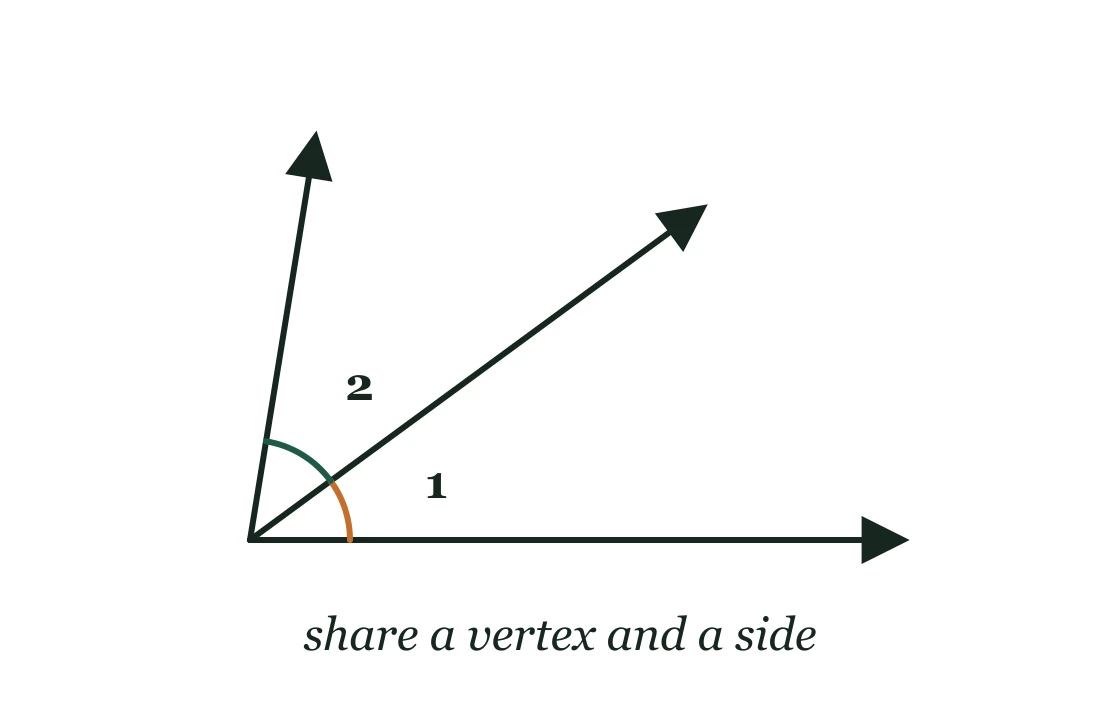
See also
Worked Example
Problem: Two adjacent angles share a common side along a straight line. One angle measures 65°. What is the measure of the other angle?
Step 1: Identify the relationship. The two adjacent angles together form a straight line, so they are supplementary and their measures add up to 180°.
∠1+∠2=180°
Step 2: Substitute the known angle measure.
65°+∠2=180°
Step 3: Solve for the unknown angle.
∠2=180°−65°=115°
Answer: The adjacent angle measures 115°.
Another Example
Problem: Two adjacent angles share a vertex and a common side. The first angle measures 40° and the second measures 30°. What is the measure of the larger angle formed by their non-shared sides?
Step 1: Because the two angles are adjacent (they share a vertex and a side, and do not overlap), the larger angle formed by their outer sides equals the sum of the two individual angles.
∠total=∠1+∠2
Step 2: Add the two angle measures.
∠total=40°+30°=70°
Answer: The larger angle formed by the two non-shared sides measures 70°.
Frequently Asked Questions
Can two adjacent angles also be supplementary or complementary?
Yes. If two adjacent angles together form a straight line, they are supplementary (sum to 180°). If they together form a right angle, they are complementary (sum to 90°). Being adjacent describes how the angles are positioned, while supplementary and complementary describe the sum of their measures — these properties can occur at the same time.
What is the difference between adjacent angles and vertical angles?
Adjacent angles share a common vertex and a common side, sitting next to each other. Vertical angles are formed by two intersecting lines and sit across from each other at the vertex — they share a vertex but do not share a side. Vertical angles are always equal in measure, while adjacent angles are not necessarily equal.
Adjacent Angles vs. Vertical Angles
Adjacent angles share both a common vertex and a common side, lying side by side. Vertical angles share only a common vertex; they are the non-adjacent pairs formed when two lines cross. Vertical angles are always congruent, but adjacent angles have no such requirement — their measures depend on the specific figure.
Why It Matters
Recognizing adjacent angles is essential when working with angle relationships along straight lines, around a point, or inside polygons. Many geometry proofs rely on identifying which angles are adjacent to set up equations using supplementary or complementary angle properties. In real-world design and construction, understanding how adjacent angles combine helps you calculate unknown measurements from known ones.
Common Mistakes
Mistake: Assuming that two angles sharing only a common vertex are adjacent.
Correction: Adjacent angles must share both a common vertex and a common side. Two angles that share a vertex but have no common side — such as vertical angles — are not adjacent.
Mistake: Assuming adjacent angles must add up to 180°.
Correction: Adjacent angles are supplementary only when their non-shared sides form a straight line. In general, two adjacent angles can sum to any value. Always check the figure before assuming a specific sum.
Related Terms
- Angle — The fundamental object adjacent angles describe
- Vertical Angles — Non-adjacent angle pairs formed by intersecting lines
- Vertex — The shared point where adjacent angles meet
- Arm of an Angle — The rays that form the sides of each angle
- Supplementary Angles — Adjacent angles on a straight line sum to 180°
- Complementary Angles — Adjacent angles forming a right angle sum to 90°
- Plane — The flat surface in which the angles lie
- Adjacent — General term meaning next to or neighboring