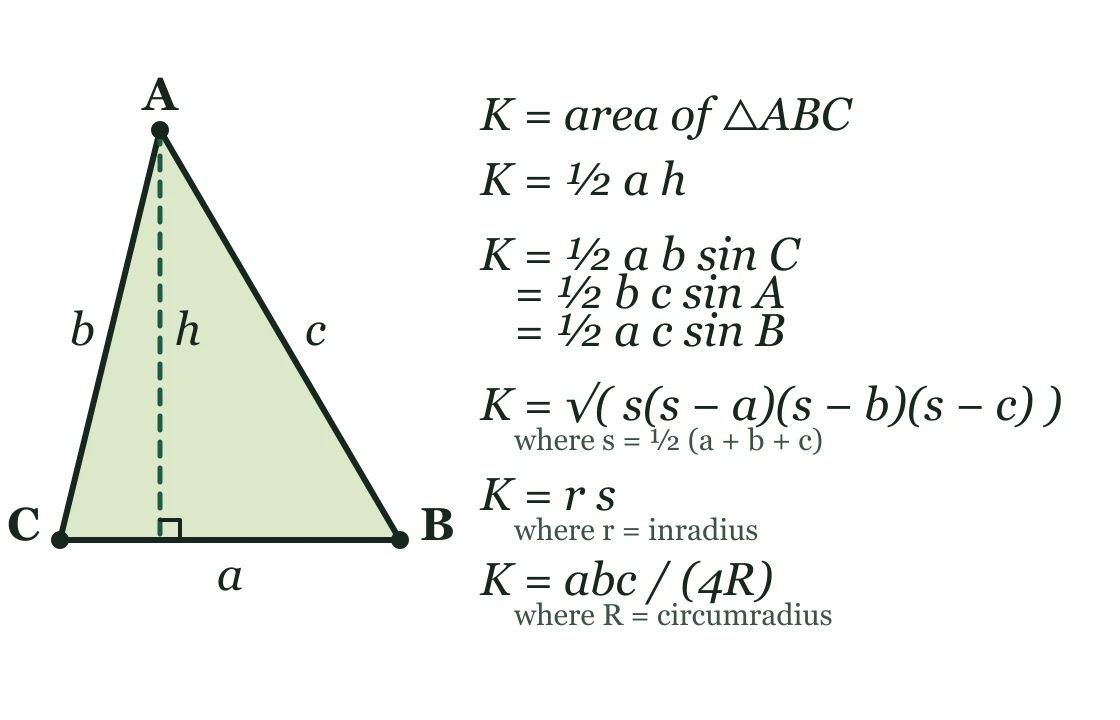
h = Height (altitude) measured perpendicular to the chosen base
Worked Example
Problem: Find the area of a triangle with a base of 10 cm and a height of 6 cm.
Step 1: Write down the formula for the area of a triangle.
A=21bh
Step 2: Substitute the given values: base = 10 cm and height = 6 cm.
A=21×10×6
Step 3: Multiply the base by the height.
10×6=60
Step 4: Multiply by one-half to get the final area.
A=21×60=30
Answer: The area of the triangle is 30 cm².
Another Example
This example uses the SAS (side-angle-side) trigonometric formula instead of base × height, which is essential when the perpendicular height is not directly given.
Problem: Two sides of a triangle measure 8 cm and 5 cm, and the angle between them is 30°. Find the area.
Step 1: When you know two sides and the included angle, use the trigonometric area formula.
A=21absinC
Step 2: Substitute a = 8, b = 5, and C = 30°.
A=21×8×5×sin30°
Step 3: Recall that sin 30° = 0.5.
sin30°=0.5
Step 4: Compute the product.
A=21×8×5×0.5=21×20=10
Answer: The area of the triangle is 10 cm².
Frequently Asked Questions
Why do you multiply by 1/2 in the area of a triangle formula?
A triangle is exactly half of a parallelogram that shares the same base and height. The area of a parallelogram is base × height, so the area of the triangle is half of that: ½ × base × height. You can visualize this by duplicating the triangle and rotating the copy to form a full parallelogram.
How do you find the area of a triangle when you only know the three sides?
Use Heron's formula. First compute the semiperimeter s = (a + b + c)/2, where a, b, and c are the side lengths. Then the area is A = √[s(s − a)(s − b)(s − c)]. This method requires no knowledge of angles or heights.
Does it matter which side you choose as the base?
No. You can pick any of the three sides as the base, as long as you use the altitude that is perpendicular to that specific side. The resulting area will be the same regardless of which side you choose.
½ × base × height formula vs. Heron's formula
½ × base × height formula
Heron's formula
Formula
A = ½ b h
A = √[s(s−a)(s−b)(s−c)]
Information needed
A base length and its perpendicular height
All three side lengths
When to use
When the height is known or easy to find
When only side lengths are available and the height is unknown
Complexity
Simple multiplication
Requires computing the semiperimeter, then a square root
Why It Matters
The area of a triangle is one of the most frequently used formulas across geometry, trigonometry, and coordinate geometry. You need it for calculating surface areas of 3D shapes (since many faces are triangles), solving real-world problems involving land measurement and architecture, and proving more advanced results like the shoelace formula for polygon area. Standardized tests—from the SAT to AP exams—regularly include triangle area problems in various forms.
Common Mistakes
Mistake: Forgetting to multiply by ½ and computing base × height as the full area.
Correction: Always remember that a triangle is half a parallelogram. The correct formula is A = ½ × b × h, not b × h.
Mistake: Using a slant side length as the height instead of the perpendicular distance from the base to the opposite vertex.
Correction: The height must be measured at a right angle (90°) to the base. If the triangle is obtuse, the altitude may fall outside the triangle, but it still must be perpendicular to the base line.
Related Terms
Triangle — The shape whose area is being calculated