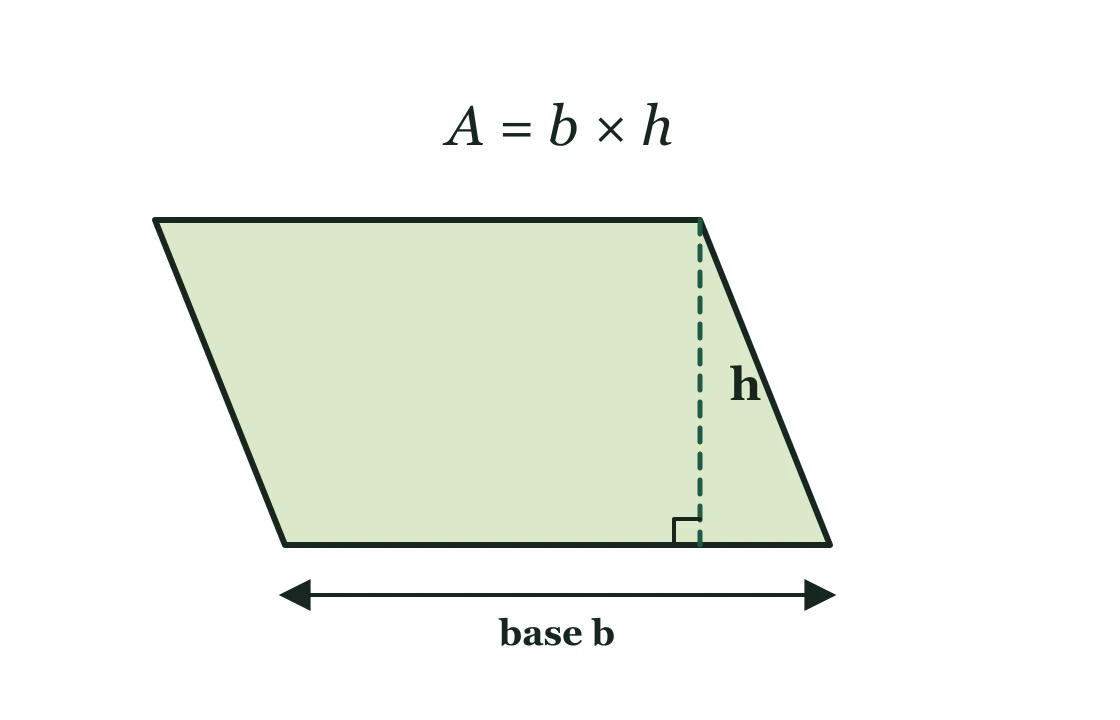
b = Length of the base (any one side of the parallelogram)
h = Height (the perpendicular distance from the base to the opposite side, also called the altitude)
Worked Example
Problem: Find the area of a parallelogram with a base of 10 cm and a height of 6 cm.
Step 1: Write down the formula for the area of a parallelogram.
A=b×h
Step 2: Substitute the given values: base = 10 cm and height = 6 cm.
A=10×6
Step 3: Multiply to find the area.
A=60 cm2
Answer: The area of the parallelogram is 60 cm².
Another Example
This example uses the sine-based formula, which is needed when the perpendicular height is not given directly but two adjacent sides and the included angle are known.
Problem: A parallelogram has sides of length 12 cm and 8 cm, and the angle between them is 30°. Find its area.
Step 1: When you know two sides and the included angle instead of the height, use the alternative formula involving sine.
A=a×b×sin(θ)
Step 2: Substitute the given values: a = 12 cm, b = 8 cm, and θ = 30°.
A=12×8×sin(30°)
Step 3: Recall that sin(30°) = 0.5.
sin(30°)=0.5
Step 4: Multiply to find the area.
A=12×8×0.5=48 cm2
Answer: The area of the parallelogram is 48 cm².
Frequently Asked Questions
Why do you use height and not the slanted side to find the area of a parallelogram?
Area measures the space inside a flat shape, and that space depends on how far apart the two parallel sides are, not on how long the slanted side is. The height is the perpendicular distance between the base and the opposite side. If you used the slanted side instead, you would overestimate the area because the slant is always longer than or equal to the perpendicular height.
What is the difference between the area of a parallelogram and the area of a rectangle?
Both use the formula A = base × height. The key difference is that in a rectangle, the height equals the length of the adjacent side (since all angles are 90°). In a general parallelogram, the height is shorter than the slanted side because the shape leans to one side. A rectangle is actually a special case of a parallelogram where all angles are right angles.
Can you use the area of a parallelogram formula for a rhombus?
Yes. A rhombus is a parallelogram with four equal sides, so A = b × h works perfectly. You can also find the area of a rhombus using its diagonals: A = (d₁ × d₂) / 2. Both methods give the same result.
Area of a Parallelogram vs. Area of a Triangle
Area of a Parallelogram
Area of a Triangle
Formula
A = b × h
A = ½ × b × h
Relationship
Full region between two pairs of parallel sides
Exactly half of a parallelogram with the same base and height
Why they differ
A diagonal of a parallelogram splits it into two congruent triangles
Each triangle is one of those two congruent halves
When to use
Shape has two pairs of parallel sides
Shape has exactly three sides
Why It Matters
You encounter the area of a parallelogram throughout geometry, from basic shape problems to proofs about triangles (since every triangle is half a parallelogram). In coordinate geometry, the area of a parallelogram formed by two vectors leads to the cross product, a concept central to physics and linear algebra. Understanding this formula also helps in real-world tasks like calculating the area of slanted surfaces, tilted plots of land, or cross-sections in engineering.
Common Mistakes
Mistake: Using the slanted side length instead of the perpendicular height.
Correction: The height must be measured at a right angle (90°) from the base to the opposite side. The slanted side is only equal to the height when the parallelogram is a rectangle. Always look for the altitude, not the side length.
Mistake: Confusing which measurement is the base and which is the height when both are given.
Correction: The base is a side of the parallelogram. The height is the perpendicular distance between that base and the side parallel to it. A height line will always form a 90° angle with the base. If a diagram shows a small square symbol where two lines meet, that line is the height.
Related Terms
Parallelogram — The shape whose area this formula calculates