Foci of a Hyperbola — Definition, Formula & Examples
Foci
of a Hyperbola
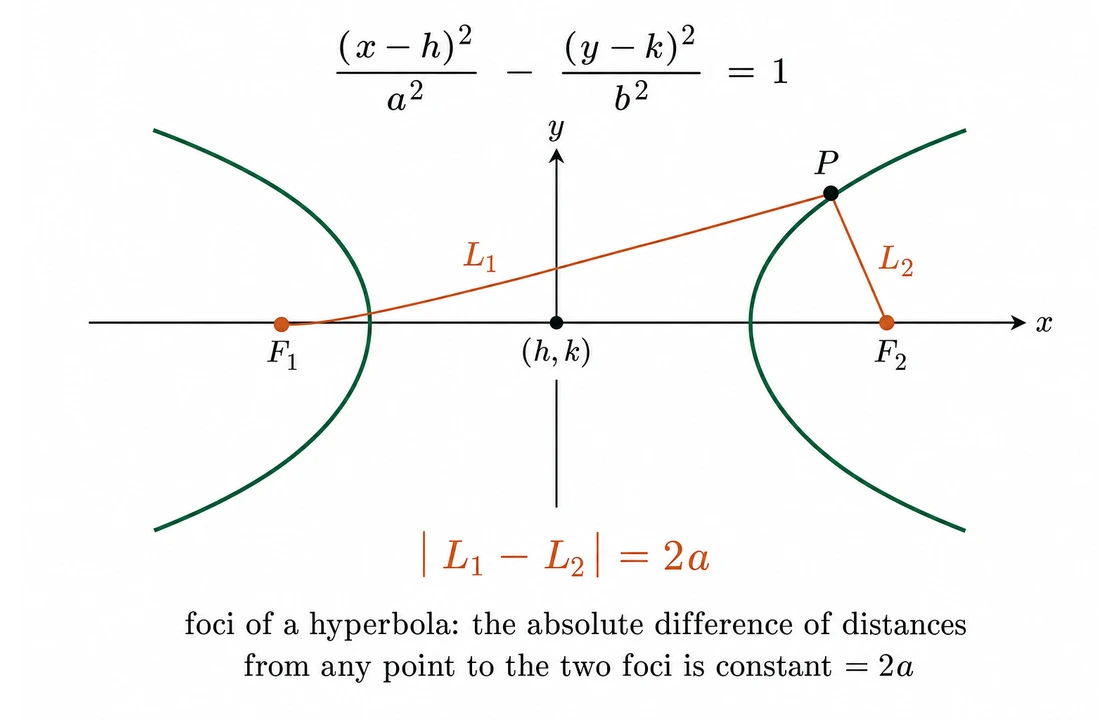
Two fixedpoints located inside each curve of
a hyperbola that are used in the
curve's formal definition. A hyperbola is defined as follows: For
two given points, the
foci, a hyperbola is the locus of points such that the difference
between
the distance to each focus is constant.
c = Distance from the center of the hyperbola to each focus
a = Distance from the center to each vertex (semi-transverse axis length)
b = Semi-conjugate axis length
Worked Example
Problem: Find the foci of the hyperbola given by the equation x²/9 − y²/16 = 1.
Step 1: Identify a² and b² from the standard form. The equation is already in the form x²/a² − y²/b² = 1.
a2=9,b2=16
Step 2: Use the relationship c² = a² + b² to find c.
c2=9+16=25
Step 3: Take the square root to get c.
c=25=5
Step 4: Since the x²-term is positive, the transverse axis is horizontal. The foci lie on the x-axis at (±c, 0).
Foci: (5,0) and (−5,0)
Answer: The foci are at (5, 0) and (−5, 0).
Another Example
This example differs by having a vertical transverse axis and a center that is not at the origin, requiring you to apply shifts to the focus coordinates.
Problem: Find the foci of the hyperbola given by (y − 2)²/25 − (x + 3)²/144 = 1.
Step 1: Identify the center from the shifted form. The center is at (h, k) = (−3, 2).
h=−3,k=2
Step 2: Identify a² and b². Because the y-term comes first (is positive), the transverse axis is vertical, with a² = 25 and b² = 144.
a2=25,b2=144
Step 3: Calculate c using c² = a² + b².
c2=25+144=169⟹c=13
Step 4: Since the transverse axis is vertical, the foci are displaced vertically from the center by ±c.
Foci: (−3,2+13)=(−3,15)and(−3,2−13)=(−3,−11)
Answer: The foci are at (−3, 15) and (−3, −11).
Frequently Asked Questions
How do you find the foci of a hyperbola?
Start by writing the equation in standard form to identify a² and b². Then compute c using c² = a² + b². If the transverse axis is horizontal (x²-term is positive), the foci are at (h ± c, k). If the transverse axis is vertical (y²-term is positive), the foci are at (h, k ± c), where (h, k) is the center.
What is the difference between the foci of a hyperbola and the foci of an ellipse?
For an ellipse, c² = a² − b², so c is always less than a and the foci sit between the vertices. For a hyperbola, c² = a² + b², so c is always greater than a and the foci lie beyond the vertices. Additionally, an ellipse uses the sum of distances to the foci (constant), while a hyperbola uses the absolute difference of distances (constant).
Why does a hyperbola have two foci?
The two foci are essential to the geometric definition of a hyperbola: a point lies on the hyperbola if and only if the absolute difference of its distances to the two foci equals 2a. With only one focus, you could not define this distance-difference relationship, and you would get a different conic (like a parabola, which has one focus).
Foci of a Hyperbola vs. Foci of an Ellipse
Foci of a Hyperbola
Foci of an Ellipse
Key formula
c² = a² + b²
c² = a² − b²
Distance property
|d₁ − d₂| = 2a (difference is constant)
d₁ + d₂ = 2a (sum is constant)
Foci position relative to vertices
Foci lie outside the vertices (c > a)
Foci lie inside the vertices (c < a)
Number of branches
Two separate branches, one focus per branch
One closed curve containing both foci
Why It Matters
You encounter the foci of a hyperbola in precalculus and analytic geometry courses whenever you classify or graph conic sections. They are also central in physics and engineering — for example, certain reflective properties of hyperbolas depend on the foci, and hyperbolic navigation systems (like LORAN) use the distance-difference definition directly. Understanding foci also builds the foundation for studying eccentricity and the directrix form of conics.
Common Mistakes
Mistake: Using c² = a² − b² (the ellipse formula) instead of c² = a² + b² for a hyperbola.
Correction: Remember that for a hyperbola, c is the largest of the three values a, b, and c. The formula is c² = a² + b², which always gives c > a.
Mistake: Placing the foci along the wrong axis — for example, putting them on the x-axis when the transverse axis is actually vertical.
Correction: The foci always lie along the transverse axis. Check which variable's term is positive in the standard form: if the x²-term is positive, the transverse axis is horizontal; if the y²-term is positive, it is vertical.