a = Semi-major axis length (half the length of the major axis)
e = Eccentricity of the ellipse, defined as e = c/a, where 0 < e < 1
c = Distance from the center to each focus, where c² = a² − b²
b = Semi-minor axis length (half the length of the minor axis)
Worked Example
Problem: Find the equations of the directrices for the ellipse given by x²/25 + y²/9 = 1.
Step 1: Identify a² and b². Here a² = 25 and b² = 9, so a = 5 and b = 3.
a=5,b=3
Step 2: Find c using the relationship c² = a² − b².
c2=25−9=16⟹c=4
Step 3: Calculate the eccentricity e = c/a.
e=54=0.8
Step 4: Apply the directrix formula x = ±a/e (or equivalently ±a²/c).
x=±0.85=±425=±6.25
Answer: The directrices are the vertical lines x = 25/4 and x = −25/4, or equivalently x = 6.25 and x = −6.25.
Another Example
This example features a vertically oriented ellipse (major axis along the y-axis) and includes a verification of the focus-directrix ratio property, showing a different orientation and deeper conceptual check.
Problem: An ellipse has foci at (0, ±3) and semi-major axis a = 5 along the y-axis. Find the directrices and verify the focus-directrix property for the point (4, 0) on the ellipse.
Step 1: Since the major axis is vertical, a = 5 and c = 3. Find b² = a² − c² = 25 − 9 = 16, so b = 4. The ellipse equation is x²/16 + y²/25 = 1.
16x2+25y2=1
Step 2: Compute eccentricity.
e=ac=53=0.6
Step 3: For a vertical major axis, the directrices are horizontal lines y = ±a/e.
y=±0.65=±325≈±8.33
Step 4: Verify with the point (4, 0). The nearer focus is (0, 3) or (0, −3); by symmetry both are equidistant. Take focus (0, 3). Distance to focus: √(16 + 9) = 5. The nearer directrix is y = 25/3. Distance from (4, 0) to this line is |0 − 25/3| = 25/3.
distance to directrixdistance to focus=25/35=255×3=2515=53=e✓
Answer: The directrices are y = 25/3 and y = −25/3. The focus-directrix ratio at (4, 0) equals 3/5, confirming it matches the eccentricity.
Frequently Asked Questions
What is the difference between the directrix of a parabola and the directrices of an ellipse?
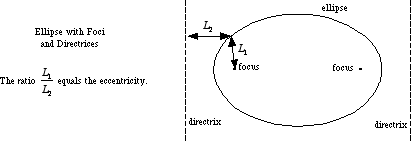
A parabola has one directrix and one focus, and the distance to the focus always equals the distance to the directrix (eccentricity = 1). An ellipse has two directrices and two foci, and the ratio of the distance to the nearer focus to the distance to the nearer directrix is a constant less than one (the eccentricity). The directrices of an ellipse lie outside the curve, while a parabola's directrix is on the opposite side of the vertex from the focus.
How do you find the directrix of an ellipse?
First find the semi-major axis a and the distance c from the center to each focus using c² = a² − b². Then compute the eccentricity e = c/a. The directrices are located at a distance a/e (equivalently a²/c) from the center, perpendicular to the major axis. If the major axis is horizontal, the directrices are vertical lines x = ±a²/c. If vertical, they are horizontal lines y = ±a²/c.
Why does an ellipse have two directrices?
An ellipse has two directrices because it has two foci, and the curve is symmetric about its center. Each directrix pairs with the focus on the same side. For any point on the ellipse, the ratio of its distance to the nearer focus to its distance to the nearer directrix is constant and equal to the eccentricity. The two-directrix structure reflects the bilateral symmetry of the ellipse along its major axis.
Directrices of an Ellipse vs. Directrix of a Parabola
Directrices of an Ellipse
Directrix of a Parabola
Number of directrices
Two (one on each side)
One
Position
Outside the ellipse, beyond the vertices
On the opposite side of the vertex from the focus
Eccentricity ratio
distance to focus / distance to directrix = e < 1
distance to focus / distance to directrix = 1
Formula (standard horizontal)
x = ±a²/c
x = −p (where p is the focal distance)
Conic type
Eccentricity 0 < e < 1
Eccentricity e = 1
Why It Matters
Directrices appear in precalculus and analytic geometry courses whenever you study conic sections through the focus-directrix definition. This unified definition — using the eccentricity ratio — lets you classify any conic as an ellipse, parabola, or hyperbola with a single framework. Understanding directrices also matters in physics and engineering: satellite orbits, reflective dish design, and optics all rely on the geometric properties that the focus-directrix relationship describes.
Common Mistakes
Mistake: Placing the directrices between the foci and the center, or at the foci themselves.
Correction: The directrices always lie outside the ellipse, farther from the center than the vertices. Since e < 1, the value a/e is greater than a, so each directrix is beyond the corresponding vertex.
Mistake: Confusing the directrix formula with the focus distance — using x = ±c instead of x = ±a²/c.
Correction: The foci are at distance c from the center, while the directrices are at distance a²/c from the center. These are different quantities: c < a < a²/c for any ellipse.