
Degenerate Conic Sections — Definition & Examples
Degenerate Conic Sections
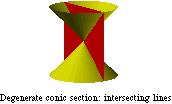
Plane figures that can be obtained by the intersection of a double cone with a plane passing through the apex. These include a point, a line, and intersecting lines. Like other conic sections, all degenerate conic sections have equations of the form Ax2 + Bxy + Cy2 + Dx + Ey + F = 0.
See also
Key Formula
Ax2+Bxy+Cy2+Dx+Ey+F=0
Where:
- A,B,C = Coefficients of the second-degree terms; their values determine the type of conic
- D,E = Coefficients of the first-degree (linear) terms
- F = The constant term
- x,y = Coordinates of points satisfying the equation
Worked Example
Problem: Determine what figure the equation x² − y² = 0 represents.
Step 1: Identify the general form coefficients. Here A = 1, B = 0, C = −1, D = 0, E = 0, F = 0.
x2+0⋅xy+(−1)y2+0⋅x+0⋅y+0=0
Step 2: Factor the left side using the difference of squares.
x2−y2=(x−y)(x+y)=0
Step 3: Set each factor equal to zero. This gives two equations: x − y = 0 (i.e., y = x) and x + y = 0 (i.e., y = −x).
y=xory=−x
Step 4: Verify with the discriminant. Compute B² − 4AC = 0² − 4(1)(−1) = 4 > 0, which corresponds to a hyperbola type. Since the equation factors into two linear equations, the conic is degenerate: a pair of intersecting lines.
B2−4AC=0−4(1)(−1)=4
Answer: The equation represents two intersecting lines: y = x and y = −x. This is a degenerate conic section.
Another Example
This example shows a degenerate conic that reduces to a single point, unlike the first example which produced intersecting lines. It also illustrates that the discriminant alone does not tell you whether a conic is degenerate.
Problem: Determine what figure the equation x² + y² = 0 represents.
Step 1: Identify the coefficients: A = 1, B = 0, C = 1, D = 0, E = 0, F = 0.
x2+y2=0
Step 2: Note that x² ≥ 0 and y² ≥ 0 for all real numbers. The sum of two non-negative quantities equals zero only when both are zero.
x2≥0 and y2≥0⟹x2+y2=0 only if x=0 and y=0
Step 3: Check the discriminant: B² − 4AC = 0 − 4(1)(1) = −4 < 0, which corresponds to an ellipse type. However, the only solution is the single point (0, 0), so this is a degenerate ellipse — a single point.
B2−4AC=−4<0
Answer: The equation represents a single point: (0, 0). This is a degenerate conic section (a degenerate ellipse).
Frequently Asked Questions
What is the difference between a conic section and a degenerate conic section?
A standard (non-degenerate) conic section is a curve — an ellipse, parabola, or hyperbola — formed when a plane slices through a double cone without passing through the apex. A degenerate conic section occurs when the plane passes through the apex itself, collapsing the curve into a point, a single line, or a pair of intersecting lines. Both types satisfy the same general second-degree equation, but degenerate conics have no curved portion.
How do you tell if an equation is a degenerate conic?
Write the equation in general form Ax² + Bxy + Cy² + Dx + Ey + F = 0 and try to factor it or complete the square. If the equation factors into two linear expressions, you get intersecting lines (or a single line if the factors are identical). If the only real solution is a single point, you have a degenerate ellipse. You can also compute the determinant of the associated 3×3 matrix; when that determinant equals zero, the conic is degenerate.
Why are degenerate conics called 'degenerate'?
The word 'degenerate' means that something has lost its typical properties and reduced to a simpler or limiting form. A degenerate conic has 'lost' its curvature — what would normally be a smooth curve has collapsed into a point or straight line(s). The term is not negative; it simply flags a special boundary case.
Degenerate Conic Sections vs. Non-Degenerate Conic Sections
| Degenerate Conic Sections | Non-Degenerate Conic Sections | |
|---|---|---|
| Definition | Plane cuts double cone through the apex | Plane cuts double cone away from the apex |
| Shapes produced | A point, a line, or two intersecting lines | Circle, ellipse, parabola, or hyperbola |
| General equation | Ax² + Bxy + Cy² + Dx + Ey + F = 0 (same form) | Ax² + Bxy + Cy² + Dx + Ey + F = 0 (same form) |
| Curvature | None — the result has no curved portion | The result is always a smooth curve |
| 3×3 matrix determinant | Equals zero | Does not equal zero |
Why It Matters
Degenerate conic sections appear in algebra courses whenever you classify second-degree equations — they are the edge cases that don't fit neatly into ellipse, parabola, or hyperbola. Recognizing them prevents errors when you try to graph an equation and find it has no curve at all. They also arise in linear algebra and analytic geometry when studying quadratic forms and matrix rank.
Common Mistakes
Mistake: Assuming the discriminant B² − 4AC alone tells you whether a conic is degenerate.
Correction: The discriminant classifies the type (ellipse-type, parabola-type, or hyperbola-type) but not whether it is degenerate. For example, x² + y² = 0 has B² − 4AC < 0 (ellipse-type) yet represents only a single point. You must also examine whether the equation can be satisfied by more than one point, typically by factoring or computing the 3×3 determinant.
Mistake: Forgetting that a single line (not just two intersecting lines) can be a degenerate conic.
Correction: When a plane is tangent to the cone at the apex, the intersection is a single line. Algebraically, this happens when the equation factors into a repeated linear factor, such as (x − y)² = 0, which gives the single line y = x. Always check for repeated factors.
Related Terms
- Conic Sections — Parent category including all cone-plane intersections
- Double Cone — The 3D solid sliced to produce conics
- Degenerate — General term for a limiting or collapsed case
- Apex — Cone vertex through which the plane passes
- Plane — The flat surface that intersects the cone
- Line — One possible degenerate conic result
- Point — Another possible degenerate conic result
- Plane Figure — Degenerate conics are plane figures