
Exterior Angle of a Polygon — Definition, Formula & Examples
Exterior Angle of a Polygon
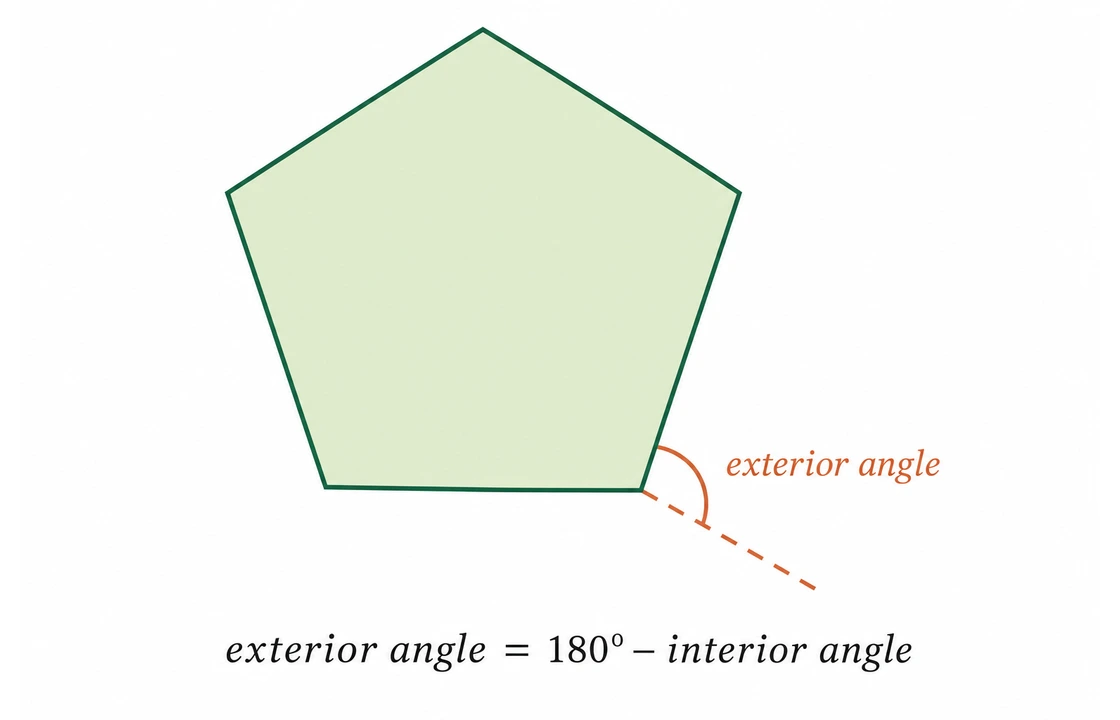
An angle between one side of a polygon and the extension of an adjacent side.
Note: The sum of the exterior angles of any convex polygon is 360°. This assumes that only one exterior angle is taken at each vertex.
Key Formula
Each exterior angle of a regular polygon=n360°
Where:
- n = The number of sides (or vertices) of the polygon
- 360° = The constant sum of all exterior angles of any convex polygon (one per vertex)
Worked Example
Problem: Find the measure of each exterior angle of a regular hexagon.
Step 1: Identify the number of sides. A hexagon has 6 sides.
n=6
Step 2: Recall that the sum of all exterior angles of any convex polygon is 360°.
Sum of exterior angles=360°
Step 3: Since the polygon is regular, all exterior angles are equal. Divide the total by the number of sides.
Each exterior angle=6360°=60°
Answer: Each exterior angle of a regular hexagon measures 60°.
Another Example
This example uses an irregular convex polygon with unequal exterior angles, showing that the 360° sum applies regardless of whether the polygon is regular.
Problem: A convex polygon has exterior angles measuring 90°, 65°, 78°, 52°, and one unknown angle. Find the unknown exterior angle.
Step 1: Recall that the exterior angles of any convex polygon sum to 360°.
90°+65°+78°+52°+x=360°
Step 2: Add the known exterior angles together.
90+65+78+52=285°
Step 3: Subtract the sum of the known angles from 360° to find the missing angle.
x=360°−285°=75°
Answer: The unknown exterior angle measures 75°.
Frequently Asked Questions
What is the difference between an interior angle and an exterior angle of a polygon?
An interior angle sits inside the polygon, formed by two adjacent sides. An exterior angle is formed outside the polygon between one side and the extension of an adjacent side. At any vertex, the interior angle and the exterior angle are supplementary, meaning they add up to 180°.
Why do exterior angles of a polygon always add up to 360°?
Imagine walking along the perimeter of a convex polygon. At each vertex, you turn through the exterior angle. By the time you return to your starting point, you have made one complete rotation, which is exactly 360°. This reasoning holds for any convex polygon regardless of the number of sides.
How do you find the number of sides of a regular polygon given one exterior angle?
Use the formula n = 360° ÷ (exterior angle). For example, if each exterior angle is 40°, then n = 360° ÷ 40° = 9 sides. The polygon is a regular nonagon.
Exterior Angle vs. Interior Angle
| Exterior Angle | Interior Angle | |
|---|---|---|
| Definition | Angle between one side and the extension of the adjacent side, formed outside the polygon | Angle formed between two adjacent sides, inside the polygon |
| Sum formula | Always 360° (one angle per vertex, convex polygon) | (n − 2) × 180° |
| Single angle (regular polygon) | 360° / n | (n − 2) × 180° / n |
| Relationship | Supplementary to the interior angle at the same vertex | Supplementary to the exterior angle at the same vertex |
Why It Matters
Exterior angles appear frequently in geometry courses when you need to find unknown angles in polygons or determine the number of sides of a regular polygon. They also show up in coordinate geometry and proofs, since the constant 360° sum provides a powerful shortcut. Understanding exterior angles is essential for standardized tests like the SAT, ACT, and many state assessments.
Common Mistakes
Mistake: Confusing the exterior angle with the interior angle and using (n − 2) × 180° / n when the question asks for the exterior angle.
Correction: Remember that the exterior angle and interior angle at the same vertex are supplementary (they add to 180°). For a regular polygon, use 360° / n directly for the exterior angle.
Mistake: Counting two exterior angles at each vertex, which would double the sum to 720°.
Correction: At each vertex, two supplementary exterior angles exist (one on each side of the polygon). The 360° rule requires that you take only one exterior angle per vertex.
Related Terms
- Angle — General concept that exterior angles are a type of
- Polygon — The shape whose exterior angles are measured
- Side of a Polygon — Exterior angles form between a side and its extension
- Convex — The 360° sum applies directly to convex polygons
- Adjacent — Exterior angles involve adjacent sides of the polygon
- Sum — The sum of exterior angles is a key property
- Regular Polygon — Has equal exterior angles, simplifying the formula
- Supplementary Angles — Interior and exterior angles at a vertex are supplementary