
Supplementary Angles (Add to 180°) — Definition & Examples
Supplementary Angles
Two angles that add up to 180°.
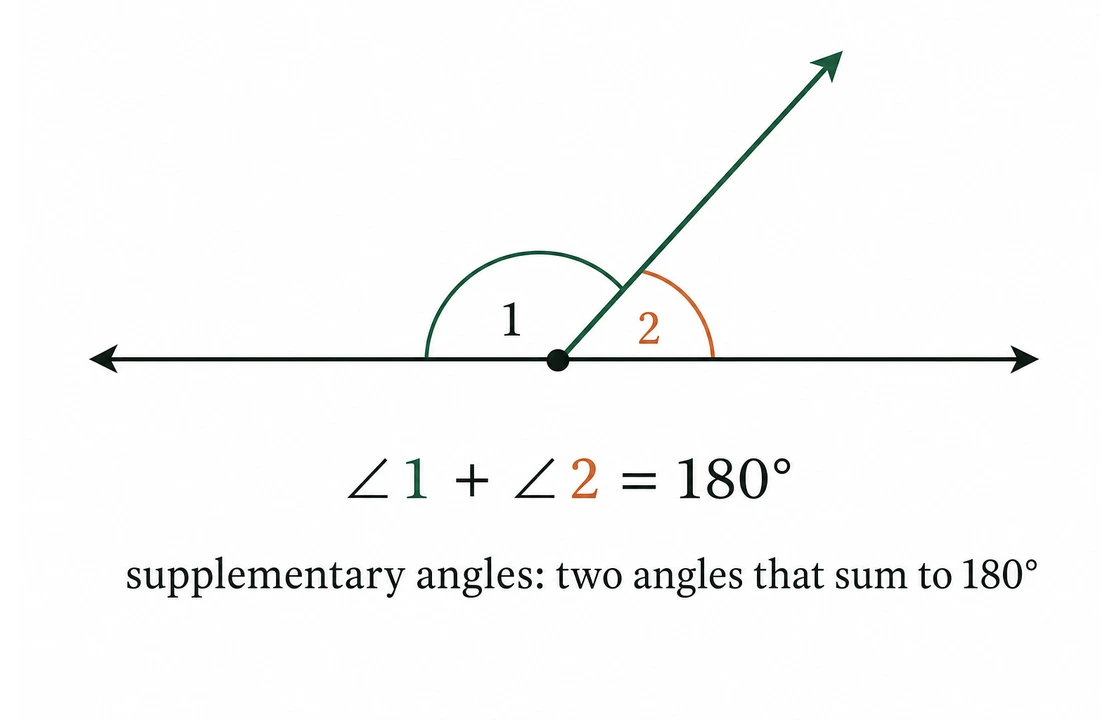
Key Formula
∠A+∠B=180°
Where:
- ∠A = The measure of the first angle in degrees
- ∠B = The measure of the second angle in degrees
Worked Example
Problem: One angle measures 65°. Find its supplementary angle.
Step 1: Write the supplementary angle formula.
∠A+∠B=180°
Step 2: Substitute the known angle into the formula.
65°+∠B=180°
Step 3: Solve for the unknown angle by subtracting 65° from both sides.
∠B=180°−65°=115°
Step 4: Verify: check that the two angles sum to 180°.
65°+115°=180°✓
Answer: The supplementary angle is 115°.
Another Example
This example introduces a ratio constraint instead of giving one angle directly, requiring students to set up and solve an algebraic equation.
Problem: Two supplementary angles are in the ratio 2 : 7. Find both angles.
Step 1: Let the two angles be 2x and 7x, where x is a common multiplier.
2x+7x=180°
Step 2: Combine like terms.
9x=180°
Step 3: Solve for x.
x=9180°=20°
Step 4: Find each angle by substituting back.
2x=2(20°)=40°and7x=7(20°)=140°
Step 5: Verify the sum.
40°+140°=180°✓
Answer: The two angles are 40° and 140°.
Frequently Asked Questions
What is the difference between supplementary and complementary angles?
Supplementary angles add up to 180°, while complementary angles add up to 90°. A quick way to remember: the 's' in supplementary stands for 'straight' (a straight angle is 180°), and the 'c' in complementary stands for 'corner' (a right-angle corner is 90°).
Do supplementary angles have to be next to each other?
No. Two angles are supplementary as long as their measures sum to 180°, regardless of their position. When they are placed adjacent so they share a common side, they form a straight line — but they can also be in completely different locations and still be supplementary.
Can two acute angles be supplementary?
No. An acute angle is less than 90°, so two acute angles would add up to less than 180°. At least one of the two supplementary angles must be obtuse (greater than 90°), unless both are exactly 90°.
Supplementary Angles vs. Complementary Angles
| Supplementary Angles | Complementary Angles | |
|---|---|---|
| Definition | Two angles that add up to 180° | Two angles that add up to 90° |
| Formula | ∠A + ∠B = 180° | ∠A + ∠B = 90° |
| Related angle type | Straight angle (180°) | Right angle (90°) |
| Example pair | 60° and 120° | 60° and 30° |
| Can both be acute? | No | Yes — both must be acute |
| Memory aid | 'S' for Straight (180°) | 'C' for Corner (90°) |
Why It Matters
Supplementary angles appear constantly in geometry — whenever two angles sit on a straight line (a linear pair), they are supplementary. You rely on this relationship to find unknown angles in triangles, parallel-line problems, and polygon calculations. Standardized tests like the SAT and ACT regularly include questions that require recognizing supplementary angle pairs to solve for missing values.
Common Mistakes
Mistake: Confusing supplementary (180°) with complementary (90°).
Correction: Remember: 'S' is for Straight line = 180°, and 'C' is for Corner (right angle) = 90°. Supplementary is the larger sum.
Mistake: Assuming supplementary angles must be adjacent or physically touching.
Correction: Two angles are supplementary based solely on their measures summing to 180°. They do not need to share a vertex or a side. Adjacent supplementary angles (a linear pair) are just one special case.
Related Terms
- Angle — The fundamental concept measured in degrees
- Supplement — The partner angle that completes 180°
- Complementary Angles — Two angles summing to 90° instead of 180°
- Straight Angle — A 180° angle formed by supplementary pairs
- Measure of an Angle — How angle size is quantified in degrees
- Vertical Angles — Opposite angles formed by intersecting lines