For a parabola with vertex (h,k) opening upward: y=k−pwhere the equation of the parabola is (x−h)2=4p(y−k)
Where:
h = The x-coordinate of the vertex
k = The y-coordinate of the vertex
p = The directed distance from the vertex to the focus (positive means the parabola opens upward or rightward; negative means it opens downward or leftward)
y=k−p = The equation of the directrix for a vertical parabola
x=h−p = The equation of the directrix for a horizontal parabola of the form (y - k)² = 4p(x - h)
Worked Example
Problem: Find the directrix of the parabola given by the equation x² = 12y.
Step 1: Identify the standard form. The equation x² = 12y matches the form (x − h)² = 4p(y − k) with vertex at (0, 0).
(x−0)2=4p(y−0)
Step 2: Solve for p by setting 4p equal to the coefficient of y.
4p=12⟹p=3
Step 3: Since the vertex is at (0, 0) and the parabola opens upward (p > 0), the focus is at (0, 3) and the directrix is the horizontal line below the vertex.
y=k−p=0−3=−3
Step 4: Verify: pick a point on the parabola, say (6, 3). Distance to the focus (0, 3) is 6. Distance to the directrix y = −3 is |3 − (−3)| = 6. The distances are equal, confirming the answer.
(6−0)2+(3−3)2=6and∣3−(−3)∣=6✓
Answer: The directrix is the line y = −3.
Another Example
This example involves a horizontal parabola opening to the left (negative p), showing that the directrix can be a vertical line rather than a horizontal one.
Problem: Find the directrix of the parabola y² + 8x = 0.
Step 1: Rewrite the equation in standard form by isolating the squared term.
y2=−8x
Step 2: This matches the horizontal form (y − k)² = 4p(x − h) with vertex (0, 0). Set 4p equal to −8.
4p=−8⟹p=−2
Step 3: Since p is negative, the parabola opens to the left. The focus is at (−2, 0). For a horizontal parabola, the directrix is a vertical line given by x = h − p.
x=0−(−2)=2
Step 4: Verify: the point (−2, 4) satisfies y² = −8x because 16 = −8(−2) = 16. Distance to focus (−2, 0) is 4. Distance to the line x = 2 is |−2 − 2| = 4. Equal, as expected.
(−2−(−2))2+(4−0)2=4and∣−2−2∣=4✓
Answer: The directrix is the vertical line x = 2.
Frequently Asked Questions
What is the difference between the focus and the directrix of a parabola?
The focus is a fixed point and the directrix is a fixed line. Together they define the parabola: every point on the curve is the same distance from the focus as it is from the directrix. The focus sits inside the curve, while the directrix lies outside, on the opposite side of the vertex.
How do you find the directrix from a quadratic equation in the form y = ax² + bx + c?
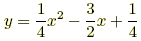
First, rewrite the equation in vertex form y = a(x − h)² + k. Then note that 4p = 1/a (since a = 1/(4p)), so p = 1/(4a). The directrix is the line y = k − p = k − 1/(4a). For example, if y = 2x², then p = 1/8 and the directrix is y = −1/8.
Is the directrix always below the parabola?
No. The directrix is always on the opposite side of the vertex from the focus. For an upward-opening parabola the directrix is below, but for a downward-opening parabola the directrix is above. For horizontal parabolas, the directrix is a vertical line to the left or right of the vertex.
Directrix vs. Focus
Directrix
Focus
Type of object
A line
A point
Position relative to vertex
On the opposite side from where the parabola opens, at distance p from the vertex
Inside the parabola, at distance p from the vertex
Formula (vertical parabola, vertex (h, k))
y = k − p
(h, k + p)
Role in definition
Every point on the parabola is equidistant from this line and the focus
Every point on the parabola is equidistant from this point and the directrix
Why It Matters
You encounter the directrix when studying conic sections in precalculus and analytic geometry courses. It is essential for deriving the equation of a parabola from scratch and for solving problems involving satellite dishes, headlight reflectors, and other applications where the reflective property of parabolas matters. Understanding the directrix also prepares you for the directrix definitions of ellipses and hyperbolas, which use a similar distance-ratio approach.
Common Mistakes
Mistake: Placing the directrix on the same side of the vertex as the focus.
Correction: The directrix is always on the opposite side of the vertex from the focus. If the focus is above the vertex, the directrix is below it (and vice versa). Remember: the vertex sits exactly halfway between the focus and the directrix.
Mistake: Confusing the sign of p when computing the directrix from y = ax².
Correction: When a > 0 the parabola opens upward, so p = 1/(4a) is positive and the directrix y = −p is below the vertex. When a < 0, p is negative and the directrix y = −p is above the vertex. Always check that the directrix ends up on the side opposite the opening.


 with all its major features labeled: