
Chord of a Circle: Definition, Length Formula (2r sin½θ)
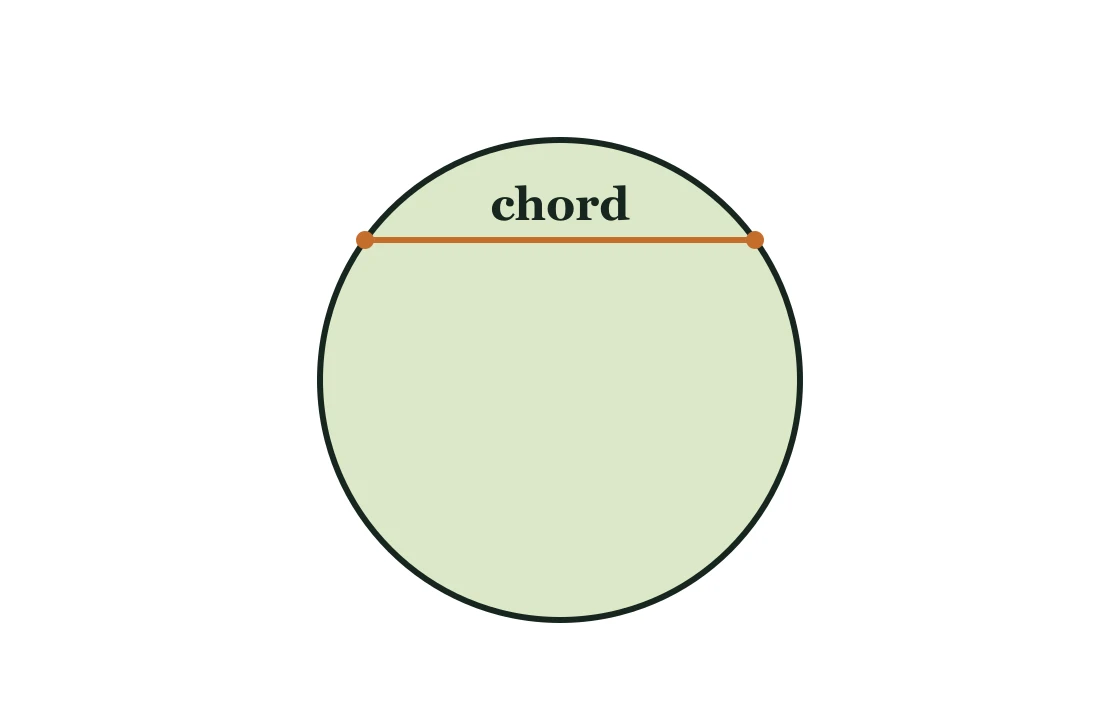
Chord
A line segment on the interior of a circle. A chord has both endpoints on the circle.
See also
Key Formula
d=2rsin(2θ)
Where:
- d = Length of the chord
- r = Radius of the circle
- θ = Central angle (in radians or degrees) subtended by the chord at the center of the circle
Worked Example
Problem: A circle has a radius of 10 cm. Find the length of a chord that subtends a central angle of 60°.
Step 1: Write down the chord length formula.
d=2rsin(2θ)
Step 2: Substitute the known values: r = 10 and θ = 60°.
d=2(10)sin(260°)=20sin(30°)
Step 3: Evaluate the sine value. Recall that sin(30°) = 0.5.
d=20×0.5=10
Answer: The chord length is 10 cm.
Another Example
This example uses the perpendicular-bisector property of chords instead of the central-angle formula, showing an alternative geometric approach.
Problem: A chord is 12 cm long in a circle of radius 10 cm. Find the perpendicular distance from the center of the circle to the chord.
Step 1: Use the relationship between a chord, the radius, and the perpendicular distance from the center. A perpendicular from the center bisects the chord, creating a right triangle with hypotenuse r, one leg equal to half the chord, and the other leg equal to the distance d.
r2=d2+(2c)2
Step 2: Substitute r = 10 and c = 12.
102=d2+(212)2⟹100=d2+36
Step 3: Solve for d.
d2=100−36=64⟹d=8
Answer: The perpendicular distance from the center to the chord is 8 cm.
Frequently Asked Questions
What is the difference between a chord and a diameter?
A diameter is a special chord that passes through the center of the circle. Every diameter is a chord, but not every chord is a diameter. The diameter is always the longest chord in a circle, equal to twice the radius.
What is the difference between a chord and a secant?
A chord is a line segment with both endpoints on the circle. A secant is a full line that intersects the circle at two points and extends infinitely in both directions. You can think of a chord as the finite piece of a secant that lies inside the circle.
How do you find the length of a chord if you know the radius and the distance from the center?
Use the formula c=2r2−d2, where r is the radius and d is the perpendicular distance from the center to the chord. This comes from the Pythagorean theorem applied to the right triangle formed by the radius, half the chord, and the perpendicular distance.
Chord vs. Secant Line
| Chord | Secant Line | |
|---|---|---|
| Definition | A line segment with both endpoints on a circle | A line that intersects a circle at exactly two points |
| Extent | Finite — ends at the circle | Infinite — extends beyond the circle in both directions |
| Contains | Only the interior portion between the two points | The chord segment plus the exterior rays |
| When to use | Finding distances, arcs, and angles inside a circle | Problems involving external points and secant–tangent relationships |
Why It Matters
Chords appear throughout geometry courses whenever you work with circles — from calculating arc lengths to proving angle relationships using inscribed angles and central angles. In coordinate geometry, finding where a line intersects a circle gives you the endpoints of a chord, connecting algebra and geometry. Chords also show up in real-world contexts such as architecture (arches), engineering (bridge design), and music theory (the term 'chord' in music originally came from the same geometric idea of a string stretched across a curve).
Common Mistakes
Mistake: Confusing a chord with an arc.
Correction: A chord is the straight line segment connecting two points on a circle. An arc is the curved part of the circle between those same two points. They connect the same endpoints but follow different paths.
Mistake: Forgetting that the perpendicular from the center bisects the chord.
Correction: This bisection property is a proven theorem: a line drawn from the center of a circle perpendicular to a chord always cuts the chord into two equal halves. Many students set up the Pythagorean theorem using the full chord length instead of half, which doubles the correct answer.
Related Terms
- Circle — The shape on which a chord's endpoints lie
- Line Segment — A chord is a specific type of line segment
- Secant Line — A line extending through both endpoints of a chord
- Diameter — The longest chord, passing through the center
- Radius — Half the diameter; used in chord length formulas
- Central Angle — The angle at the center subtended by a chord
- Interior — A chord lies in the interior of a circle