
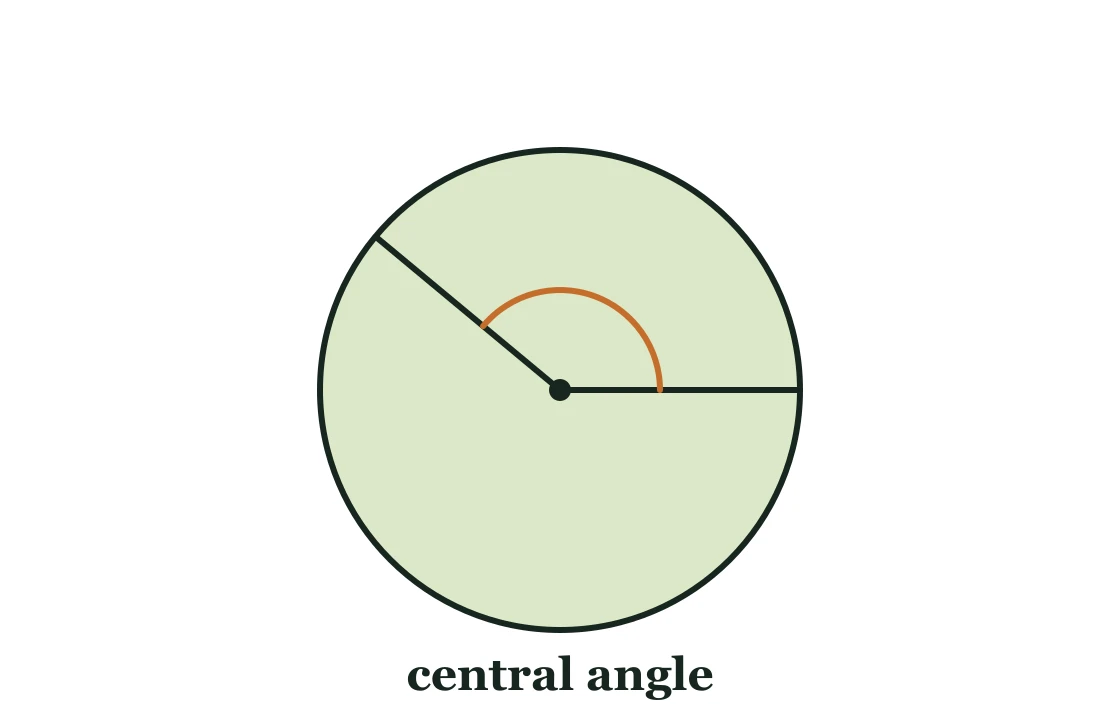
Central Angle — Definition, Formula & Examples
See also
Key Formula
s=rθ
Where:
- s = Arc length intercepted by the central angle
- r = Radius of the circle
- θ = Central angle measured in radians
Worked Example
Problem: A circle has a radius of 10 cm. A central angle measures 72°. Find the length of the arc intercepted by this central angle.
Step 1: Convert the central angle from degrees to radians. Multiply the degree measure by π/180.
θ=72°×180π=18072π=52π radians
Step 2: Write the arc length formula.
s=rθ
Step 3: Substitute r = 10 cm and θ = 2π/5 radians into the formula.
s=10×52π=520π=4π
Step 4: Calculate the numerical value.
s=4π≈12.57 cm
Answer: The intercepted arc length is 4π ≈ 12.57 cm.
Another Example
This example works in reverse — finding the angle from a known arc length and radius — and produces a non-integer degree measure, showing that central angles are not always neat whole numbers.
Problem: A central angle intercepts an arc of length 15 cm on a circle with radius 6 cm. Find the measure of the central angle in both radians and degrees.
Step 1: Rearrange the arc length formula to solve for the central angle.
θ=rs
Step 2: Substitute s = 15 cm and r = 6 cm.
θ=615=2.5 radians
Step 3: Convert radians to degrees by multiplying by 180/π.
θ=2.5×π180≈143.24°
Answer: The central angle measures 2.5 radians, or approximately 143.24°.
Frequently Asked Questions
What is the difference between a central angle and an inscribed angle?
A central angle has its vertex at the center of the circle, while an inscribed angle has its vertex on the circle itself. When both intercept the same arc, the inscribed angle is exactly half the central angle. For example, if a central angle measures 80°, an inscribed angle intercepting the same arc measures 40°.
Is the central angle equal to the arc it intercepts?
Yes, the degree measure of a central angle equals the degree measure of its intercepted arc. If a central angle is 90°, the arc it cuts off is also 90° (a quarter of the full circle). This one-to-one relationship is what makes central angles especially useful for measuring arcs.
Can a central angle be greater than 180 degrees?
Yes. A central angle greater than 180° is called a reflex central angle, and it intercepts a major arc (an arc larger than a semicircle). For instance, if one central angle between two radii is 120°, the reflex central angle going the other way around is 360° − 120° = 240°.
Central Angle vs. Inscribed Angle
| Central Angle | Inscribed Angle | |
|---|---|---|
| Vertex location | At the center of the circle | On the circle itself |
| Formed by | Two radii | Two chords that share an endpoint on the circle |
| Relationship to intercepted arc | Equal to the arc measure | Half the arc measure |
| Formula (arc relationship) | Central angle = arc measure | Inscribed angle = ½ × arc measure |
| Maximum possible measure | Up to 360° (reflex angles included) | Up to 180° (semicircle case) |
Why It Matters
Central angles appear throughout geometry whenever you work with circles — from finding arc lengths and sector areas to analyzing pie charts and clock problems. They form the foundation for the inscribed angle theorem, which states every inscribed angle is half the central angle on the same arc. In trigonometry and physics, central angles measured in radians connect angular rotation to linear distance through the formula s = rθ.
Common Mistakes
Mistake: Using degrees in the arc length formula s = rθ instead of radians.
Correction: The formula s = rθ requires θ in radians. Always convert degrees to radians first by multiplying by π/180. For example, 90° must become π/2 before substituting into the formula.
Mistake: Confusing the central angle with the inscribed angle that intercepts the same arc.
Correction: An inscribed angle is half the central angle for the same arc. If you see a vertex on the circle (not at the center), you must double the angle to find the corresponding arc measure.
Related Terms
- Angle — General concept; central angle is a specific type
- Circle — The shape in which central angles are defined
- Vertex — The center point where the two radii meet
- Arc of a Circle — The arc intercepted by a central angle
- Radius — The two rays forming a central angle are radii
- Sector — Region bounded by two radii and an arc
- Inscribed Angle — Equals half the central angle on the same arc
- Radian — Unit of angle measure used in arc length formula