
Secant Line: Equation & Slope Formula (a, f(a)) to (b, f(b))
Secant Line
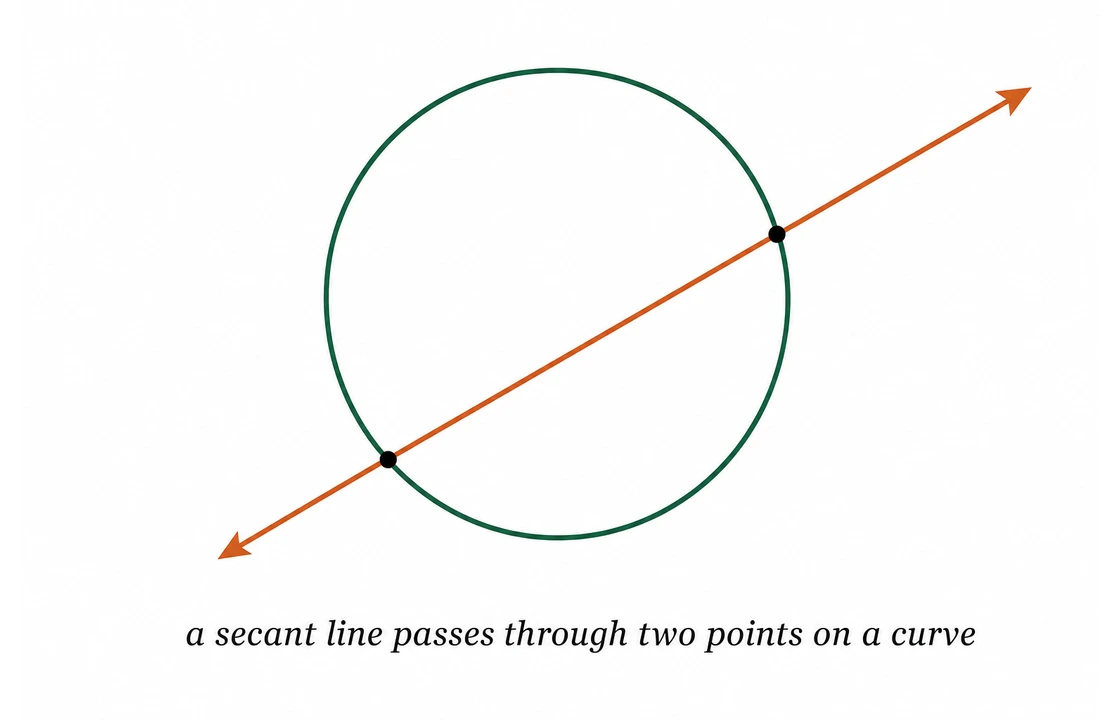
A line which passes through at least two points of a curve. Note: If the two points are close together, the secant line is nearly the same as a tangent line.
See also
Key Formula
msec=x2−x1f(x2)−f(x1)
Where:
- msec = Slope of the secant line
- f(x1) = Value of the function at the first point
- f(x2) = Value of the function at the second point
- x1 = x-coordinate of the first point on the curve
- x2 = x-coordinate of the second point on the curve
Worked Example
Problem: Find the equation of the secant line to f(x) = x² that passes through the points where x = 1 and x = 3.
Step 1: Evaluate the function at both x-values to find the two points.
f(1)=12=1andf(3)=32=9
Step 2: The two points on the curve are (1, 1) and (3, 9). Use the secant slope formula.
msec=3−19−1=28=4
Step 3: Use point-slope form with the point (1, 1) to write the equation of the line.
y−1=4(x−1)
Step 4: Simplify to slope-intercept form.
y=4x−3
Answer: The secant line is y = 4x − 3, with a slope of 4.
Another Example
This example uses a variable second point (2 + h) instead of two fixed numbers, showing how the secant line leads directly to the definition of the derivative.
Problem: Find the slope of the secant line to f(x) = x² between x = 2 and x = 2 + h, and show what happens as h approaches 0.
Step 1: Evaluate the function at x = 2 and x = 2 + h.
f(2)=4andf(2+h)=(2+h)2=4+4h+h2
Step 2: Apply the secant slope formula using these two points.
msec=(2+h)−2(4+4h+h2)−4=h4h+h2
Step 3: Simplify by factoring h from the numerator and cancelling (valid since h ≠ 0).
msec=hh(4+h)=4+h
Step 4: As h → 0, the secant slope approaches the tangent slope (the derivative).
h→0lim(4+h)=4
Answer: The secant slope is 4 + h. As h → 0, it approaches 4, which equals f′(2) — the slope of the tangent line at x = 2.
Frequently Asked Questions
What is the difference between a secant line and a tangent line?
A secant line intersects a curve at two distinct points and measures the average rate of change between them. A tangent line touches the curve at exactly one point (locally) and measures the instantaneous rate of change at that point. The tangent line is the limit of the secant line as the two points merge into one.
What is the difference between a secant line and a chord?
A chord is the line segment between two points on a curve — it has finite length and endpoints. A secant line passes through the same two points but extends infinitely in both directions. Every chord lies on a secant line, but the secant line itself is not bounded.
How is a secant line related to the derivative?
The slope of a secant line gives the average rate of change of a function over an interval. When you shrink that interval to zero width by taking a limit, the secant slope becomes the derivative. This is exactly how the derivative is formally defined: as the limit of the difference quotient.
Secant Line vs. Tangent Line
| Secant Line | Tangent Line | |
|---|---|---|
| Definition | A line through two points on a curve | A line that touches a curve at one point, matching its direction |
| Points of intersection | At least two points on the curve | One point (locally), though it may cross the curve elsewhere |
| Slope formula | (f(x₂) − f(x₁)) / (x₂ − x₁) | f′(a) = lim as x₂ → x₁ of the secant slope |
| What it measures | Average rate of change over an interval | Instantaneous rate of change at a single point |
| When to use | Estimating rates of change; building toward the derivative | Finding the exact slope of a curve at a specific point |
Why It Matters
Secant lines appear throughout pre-calculus and calculus. In pre-calculus, you use them to calculate average rates of change — for instance, the average velocity of an object over a time interval. In calculus, shrinking the secant line to a tangent line is the central idea behind the limit definition of the derivative, so understanding secant lines is essential before you can work with derivatives.
Common Mistakes
Mistake: Confusing the secant line (a geometry/calculus concept) with the secant function (sec θ = 1/cos θ in trigonometry).
Correction: These share the Latin root 'secare' (to cut), but they are different concepts. The secant line is a line through two points on a curve; the secant function is a trigonometric ratio. Context will tell you which is meant.
Mistake: Subtracting the x- and y-values in the wrong order when computing the slope, such as writing (f(x₂) − f(x₁)) / (x₁ − x₂).
Correction: The order must be consistent: if you subtract x₁ from x₂ in the denominator, you must subtract f(x₁) from f(x₂) in the numerator. Swapping one but not the other gives the wrong sign.
Related Terms
- Tangent Line — Limiting case of a secant line
- Chord — Finite segment between two curve points
- Line — General concept a secant line is
- Curve — The graph the secant line intersects
- Point — Secant line passes through two points
- Slope — Secant slope is average rate of change
- Derivative — Limit of the secant slope
- Difference Quotient — Another name for the secant slope formula