
Diameter of a Circle: Formula d = 2r, Definition & Examples
Diameter of a Circle or Sphere
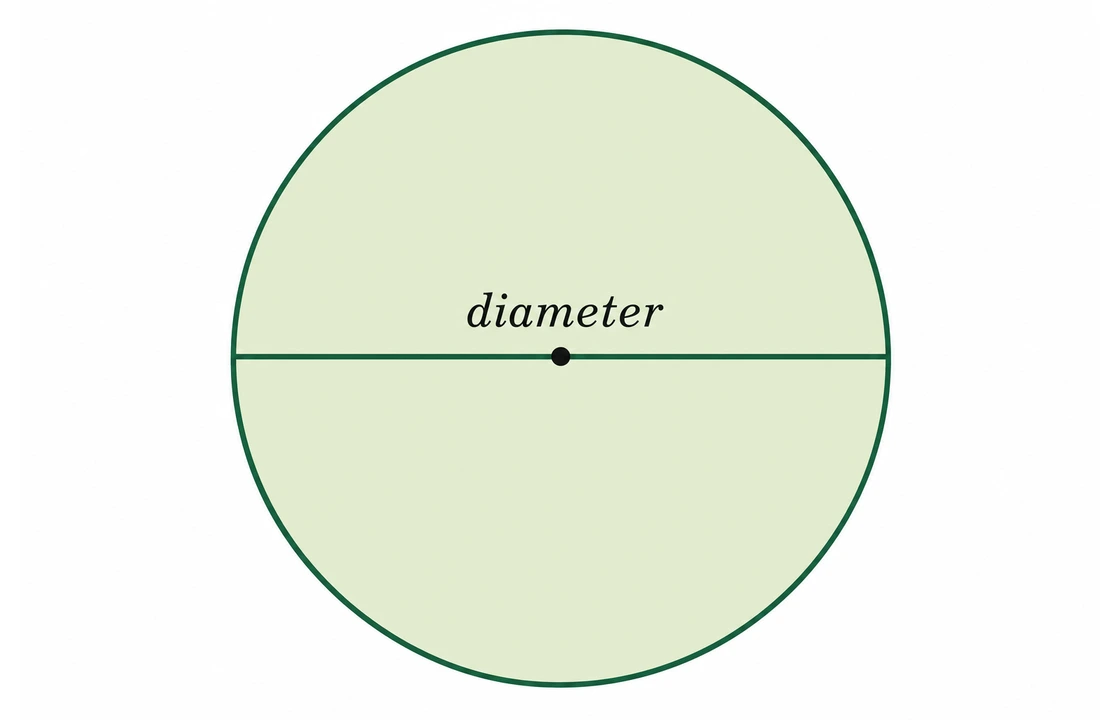
A line segment between two points on the circle or sphere which passes through the center. The word diameter also refers to the length of this line segment.
See also
Key Formula
d=2r
Where:
- d = Diameter — the length of the line segment passing through the center
- r = Radius — the distance from the center to any point on the circle or sphere
Worked Example
Problem: A circle has a radius of 7 cm. Find the diameter, the circumference, and the area of the circle.
Step 1: Use the diameter formula to find the diameter from the radius.
d=2r=2×7=14 cm
Step 2: Calculate the circumference using the diameter. The circumference formula can be written as C = πd.
C=πd=π×14=14π≈43.98 cm
Step 3: Calculate the area using the radius. You could also substitute d/2 for r.
A=πr2=π×72=49π≈153.94 cm2
Answer: The diameter is 14 cm, the circumference is approximately 43.98 cm, and the area is approximately 153.94 cm².
Another Example
This example applies the diameter concept to a sphere (3D) instead of a circle (2D), and works from diameter to radius rather than radius to diameter.
Problem: A sphere has a diameter of 20 meters. Find its radius, surface area, and volume.
Step 1: Find the radius by rearranging the diameter formula.
r=2d=220=10 m
Step 2: Calculate the surface area of the sphere.
S=4πr2=4π×102=400π≈1,256.64 m2
Step 3: Calculate the volume of the sphere.
V=34πr3=34π×103=34,000π≈4,188.79 m3
Answer: The radius is 10 m, the surface area is approximately 1,256.64 m², and the volume is approximately 4,188.79 m³.
Frequently Asked Questions
What is the difference between diameter and radius?
The radius is the distance from the center of a circle or sphere to any point on its edge, while the diameter is the distance across the full shape through the center. The diameter is always exactly twice the radius: d = 2r. If you know one, you can immediately find the other.
How do you find the diameter of a circle from its circumference?
Since the circumference formula is C = πd, you can solve for the diameter by dividing the circumference by π: d = C / π. For example, if a circle has a circumference of 31.4 cm, then d = 31.4 / π ≈ 10 cm.
Is the diameter the longest chord of a circle?
Yes. A chord is any line segment with both endpoints on the circle, and the diameter is the special chord that passes through the center. Because it goes through the center, no other chord can be longer. Every diameter is a chord, but not every chord is a diameter.
Diameter vs. Radius
| Diameter | Radius | |
|---|---|---|
| Definition | Line segment through the center with endpoints on the circle/sphere | Line segment from the center to any point on the circle/sphere |
| Formula | d = 2r | r = d / 2 |
| Relative size | Twice the radius | Half the diameter |
| In circumference formula | C = πd | C = 2πr |
| In area formula | A = π(d/2)² | A = πr² |
Why It Matters
The diameter appears constantly in geometry problems involving circles and spheres — from computing circumference and area to working with arcs, sectors, and volume. In everyday life, pipes, wheels, balls, and coins are all specified by diameter, so converting between diameter, radius, and circumference is a practical skill. Standardized tests frequently require you to move between diameter and radius quickly, so knowing d = 2r by heart saves time.
Common Mistakes
Mistake: Using the diameter where the radius is needed (or vice versa) in area and volume formulas.
Correction: The area formula for a circle is A = πr², not A = πd². If you are given the diameter, divide by 2 first to get the radius before substituting. Forgetting this step quadruples your answer.
Mistake: Thinking every chord is a diameter.
Correction: A chord only qualifies as a diameter if it passes through the center of the circle. Many chords connect two points on a circle without going through the center, and these are shorter than the diameter.
Related Terms
- Radius of a Circle or Sphere — Half the diameter; the most closely linked measurement
- Circle — The 2D shape whose diameter is defined
- Sphere — The 3D shape whose diameter is defined
- Line Segment — The geometric object that a diameter is
- Point — Endpoints of the diameter lie on the circle/sphere
- Circumference — Calculated directly from diameter as C = πd
- Chord — Diameter is the longest possible chord of a circle