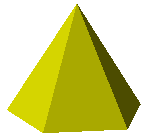
s = Slant height — the distance from the apex to the midpoint of a base edge, measured along a lateral face
B = Area of the regular polygon base
h = Height (altitude) of the pyramid — the perpendicular distance from the apex to the base
V = Volume of the pyramid
Worked Example
Problem: A right regular pyramid has a square base with side length 10 cm and a slant height of 13 cm. Find the lateral surface area, total surface area, and volume.
Step 1: Find the perimeter and area of the square base.
P=4×10=40 cmB=102=100 cm2
Step 2: Calculate the lateral surface area using the formula.
LSA=21Ps=21(40)(13)=260 cm2
Step 3: Calculate the total surface area by adding the base area.
TSA=260+100=360 cm2
Step 4: Find the height using the Pythagorean theorem. The slant height, the height, and half the base side form a right triangle (since the base is a square, the apothem equals half the side length, which is 5 cm).
h=s2−a2=132−52=169−25=144=12 cm
Step 5: Calculate the volume.
V=31Bh=31(100)(12)=400 cm3
Answer: Lateral surface area = 260 cm², total surface area = 360 cm², volume = 400 cm³.
Another Example
This example uses a hexagonal base instead of a square, showing how to compute the apothem and how to find the slant height from the pyramid's height rather than having it given directly.
Problem: A right regular pyramid has a regular hexagonal base with side length 6 cm and a height of 8 cm. Find the slant height, lateral surface area, and volume.
Step 1: Find the apothem of the regular hexagonal base. For a regular hexagon with side length a, the apothem is a√3/2.
apothem=263=33≈5.196 cm
Step 2: Find the slant height using the Pythagorean theorem. The height, the apothem of the base, and the slant height form a right triangle.
s=h2+(33)2=64+27=91≈9.539 cm
Step 3: Find the perimeter and area of the hexagonal base. A regular hexagon with side a has perimeter 6a and area (3√3/2)a².
P=6×6=36 cmB=233(62)=543≈93.53 cm2
Step 4: Calculate the lateral surface area.
LSA=21Ps=21(36)(91)=1891≈171.7 cm2
Step 5: Calculate the volume.
V=31Bh=31(543)(8)=1443≈249.4 cm3
Answer: Slant height ≈ 9.54 cm, lateral surface area ≈ 171.7 cm², volume ≈ 249.4 cm³.
Frequently Asked Questions
What is the difference between a right pyramid and a right regular pyramid?
A right pyramid has its apex directly above the centroid of its base, but the base can be any polygon. A right regular pyramid adds the requirement that the base must be a regular polygon (all sides and angles equal). So every right regular pyramid is a right pyramid, but not every right pyramid is a right regular pyramid.
How do you find the slant height of a right regular pyramid?
The slant height connects the apex to the midpoint of a base edge. It forms a right triangle with the pyramid's height and the apothem of the base. Use the Pythagorean theorem: s=h2+a2, where h is the height and a is the apothem of the regular polygon base.
Why does the formula ½Ps work for lateral surface area?
Each lateral face of a right regular pyramid is a congruent isosceles triangle with base equal to one side of the polygon and height equal to the slant height. The area of one triangle is ½ × (side) × s. When you add all the triangles together, the sum of all the sides equals the perimeter P, giving ½Ps for the total lateral area.
Right Regular Pyramid vs. Oblique Pyramid
Right Regular Pyramid
Oblique Pyramid
Apex position
Directly above the center of the base
Not directly above the center of the base
Base requirement
Must be a regular polygon
Can be any polygon
Lateral faces
All congruent isosceles triangles
Triangles of different shapes and sizes
Lateral surface area formula
½Ps (simple formula applies)
Must calculate each face individually
Height measurement
Perpendicular from apex to center of base
Perpendicular from apex to base plane (not through center)
Why It Matters
Right regular pyramids appear frequently in geometry courses when studying three-dimensional solids, surface area, and volume. The Great Pyramid of Giza is a real-world example — a right regular pyramid with a square base. Understanding this shape also prepares you for more advanced topics like cross-sections of solids and calculus-based volume integration.
Common Mistakes
Mistake: Confusing the slant height with the lateral edge or the pyramid's height.
Correction: The slant height runs from the apex to the midpoint of a base edge (along a face). The lateral edge runs from the apex to a vertex of the base. The height is the perpendicular distance from the apex straight down to the base. These are three different measurements — draw and label a diagram to keep them straight.
Mistake: Using the height instead of the slant height in the lateral surface area formula.
Correction: The formula LSA = ½Ps requires the slant height s, not the vertical height h. If you are given only h, first find the apothem of the base, then compute s = √(h² + a²) before plugging into the formula.
Related Terms
Right Pyramid — Parent category — apex above base centroid