
Regular Pyramid — Definition, Formula & Examples
Regular Pyramid
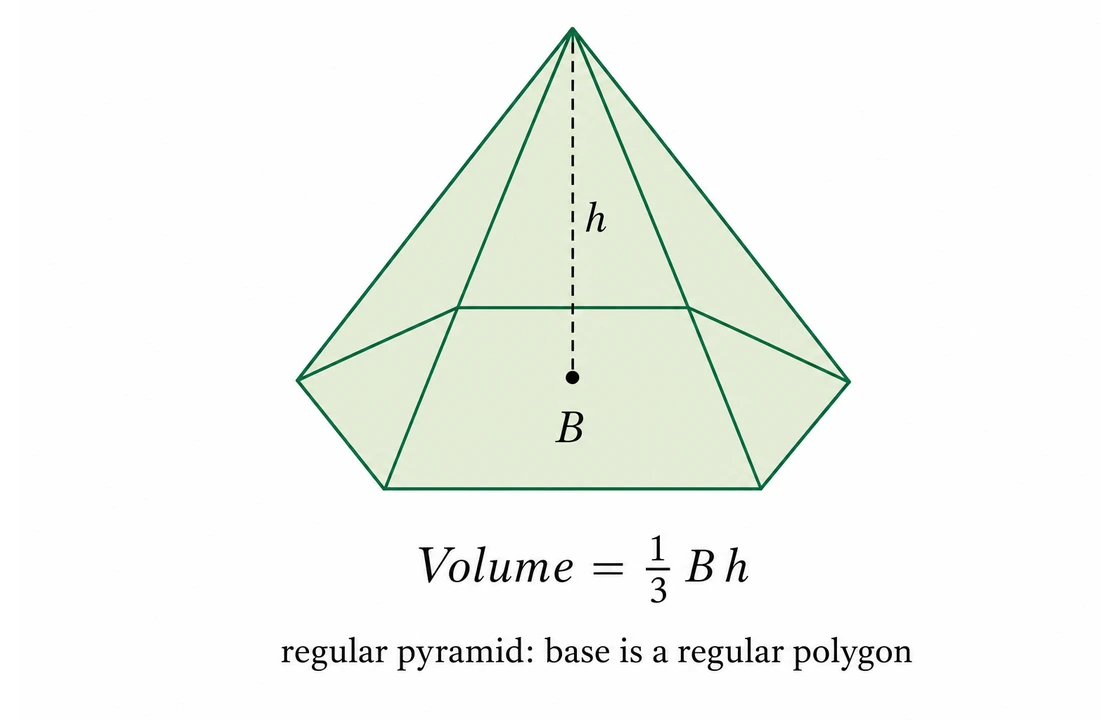
A pyramid with a base that is a regular polygon. The apex is not necessarily directly above the center of the base.
Note: For some mathematicians regular pyramid means the same as right regular pyramid.
See also
Key Formula
V=31Bh
Where:
- V = Volume of the pyramid
- B = Area of the regular polygon base
- h = Perpendicular height from the base to the apex (altitude of the pyramid)
Worked Example
Problem: A regular pyramid has a square base with side length 6 cm and a height of 10 cm. Find its volume.
Step 1: Identify the base shape. The base is a square with side length 6 cm, which is a regular polygon (all four sides equal, all angles 90°).
Step 2: Calculate the area of the square base.
B=s2=62=36 cm2
Step 3: Apply the pyramid volume formula using the base area and the given height.
V=31Bh=31(36)(10)
Step 4: Compute the volume.
V=3360=120 cm3
Answer: The volume of the regular pyramid is 120 cm³.
Another Example
This example uses a hexagonal base instead of a square, showing how you need the area formula for a different regular polygon before applying the same volume formula.
Problem: A regular pyramid has a regular hexagonal base with side length 4 cm and a height of 9 cm. Find its volume.
Step 1: Recall the area formula for a regular hexagon with side length s.
B=233s2
Step 2: Substitute s = 4 cm into the hexagon area formula.
B=233(4)2=233(16)=243 cm2
Step 3: Apply the pyramid volume formula with h = 9 cm.
V=31Bh=31(243)(9)=723 cm3
Step 4: Approximate the result if needed.
V≈72(1.732)≈124.7 cm3
Answer: The volume is 723≈124.7 cm³.
Frequently Asked Questions
What is the difference between a regular pyramid and a right regular pyramid?
A regular pyramid only requires that the base is a regular polygon. A right regular pyramid additionally requires that the apex lies directly above the center of the base, so the altitude drops perpendicularly to the centroid. Many textbooks treat these terms as synonymous, but strictly a regular pyramid can be oblique (tilted) as long as the base is regular.
How do you find the surface area of a regular pyramid?
For a right regular pyramid, the total surface area is the base area plus the lateral area. The lateral area equals 21Pl, where P is the perimeter of the base and l is the slant height. So the total surface area is SA=B+21Pl. If the pyramid is oblique, each lateral face may have a different area and must be calculated individually.
Can a triangle be the base of a regular pyramid?
Yes. If the base is an equilateral triangle (which is a regular polygon with three equal sides), the pyramid is a regular pyramid. A regular pyramid with an equilateral triangular base where all four faces are equilateral triangles is called a regular tetrahedron.
Regular Pyramid vs. Right Regular Pyramid
| Regular Pyramid | Right Regular Pyramid | |
|---|---|---|
| Base requirement | Must be a regular polygon | Must be a regular polygon |
| Apex position | Can be anywhere above or beside the base | Must be directly above the center of the base |
| Lateral faces | Triangles (not necessarily congruent) | Congruent isosceles triangles |
| Volume formula | V = (1/3)Bh | V = (1/3)Bh |
| Slant height | May differ for each face | Same for all lateral faces |
Why It Matters
Regular pyramids appear frequently in geometry courses when studying three-dimensional solids, surface area, and volume. They also show up in real-world structures—the Great Pyramid of Giza, for instance, has a nearly square (regular polygon) base. Understanding how the base shape affects formulas for area and volume is a key skill tested in standardized exams.
Common Mistakes
Mistake: Confusing height (h) with slant height (l).
Correction: The height h is the perpendicular distance from the base to the apex, measured inside the pyramid. The slant height l runs along a lateral face from the apex to the midpoint of a base edge. Using slant height in the volume formula gives the wrong answer. For volume, always use the perpendicular height.
Mistake: Assuming every regular pyramid is also a right pyramid.
Correction: A regular pyramid only requires a regular polygon base. The apex does not have to be centered above the base. If a problem says 'regular pyramid,' check whether the apex is centered before using slant-height shortcuts that assume congruent lateral faces.
Related Terms
- Pyramid — General category that includes regular pyramids
- Right Regular Pyramid — A regular pyramid with apex centered over base
- Regular Polygon — Shape required for the base
- Apex — The top vertex of the pyramid
- Altitude of a Pyramid — The perpendicular height h used in volume
- Volume — Computed using V = (1/3)Bh
- Area of a Regular Polygon — Used to find base area B
- Right Pyramid — Apex directly above centroid; base need not be regular