
Right Regular Prism — Definition, Formula & Examples
Right Regular Prism
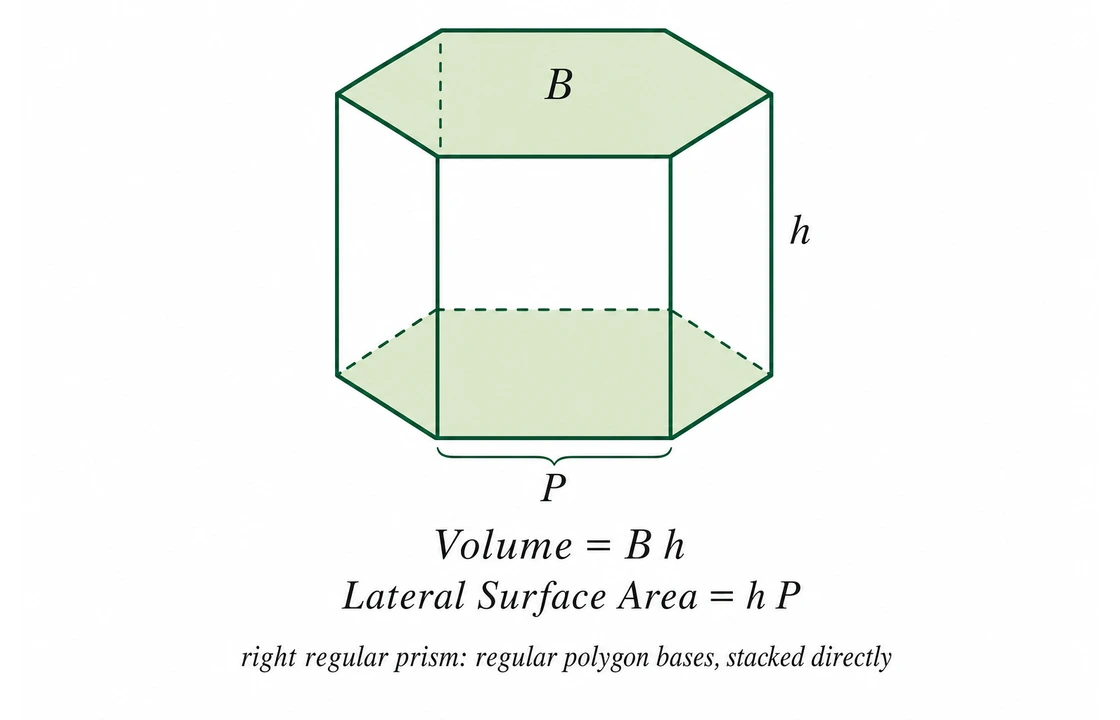
A right prism with bases that are regular polygons.
See also
Prism, right square prism, hexagon, height of a prism, perimeter, volume, lateral surface, lateral surface area, surface area
Key Formula
V=B⋅hSA=2B+P⋅h
Where:
- V = Volume of the prism
- B = Area of one regular-polygon base
- h = Height (altitude) of the prism — the perpendicular distance between the two bases
- SA = Total surface area of the prism
- P = Perimeter of one base
Worked Example
Problem: A right regular hexagonal prism has a base edge length of 4 cm and a height of 10 cm. Find its volume and total surface area.
Step 1: Find the area of the regular hexagonal base. The area of a regular hexagon with side length s is:
B=233s2=233(4)2=233⋅16=243≈41.57cm2
Step 2: Compute the volume using V = B · h.
V=243⋅10=2403≈415.69cm3
Step 3: Find the perimeter of the hexagonal base. A regular hexagon has 6 equal sides.
P=6×4=24cm
Step 4: Compute the lateral surface area (the area of the six rectangular faces).
Lateral Area=P⋅h=24×10=240cm2
Step 5: Compute the total surface area by adding the two bases and the lateral area.
SA=2B+P⋅h=2(243)+240=483+240≈323.14cm2
Answer: Volume ≈ 415.69 cm³ and total surface area ≈ 323.14 cm².
Another Example
This example works backward from a known surface area to find the height, demonstrating how to rearrange the surface area formula. It also uses a triangular base instead of a hexagonal one.
Problem: A right regular triangular prism has a total surface area of 108 + 12√3 cm² and a base edge length of 4 cm. Find the height of the prism.
Step 1: Find the area of the equilateral-triangle base with side length 4 cm.
B=43s2=43(4)2=43cm2
Step 2: Find the perimeter of the base.
P=3×4=12cm
Step 3: Set up the surface area equation and substitute known values.
SA=2B+P⋅h⟹108+123=2(43)+12h
Step 4: Solve for h. Simplify the right side and isolate h.
108+123=83+12h⟹12h=108+43⟹h=9+33
Answer: The height of the prism is 9 + √3/3 ≈ 9.577 cm.
Frequently Asked Questions
What is the difference between a right prism and a right regular prism?
A right prism has lateral edges perpendicular to its bases, but the bases can be any polygon (even an irregular one). A right regular prism adds the requirement that the bases are regular polygons — polygons with all sides equal and all interior angles equal. So every right regular prism is a right prism, but not every right prism is a right regular prism.
Is a cube a right regular prism?
Yes. A cube can be viewed as a right regular prism whose bases are squares (a regular 4-sided polygon) and whose height equals the side length of the base. It is a special case of a right square prism where all edges are equal.
How do you find the lateral surface area of a right regular prism?
Multiply the perimeter of the base by the height of the prism: Lateral Area = P · h. Because all base edges are equal in a regular polygon with n sides and edge length s, this simplifies to Lateral Area = n · s · h. Each of the n rectangular lateral faces has area s × h.
Right Regular Prism vs. Oblique Prism
| Right Regular Prism | Oblique Prism | |
|---|---|---|
| Lateral edges | Perpendicular to the bases | Tilted (not perpendicular) to the bases |
| Lateral faces | Rectangles | Parallelograms (not necessarily rectangles) |
| Base shape | Regular polygon (all sides and angles equal) | Any polygon |
| Volume formula | V = B · h (h is the prism's height and equals the lateral edge length) | V = B · h (h is the perpendicular distance between bases, not the lateral edge length) |
| Lateral surface area | P · h (simple product) | Requires finding the slant height of each parallelogram face |
Why It Matters
Right regular prisms appear frequently in geometry courses when students study three-dimensional solids, surface area, and volume. They also serve as the foundation for understanding more complex solids like antiprisms and cylinders (which can be thought of as prisms with infinitely many sides). In real life, many everyday objects — hexagonal pencils, triangular Toblerone boxes, and square columns — are right regular prisms.
Common Mistakes
Mistake: Confusing the height of the prism with the slant height or the apothem of the base.
Correction: In a right regular prism the height h is the perpendicular distance between the two bases (equal to the lateral edge length). The apothem is the distance from the center of the base polygon to the midpoint of a side and is used only when computing the base area.
Mistake: Forgetting to include both bases when calculating total surface area.
Correction: The total surface area formula is SA = 2B + P · h. Students sometimes compute only P · h (the lateral area) and forget to add the two base areas (2B).
Related Terms
- Right Prism — Parent category — bases need not be regular
- Prism — General solid with two congruent parallel bases
- Regular Polygon — Shape of the bases in this prism
- Base — The two congruent polygonal faces of the prism
- Right Square Prism — Special case with square bases
- Lateral Surface Area — Area of the rectangular side faces
- Surface Area — Total area including bases and lateral faces
- Volume — Space enclosed, found with V = B · h