
Right Prism: Definition, Volume Formula V = Bh & Examples
Right Prism
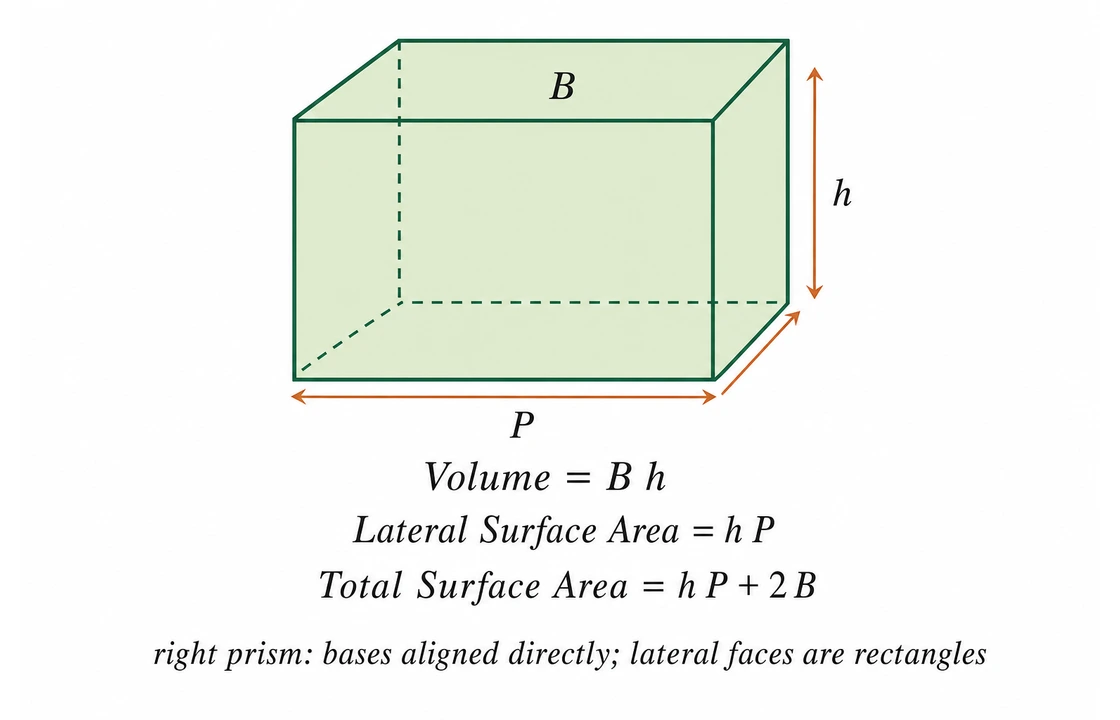
A prism which has bases aligned one directly above the other and has lateral faces that are rectangles.
See also
Oblique prism, right regular prism, right square prism, height of a prism, perimeter, volume, lateral surface, lateral surface area, surface area
Key Formula
V=B⋅hSA=2B+P⋅h
Where:
- V = Volume of the right prism
- B = Area of one base
- h = Height of the prism (distance between bases, equal to the lateral edge length)
- SA = Total surface area of the right prism
- P = Perimeter of one base
Worked Example
Problem: A right triangular prism has a base that is a right triangle with legs of 3 cm and 4 cm. The height of the prism is 10 cm. Find the volume, lateral surface area, and total surface area.
Step 1: Find the area of the triangular base. The base is a right triangle with legs 3 cm and 4 cm.
B=21(3)(4)=6 cm2
Step 2: Calculate the volume using V = B · h.
V=6×10=60 cm3
Step 3: Find the perimeter of the base. The hypotenuse of the right triangle is √(3² + 4²) = 5 cm.
P=3+4+5=12 cm
Step 4: Calculate the lateral surface area. Since this is a right prism, every lateral face is a rectangle.
LSA=P⋅h=12×10=120 cm2
Step 5: Calculate the total surface area by adding the two bases to the lateral surface area.
SA=2B+LSA=2(6)+120=132 cm2
Answer: The volume is 60 cm³, the lateral surface area is 120 cm², and the total surface area is 132 cm².
Another Example
This example uses a regular hexagonal base instead of a triangle, showing that the same right prism formulas apply regardless of the polygon shape. It also involves an irrational number (√3), which is common in problems with regular polygons.
Problem: A right hexagonal prism has a regular hexagon base with side length 6 cm and a height of 8 cm. Find the volume and total surface area.
Step 1: Find the area of a regular hexagon with side length s = 6 cm using the formula for a regular hexagon.
B=233s2=233(6)2=233(36)=543≈93.53 cm2
Step 2: Calculate the volume.
V=B⋅h=543×8=4323≈748.25 cm3
Step 3: Find the perimeter of the regular hexagon (6 sides, each of length 6 cm).
P=6×6=36 cm
Step 4: Calculate the total surface area.
SA=2B+P⋅h=2(543)+36(8)=1083+288≈475.06 cm2
Answer: The volume is 432√3 ≈ 748.25 cm³ and the total surface area is 108√3 + 288 ≈ 475.06 cm².
Frequently Asked Questions
What is the difference between a right prism and an oblique prism?
In a right prism, the lateral edges are perpendicular to the bases, so the lateral faces are rectangles and the bases sit directly above each other. In an oblique prism, the lateral edges are tilted at an angle to the bases, making the lateral faces parallelograms (not necessarily rectangles). Both types use V = B · h for volume, but for an oblique prism, h is the perpendicular distance between the bases, not the lateral edge length.
Is a rectangular box a right prism?
Yes. A rectangular box (also called a rectangular prism or cuboid) is a right prism whose bases are rectangles. Since the lateral faces are also rectangles and the bases are aligned directly above each other, it satisfies all conditions of a right prism. A cube is a special case where all six faces are squares.
How do you find the lateral surface area of a right prism?
Multiply the perimeter of the base by the height of the prism: LSA = P · h. This works because each lateral face is a rectangle, and when you 'unwrap' all the lateral faces, they form one large rectangle with width equal to the base perimeter and height equal to the prism height.
Right Prism vs. Oblique Prism
| Right Prism | Oblique Prism | |
|---|---|---|
| Lateral edges | Perpendicular to the bases | Tilted at an angle to the bases |
| Lateral faces | Rectangles | Parallelograms |
| Height vs. lateral edge | Height equals the lateral edge length | Height is shorter than the lateral edge length |
| Volume formula | V = B · h (h = lateral edge length) | V = B · h (h = perpendicular distance between bases) |
| Lateral surface area | LSA = P · h | Requires computing each parallelogram face individually |
Why It Matters
Right prisms appear throughout geometry courses when you study three-dimensional shapes, surface area, and volume. Many everyday objects — boxes, aquariums, tent shapes, and structural beams — are modeled as right prisms. Understanding the right prism formulas also prepares you for working with cylinders (a right circular prism) and for comparing right vs. oblique solids in more advanced geometry.
Common Mistakes
Mistake: Confusing the height of the prism with the slant height of a lateral edge in oblique prism problems.
Correction: For a right prism, the height and the lateral edge length are the same. However, when a problem involves an oblique prism, the height is the perpendicular distance between the two bases, which is shorter than the lateral edge. Always check whether the prism is right or oblique before applying formulas.
Mistake: Forgetting to include both bases when calculating total surface area.
Correction: The total surface area formula is SA = 2B + P · h. A common error is writing SA = B + P · h, which accounts for only one base. Remember that a prism has two congruent bases, so you must double the base area.
Related Terms
- Oblique Prism — Prism with tilted lateral edges, contrasts with right prism
- Right Regular Prism — Right prism whose bases are regular polygons
- Right Square Prism — Right prism with square bases (special case)
- Base — The two congruent polygons forming the prism's ends
- Lateral Surface Area — Area of the rectangular side faces of a right prism
- Surface Area — Total area including both bases and lateral faces
- Volume — Computed as base area times height for any prism
- Perimeter — Base perimeter used in lateral surface area formula