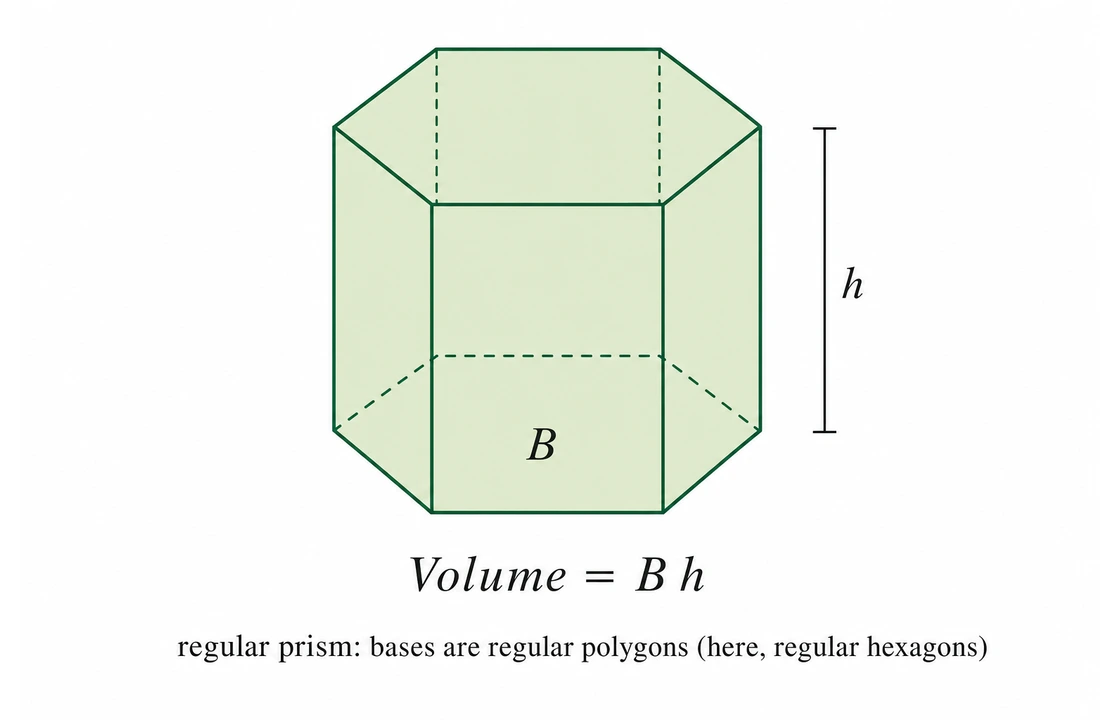
A prism with bases that are regular
polygons.
The bases are not necessarily aligned one directly above the other.
Note: For some mathematicians regular prism means the same as right
regular prism.
h = Height (altitude) of the prism — the perpendicular distance between the two bases
SA = Total surface area of the prism
P = Perimeter of the regular-polygon base
l = Lateral edge length (slant length of a lateral face); equals h when the prism is a right prism
Worked Example
Problem: Find the volume and total surface area of a right regular hexagonal prism whose base edge is 4 cm and whose height is 10 cm.
Step 1: Find the area of the regular hexagonal base. A regular hexagon with side length s has area:
B=233s2=233(4)2=233⋅16=243≈41.57cm2
Step 2: Compute the volume using V = B · h.
V=243⋅10=2403≈415.69cm3
Step 3: Find the perimeter of the hexagonal base.
P=6s=6(4)=24cm
Step 4: For a right prism the lateral edge length l equals the height h, so compute the lateral area.
Lateral Area=P⋅l=24⋅10=240cm2
Step 5: Add the two bases to get the total surface area.
SA=2B+240=2(243)+240=483+240≈323.14cm2
Answer: Volume ≈ 415.69 cm³ and total surface area ≈ 323.14 cm².
Another Example
This example uses the simplest regular polygon (equilateral triangle) as the base, contrasting with the hexagonal base in the first example. It shows how the same formulas apply regardless of how many sides the base has.
Problem: A right regular triangular prism (equilateral-triangle bases) has a base edge of 6 cm and a height of 8 cm. Find its volume and total surface area.
Step 1: Find the area of one equilateral-triangle base with side s = 6 cm.
B=43s2=43(6)2=43⋅36=93≈15.59cm2
Step 2: Compute the volume.
V=B⋅h=93⋅8=723≈124.71cm3
Step 3: Find the perimeter and lateral area.
P=3(6)=18cm,Lateral Area=18⋅8=144cm2
Step 4: Compute the total surface area.
SA=2(93)+144=183+144≈175.18cm2
Answer: Volume ≈ 124.71 cm³ and total surface area ≈ 175.18 cm².
Frequently Asked Questions
What is the difference between a regular prism and a right prism?
A regular prism requires the bases to be regular polygons (all sides and angles equal), but the lateral edges do not have to be perpendicular to the bases. A right prism requires the lateral edges to be perpendicular to the bases, but the bases can be any polygon — they need not be regular. A right regular prism satisfies both conditions.
Is a cube a regular prism?
Yes. A cube has square bases (a square is a regular polygon) and its lateral edges are perpendicular to the bases, so it is a right regular prism. Every edge of a cube has the same length, making it the most symmetric example of a regular prism.
How do you find the volume of a regular prism?
Use V = B · h, where B is the area of the regular polygon base and h is the perpendicular distance between the two bases. First calculate B using the appropriate regular polygon area formula, then multiply by h.
Regular Prism vs. Right Regular Prism
Regular Prism
Right Regular Prism
Base requirement
Bases must be regular polygons
Bases must be regular polygons
Lateral edges
May be oblique (tilted) relative to the bases
Must be perpendicular to the bases
Lateral faces
Parallelograms (not necessarily rectangles)
Rectangles
Volume formula
V = B · h (h = perpendicular height)
V = B · h (h = lateral edge length, since edge ⊥ base)
Surface area
Lateral area uses slant length of the parallelogram faces
SA = 2B + P · h (simpler because faces are rectangles)
Why It Matters
Regular prisms appear throughout geometry courses when you study surface area and volume of 3-D shapes. Packaging, structural columns, and honeycomb cross-sections are real-world examples built on regular-polygon cross sections. Understanding regular prisms also prepares you for working with antiprisms, regular polyhedra, and more complex solid geometry problems.
Common Mistakes
Mistake: Confusing the height (altitude) with the lateral edge length in an oblique regular prism.
Correction: The height h is always the perpendicular distance between the two base planes. In an oblique prism the lateral edge is longer than h. Always use the perpendicular height in the volume formula V = B · h.
Mistake: Assuming a right prism is automatically a regular prism.
Correction: A right prism only guarantees that lateral edges are perpendicular to the bases. If the bases are irregular polygons (e.g., a non-equilateral triangle), the prism is right but not regular. Both conditions — right angles and regular-polygon bases — must hold for a right regular prism.
Related Terms
Prism — General category that includes regular prisms