
Reflection — Definition, Formula & Examples
Reflection
Flip
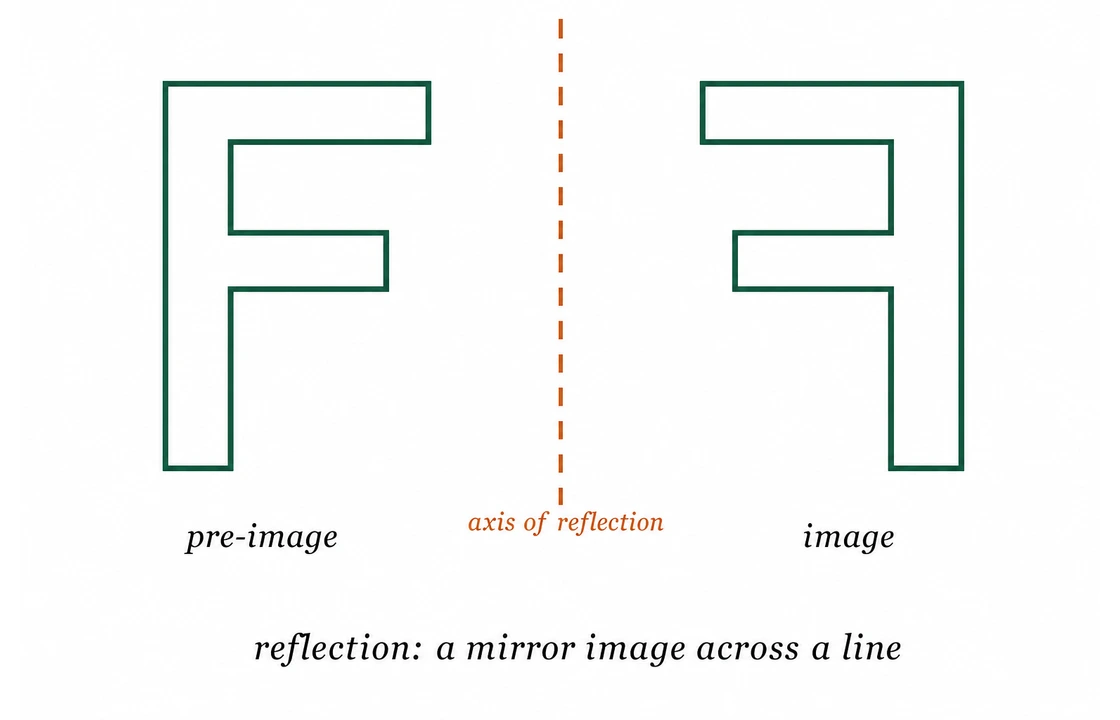
A transformation in which a geometric figure is reflected across a line, creating a mirror image. That line is called the axis of reflection.
See also
Pre-image, image, horizontal reflection, vertical reflection
Key Formula
Reflection over the x-axis: (x,y)→(x,−y)
Reflection over the y-axis: (x,y)→(−x,y)
Reflection over the line y=x:(x,y)→(y,x)
Reflection over the line y=−x:(x,y)→(−y,−x)
Where:
- (x,y) = The coordinates of any point in the original figure (pre-image)
- (x,−y) = The image point after reflecting over the x-axis
- (−x,y) = The image point after reflecting over the y-axis
- (y,x) = The image point after reflecting over the line y = x
- (−y,−x) = The image point after reflecting over the line y = -x
Worked Example
Problem: Triangle ABC has vertices A(1, 3), B(4, 3), and B(4, 1). Reflect the triangle over the x-axis and find the coordinates of the image.
Step 1: Identify the reflection rule. For a reflection over the x-axis, the rule is: keep the x-coordinate the same and negate the y-coordinate.
(x,y)→(x,−y)
Step 2: Apply the rule to point A(1, 3).
A(1,3)→A′(1,−3)
Step 3: Apply the rule to point B(4, 3).
B(4,3)→B′(4,−3)
Step 4: Apply the rule to point C(4, 1).
C(4,1)→C′(4,−1)
Step 5: Verify: each image point is the same perpendicular distance from the x-axis as its pre-image, but on the opposite side. For example, A was 3 units above the x-axis, and A' is 3 units below it.
Answer: The reflected triangle has vertices A'(1, −3), B'(4, −3), and C'(4, −1).
Another Example
This example uses a diagonal line of reflection (y = x) instead of an axis, showing that the rule changes depending on which line you reflect over. It also demonstrates the midpoint verification technique.
Problem: Point P(2, 5) is reflected over the line y = x. Find the coordinates of the image P'.
Step 1: Identify the reflection rule. For a reflection over the line y = x, you swap the x- and y-coordinates.
(x,y)→(y,x)
Step 2: Apply the rule to point P(2, 5).
P(2,5)→P′(5,2)
Step 3: Verify: the midpoint of P and P' should lie on the line y = x. The midpoint is ((2+5)/2, (5+2)/2) = (3.5, 3.5), and indeed 3.5 = 3.5, so it lies on y = x.
Midpoint=(22+5,25+2)=(3.5,3.5)
Answer: The image is P'(5, 2).
Frequently Asked Questions
What is the difference between a reflection and a rotation?
A reflection flips a figure across a line, creating a mirror image that reverses the figure's orientation (clockwise becomes counterclockwise). A rotation turns a figure around a fixed point by a certain angle without flipping it. Both preserve shape and size, but only a reflection reverses orientation.
How do you reflect a point over the y-axis?
To reflect a point over the y-axis, negate the x-coordinate and keep the y-coordinate the same. A point (x, y) becomes (−x, y). For example, the point (3, 7) reflected over the y-axis becomes (−3, 7).
Does a reflection change the size or shape of a figure?
No. A reflection is a rigid transformation (also called an isometry), which means it preserves all distances and angle measures. The image is congruent to the pre-image. The only thing that changes is the orientation — the figure is "flipped" as if viewed in a mirror.
Reflection vs. Rotation
| Reflection | Rotation | |
|---|---|---|
| Definition | Flips a figure across a line (axis of reflection) | Turns a figure around a fixed point (center of rotation) |
| Key input | A line of reflection | A center point and an angle of rotation |
| Orientation | Reversed (mirror image) | Preserved (same orientation) |
| Common formula (x-axis / 180°) | (x, y) → (x, −y) | (x, y) → (−x, −y) |
| Preserves size and shape? | Yes (rigid transformation) | Yes (rigid transformation) |
Why It Matters
Reflections appear throughout geometry courses when you study congruence, symmetry, and coordinate transformations. They are one of the four rigid transformations (along with translations, rotations, and glide reflections) used to prove that two figures are congruent. You will also encounter reflections in real-world contexts such as mirror optics, design symmetry, and computer graphics.
Common Mistakes
Mistake: Negating the wrong coordinate when reflecting over an axis.
Correction: Remember: reflecting over the x-axis changes the y-coordinate (negate y), while reflecting over the y-axis changes the x-coordinate (negate x). A helpful mnemonic: the coordinate that matches the axis name stays the same.
Mistake: Assuming a reflection only moves points perpendicular to the axis by one unit, regardless of their actual distance.
Correction: Each point must move to the exact same distance on the opposite side of the line of reflection. Measure the perpendicular distance from the point to the line, then place the image that same distance away on the other side.
Related Terms
- Transformations — Reflection is one type of transformation
- Axis of Reflection — The line across which a figure is reflected
- Pre-Image of a Transformation — The original figure before the reflection
- Image of a Transformation — The resulting figure after the reflection
- Horizontal Reflection — Reflection across a horizontal line such as the x-axis
- Vertical Reflection — Reflection across a vertical line such as the y-axis
- Geometric Figure — The shape being reflected
- Line — The axis of reflection is a specific line