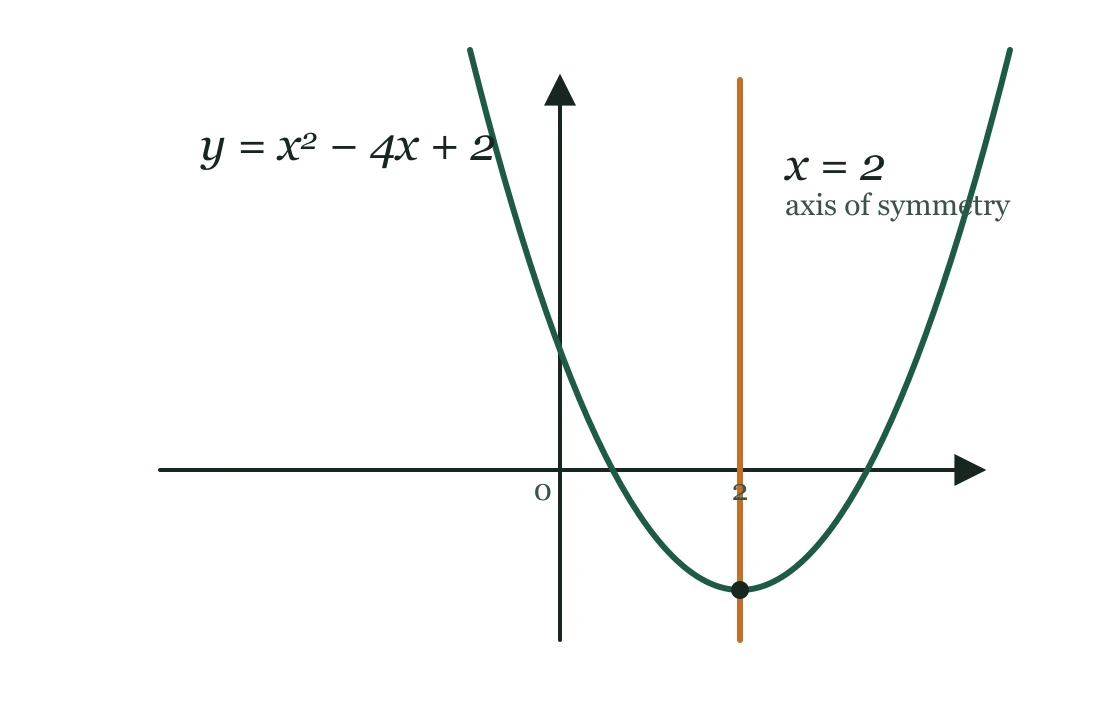
x = The equation of the axis of symmetry (a vertical line)
a = The coefficient of x² in the quadratic y = ax² + bx + c
b = The coefficient of x in the quadratic y = ax² + bx + c
Worked Example
Problem: Find the axis of symmetry for the parabola y = 2x² − 8x + 5.
Step 1: Identify the coefficients a, b, and c from the standard form y = ax² + bx + c.
a=2,b=−8,c=5
Step 2: Substitute a and b into the axis of symmetry formula.
x=−2ab=−2(2)−8
Step 3: Simplify the expression.
x=−4−8=48=2
Step 4: The axis of symmetry is the vertical line x = 2. Every point on the parabola has a mirror point on the opposite side of this line.
x=2
Answer: The axis of symmetry is x = 2.
Another Example
This example finds the axis of symmetry using two symmetric points rather than the formula x = −b/(2a). It reinforces the geometric meaning: the axis is the midpoint between any pair of mirror points on the parabola.
Problem: A parabola passes through the points (1, 10) and (5, 10). Find its axis of symmetry without knowing the equation.
Step 1: Notice that both points have the same y-value (y = 10). This means they are mirror images of each other across the axis of symmetry.
Points: (1,10) and (5,10)
Step 2: The axis of symmetry lies exactly halfway between any two points that share the same y-value. Find the midpoint of their x-coordinates.
x=21+5=26=3
Step 3: The axis of symmetry is the vertical line passing through that midpoint.
x=3
Answer: The axis of symmetry is x = 3.
Frequently Asked Questions
How do you find the axis of symmetry from vertex form?
If a parabola is written in vertex form y = a(x − h)² + k, the axis of symmetry is simply x = h. The value h is the x-coordinate of the vertex, and the axis of symmetry always passes through the vertex. For example, if y = 3(x − 4)² + 1, then the axis of symmetry is x = 4.
Is the axis of symmetry always vertical?
For parabolas that open upward or downward (the kind you see in most algebra courses), yes — the axis of symmetry is always a vertical line. However, a parabola that opens left or right, such as x = y², has a horizontal axis of symmetry. More generally, other shapes like circles and ellipses can have both vertical and horizontal axes of symmetry.
What is the difference between the axis of symmetry and the vertex?
The vertex is a point — specifically the highest or lowest point on the parabola. The axis of symmetry is a line that passes through the vertex and divides the parabola into two equal halves. If the vertex is at (h, k), then the axis of symmetry is the line x = h. One is a point; the other is a line.
Axis of Symmetry vs. Point of Symmetry
Axis of Symmetry
Point of Symmetry
What it is
A line that divides a graph into two mirror halves
A single point around which a graph is symmetric (rotational symmetry)
Type
A line (e.g., x = 2)
A point (e.g., (0, 0))
Symmetry type
Reflective — fold the graph along the line and both sides match
Rotational — rotate the graph 180° around the point and it looks the same
Common example
Parabola y = x² has axis of symmetry x = 0
Cubic y = x³ has point of symmetry at the origin (0, 0)
Why It Matters
The axis of symmetry appears throughout algebra whenever you work with quadratic functions — graphing parabolas, finding the vertex, and solving optimization problems all depend on it. It also shows up in geometry when analyzing reflections and symmetric figures. On standardized tests like the SAT and ACT, knowing how to quickly find the axis of symmetry saves time on both multiple-choice and graphing questions.
Common Mistakes
Mistake: Forgetting the negative sign in x = −b/(2a) and writing x = b/(2a) instead.
Correction: The formula has a negative sign in front of b. A helpful check: for y = x² − 6x + 5, the correct axis is x = −(−6)/(2·1) = 3, not x = −3. You can verify by noting the vertex should lie between the roots x = 1 and x = 5.
Mistake: Confusing the axis of symmetry (a line) with the vertex (a point).
Correction: The axis of symmetry is an equation of a vertical line, like x = 3. The vertex is an ordered pair, like (3, −4). The axis passes through the vertex, but they are different things. Always write the axis as "x = ..." rather than as a coordinate pair.