
Obtuse Triangle — Definition, Properties & Examples
Obtuse Triangle
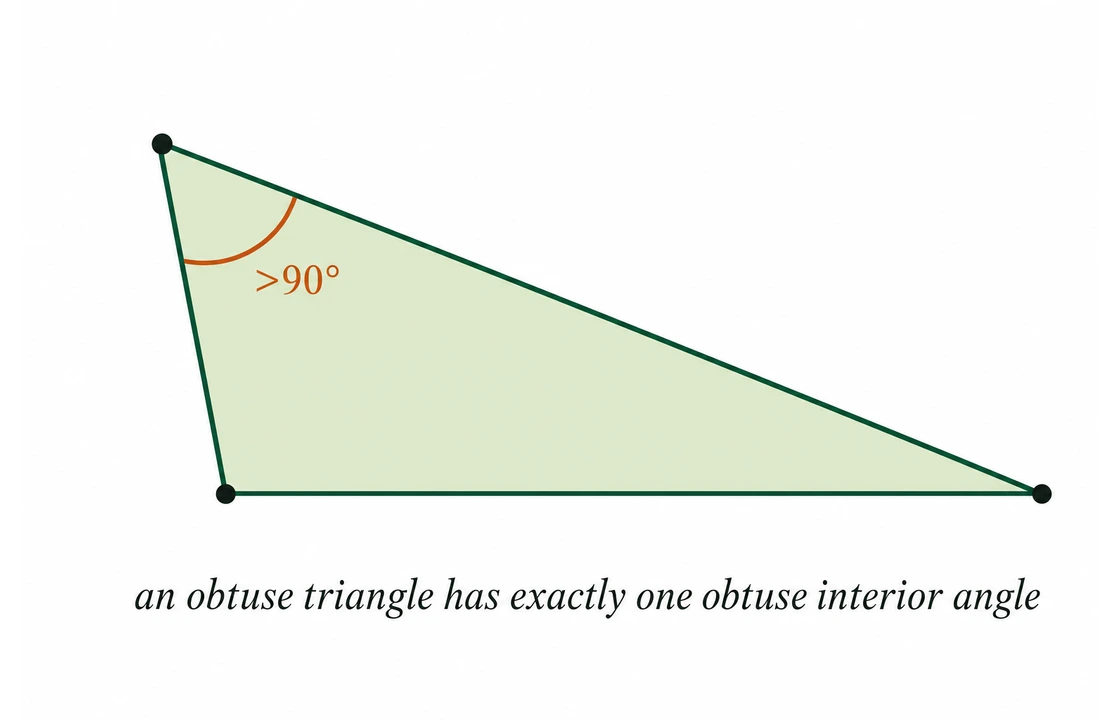
A triangle which has an obtuse angle as one of its interior angles.
See also
Key Formula
A+B+C=180°,where exactly one of A,B,C>90°
Where:
- A = The first interior angle of the triangle
- B = The second interior angle of the triangle
- C = The third interior angle of the triangle
Worked Example
Problem: A triangle has angles measuring 30°, 40°, and an unknown angle C. Determine whether the triangle is obtuse.
Step 1: Use the angle sum property: the three interior angles of any triangle add up to 180°.
A+B+C=180°
Step 2: Substitute the known angles and solve for C.
30°+40°+C=180°⟹C=180°−70°=110°
Step 3: Check whether any angle exceeds 90°. Since C = 110° > 90°, the triangle contains an obtuse angle.
110°>90°✓
Answer: The triangle is obtuse because its third angle measures 110°, which is greater than 90°.
Another Example
This example uses side lengths instead of angles, demonstrating the Pythagorean inequality test — a practical method when angles are not given directly.
Problem: A triangle has sides of length 5, 7, and 10. Use the side lengths to determine whether the triangle is obtuse.
Step 1: Identify the longest side. Here the longest side is c = 10, and the other two sides are a = 5 and b = 7.
a=5,b=7,c=10
Step 2: Apply the side-length test. A triangle is obtuse if the square of the longest side is greater than the sum of the squares of the other two sides.
c2>?a2+b2
Step 3: Compute each side.
102=100,52+72=25+49=74
Step 4: Compare the results. Since 100 > 74, the angle opposite the longest side is obtuse.
100>74⟹obtuse triangle
Answer: The triangle with sides 5, 7, and 10 is obtuse because 10² > 5² + 7².
Frequently Asked Questions
Can a triangle have two obtuse angles?
No. If two angles were each greater than 90°, their sum alone would exceed 180°, which violates the rule that all three interior angles must add to exactly 180°. Therefore, a triangle can have at most one obtuse angle.
How do you tell if a triangle is obtuse from its side lengths?
Square all three side lengths. If the square of the longest side is greater than the sum of the squares of the other two sides (c² > a² + b²), the triangle is obtuse. If c² = a² + b², it is a right triangle. If c² < a² + b², it is acute.
What is the difference between an obtuse triangle and an acute triangle?
An obtuse triangle has exactly one angle greater than 90°, while an acute triangle has all three angles less than 90°. Both types still satisfy the angle sum of 180°. A right triangle, which has exactly one 90° angle, falls between the two categories.
Obtuse Triangle vs. Acute Triangle
| Obtuse Triangle | Acute Triangle | |
|---|---|---|
| Definition | Has exactly one angle greater than 90° | All three angles are less than 90° |
| Side-length test | c² > a² + b² (longest side squared exceeds sum of other squares) | c² < a² + b² (longest side squared is less than sum of other squares) |
| Number of obtuse angles | Exactly 1 | 0 |
| Example angles | 20°, 30°, 130° | 60°, 70°, 50° |
| Circumcenter location | Outside the triangle | Inside the triangle |
Why It Matters
Classifying triangles as obtuse, acute, or right is a core skill in geometry courses and standardized tests. The side-length inequality test connects directly to the Pythagorean theorem, reinforcing one of the most important relationships in mathematics. In practical applications such as engineering, navigation, and computer graphics, knowing whether a triangle is obtuse affects how area, height, and circumscribed circles are calculated.
Common Mistakes
Mistake: Thinking a triangle can have more than one obtuse angle.
Correction: Two angles each exceeding 90° would sum to more than 180°, which is impossible in a triangle. A triangle has at most one obtuse angle.
Mistake: Comparing the wrong side when using the Pythagorean inequality test.
Correction: You must square the longest side and compare it to the sum of the squares of the other two sides. If you accidentally use a shorter side as c, you will get the wrong classification.
Related Terms
- Triangle — General category that includes obtuse triangles
- Obtuse Angle — The defining angle type in an obtuse triangle
- Interior Angle — The angles inside the triangle that determine its type
- Acute Triangle — Triangle where all angles are less than 90°
- Right Triangle — Triangle with exactly one 90° angle
- Pythagorean Theorem — Basis for the side-length inequality test
- Scalene Triangle — An obtuse triangle is often also scalene