
Base of an Isosceles Triangle — Definition & Formula
Base of an Isosceles Triangle
The side that is not a leg. That is, the non-congruent side of the triangle.
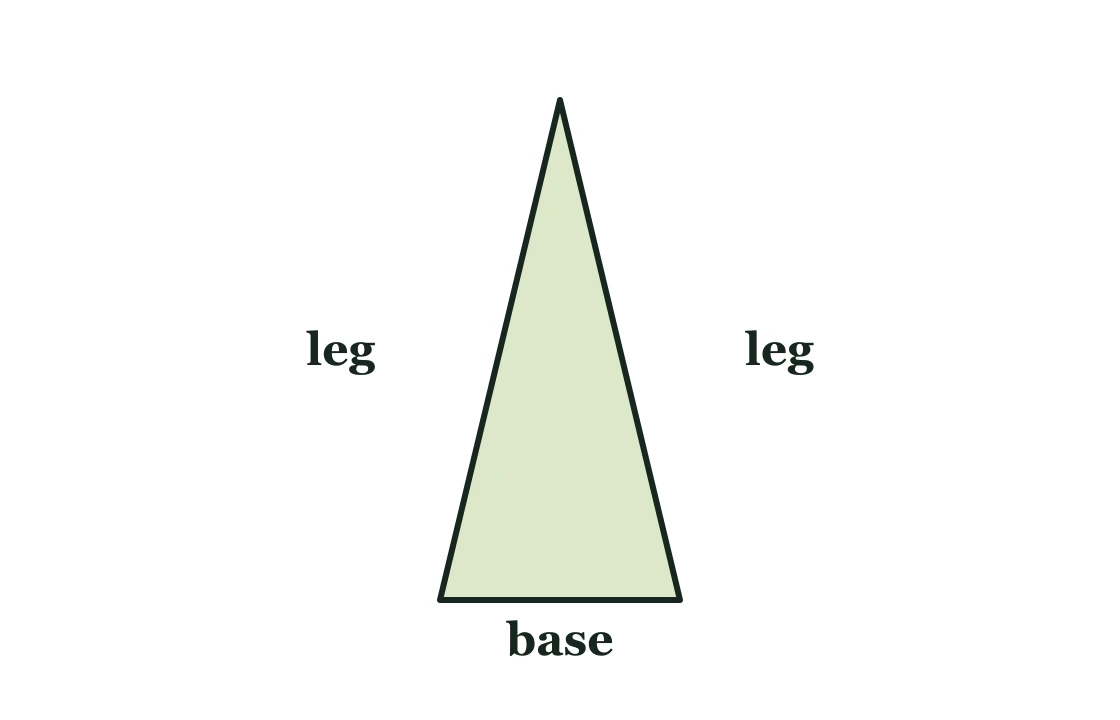
See also
Key Formula
b=2l2−h2
Where:
- b = Length of the base of the isosceles triangle
- l = Length of each congruent leg
- h = Height (altitude) drawn from the vertex angle perpendicular to the base
Worked Example
Problem: An isosceles triangle has legs of length 13 cm each and a height of 12 cm drawn from the vertex angle to the base. Find the length of the base.
Step 1: Identify what you know. Each leg is 13 cm and the altitude from the vertex angle to the base is 12 cm. The altitude bisects the base into two equal segments.
l=13,h=12
Step 2: Use the Pythagorean theorem on one of the two right triangles formed by the altitude. Each right triangle has hypotenuse l, one leg h, and the other leg equal to half the base.
(2b)2+h2=l2
Step 3: Solve for half the base.
2b=l2−h2=132−122=169−144=25=5
Step 4: Double the result to find the full base length.
b=2×5=10 cm
Answer: The base of the isosceles triangle is 10 cm.
Another Example
This example reverses the process: instead of finding the base, you start with the base and find the altitude, then compute the area. It shows how the base plays a central role in area calculations for isosceles triangles.
Problem: An isosceles triangle has legs of length 10 cm each and a base of 16 cm. Find the area of the triangle using the base and the altitude to the base.
Step 1: Identify the base and the legs. The base is the non-congruent side: b = 16 cm. Each leg is l = 10 cm.
b=16,l=10
Step 2: Find the altitude to the base. The altitude bisects the base, so each half is 8 cm. Use the Pythagorean theorem.
h=l2−(2b)2=102−82=100−64=36=6 cm
Step 3: Calculate the area using the standard triangle area formula with the base and corresponding altitude.
A=21×b×h=21×16×6=48 cm2
Answer: The area of the triangle is 48 cm².
Frequently Asked Questions
How do you find the base of an isosceles triangle?
If you know the leg length l and the altitude h drawn from the vertex angle to the base, use the formula b = 2√(l² − h²). The altitude splits the base into two equal halves, creating two right triangles you can solve with the Pythagorean theorem.
What is the difference between the base and the legs of an isosceles triangle?
The two legs are the congruent (equal-length) sides of an isosceles triangle. The base is the third side, which generally has a different length. The two base angles (the angles at each end of the base) are always equal to each other.
Can the base of an isosceles triangle be longer than the legs?
Yes. The base can be shorter than, equal to, or longer than the legs, as long as the triangle inequality is satisfied. When the base equals the legs, the triangle is equilateral — a special case of isosceles. When the base is longer than the legs, the vertex angle is obtuse.
Base of an Isosceles Triangle vs. Leg of an Isosceles Triangle
| Base of an Isosceles Triangle | Leg of an Isosceles Triangle | |
|---|---|---|
| Definition | The non-congruent side, opposite the vertex angle | One of the two congruent sides meeting at the vertex angle |
| How many | Exactly one per triangle | Exactly two per triangle |
| Adjacent angles | Two equal base angles at its endpoints | One base angle and one vertex angle at its endpoints |
| Altitude relationship | The altitude from the vertex angle bisects the base perpendicularly | Each leg is the hypotenuse of the right triangle formed by that altitude |
Why It Matters
The base of an isosceles triangle appears frequently in geometry problems involving the Pythagorean theorem, triangle area, and coordinate geometry. Identifying the base correctly is essential because the altitude from the vertex angle always bisects it, giving you a powerful shortcut for calculations. You will also encounter this concept in real-world contexts like architecture, roof trusses, and bridge supports, where symmetrical triangular shapes are common.
Common Mistakes
Mistake: Confusing the base with one of the legs. Students sometimes label a congruent side as the base simply because the triangle is drawn with that side on the bottom.
Correction: The base is defined by its properties, not its orientation. It is always the non-congruent side, regardless of how the triangle is rotated or drawn. A triangle resting on one of its legs still has the non-congruent side as its base.
Mistake: Forgetting that the altitude to the base bisects the base. Students sometimes set up the Pythagorean theorem using the full base length instead of half the base.
Correction: The altitude from the vertex angle lands at the midpoint of the base, creating two congruent right triangles. Each right triangle has legs of length h and b/2, not h and b.
Related Terms
- Leg of an Isosceles Triangle — The two congruent sides paired with the base
- Triangle — The general shape; isosceles is a special type
- Congruent — Describes the equal legs that define the base
- Altitude of a Triangle — Height drawn to the base; bisects it in isosceles triangles
- Area of a Triangle — Computed using the base and its corresponding altitude
- Side of a Polygon — General term for any segment forming the triangle