
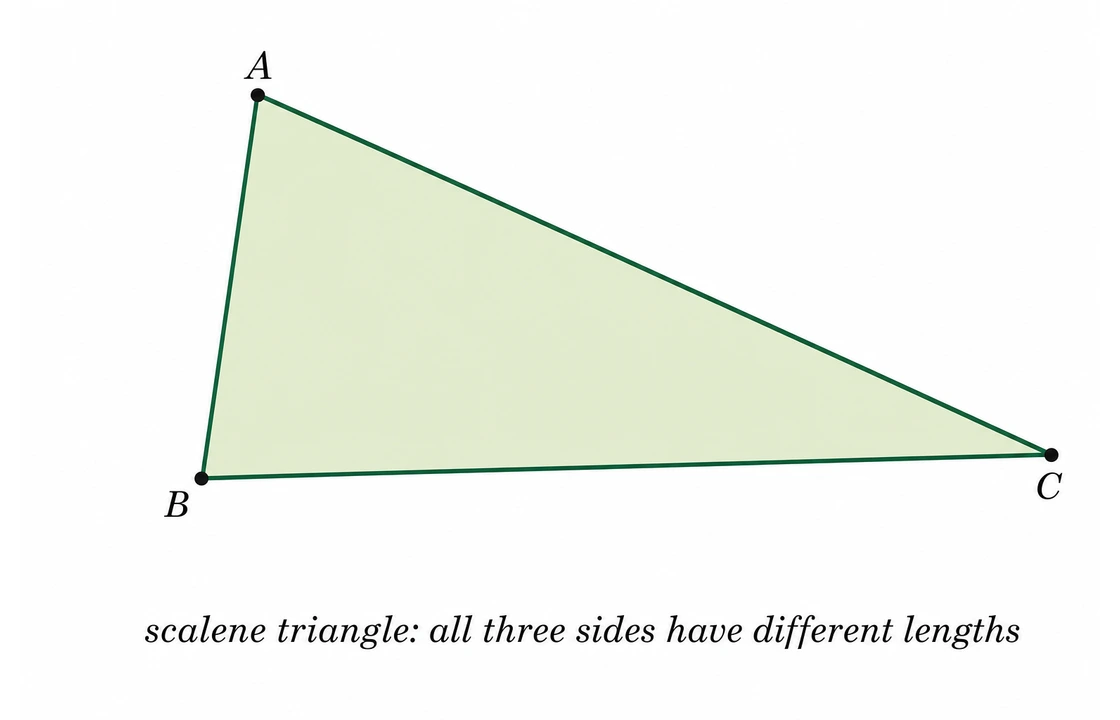
Scalene Triangle — Definition, Properties & Examples
See also
Key Formula
Perimeter=a+b+cArea=s(s−a)(s−b)(s−c)
Where:
- a,b,c = The three side lengths of the scalene triangle, where a ≠ b ≠ c and a ≠ c
- s = The semi-perimeter, defined as s = (a + b + c) / 2
Worked Example
Problem: A scalene triangle has sides of length 5, 7, and 10. Find its perimeter and area.
Step 1: Verify the triangle is scalene by checking that all three sides are different: 5 ≠ 7 ≠ 10, and 5 ≠ 10. Also confirm the triangle inequality holds: 5 + 7 = 12 > 10. ✓
a=5,b=7,c=10
Step 2: Calculate the perimeter by adding all three sides.
P=5+7+10=22
Step 3: Find the semi-perimeter.
s=222=11
Step 4: Apply Heron's formula to find the area.
A=11(11−5)(11−7)(11−10)=11×6×4×1=264
Step 5: Simplify the square root.
A=4×66=266≈16.25
Answer: The perimeter is 22 units and the area is 266≈16.25 square units.
Another Example
This example shows that a scalene triangle can also be a right triangle. It also demonstrates using a simpler area formula when a right angle is present, and cross-checking with Heron's formula.
Problem: A scalene triangle has sides 9, 12, and 15. Find the area and determine whether it is a right triangle.
Step 1: Check if the triangle is scalene: 9 ≠ 12 ≠ 15, and 9 ≠ 15. All sides are different, so it is scalene.
a=9,b=12,c=15
Step 2: Test whether it is a right triangle using the Pythagorean theorem. The longest side (15) would be the hypotenuse.
92+122=81+144=225=152✓
Step 3: Since this is a right triangle, you can use the simpler right-triangle area formula with the two legs as base and height.
A=21×9×12=54
Step 4: Verify with Heron's formula: s = (9 + 12 + 15)/2 = 18.
A=18×9×6×3=2916=54✓
Answer: The triangle is both scalene and right-angled, with an area of 54 square units.
Frequently Asked Questions
What is the difference between scalene, isosceles, and equilateral triangles?
A scalene triangle has no equal sides and no equal angles. An isosceles triangle has exactly two equal sides and two equal base angles. An equilateral triangle has all three sides equal and all three angles equal to 60°. These three categories cover every possible triangle classified by side length.
Can a scalene triangle be a right triangle?
Yes. A scalene triangle can also be a right triangle, as long as its three sides all have different lengths. For example, a triangle with sides 3, 4, and 5 is both scalene (all sides different) and right-angled (since 3² + 4² = 5²). Triangle classifications by sides (scalene, isosceles, equilateral) and by angles (acute, right, obtuse) are independent of each other.
How do you find the area of a scalene triangle?
If you know all three side lengths, use Heron's formula: first compute the semi-perimeter s=(a+b+c)/2, then the area is s(s−a)(s−b)(s−c). If you know a base and its corresponding height, the simpler formula A=21×base×height works for any triangle, including scalene ones.
Scalene Triangle vs. Isosceles Triangle
| Scalene Triangle | Isosceles Triangle | |
|---|---|---|
| Definition | All three sides have different lengths | At least two sides have equal length |
| Equal angles | No two angles are equal | The two base angles are equal |
| Lines of symmetry | 0 | 1 |
| Area formula (sides only) | Heron's formula required | Heron's formula, or specialized formulas using the equal sides |
| Example side lengths | 5, 7, 10 | 5, 5, 8 |
Why It Matters
Scalene triangles appear constantly in real-world geometry — most triangles you encounter in architecture, surveying, and navigation are scalene. Understanding them is essential because they lack the symmetry shortcuts available for isosceles or equilateral triangles, so you must rely on general tools like Heron's formula, the law of cosines, and the law of sines. Many standardized math tests ask you to classify triangles by side lengths and then choose the correct approach to find missing measurements.
Common Mistakes
Mistake: Assuming a scalene triangle cannot be a right triangle or an obtuse triangle.
Correction: Classification by sides (scalene, isosceles, equilateral) is separate from classification by angles (acute, right, obtuse). A triangle can be both scalene and right-angled (e.g., 3-4-5), or both scalene and obtuse (e.g., 3-4-6).
Mistake: Forgetting to verify the triangle inequality before computing area or perimeter.
Correction: Three lengths form a valid triangle only if the sum of any two sides is greater than the third side. For example, sides 2, 3, and 7 cannot form a triangle because 2 + 3 = 5 < 7. Always check this first.
Related Terms
- Triangle — General category that includes scalene triangles
- Isosceles Triangle — Triangle with exactly two equal sides
- Equilateral Triangle — Triangle with all three sides equal
- Side of a Polygon — Line segments that define a triangle's shape
- Heron's Formula — Key formula for finding scalene triangle area
- Triangle Inequality — Rule that determines valid side lengths
- Law of Cosines — Used to find angles in scalene triangles
- Law of Sines — Used to solve scalene triangles for missing parts