
AAS Congruence Theorem (Angle-Angle-Side) vs ASA & Examples
AAS
Congruence
SAA Congruence
Angle-angle-side congruence. When two triangles have corresponding angles and sides that are congruent as shown below, the triangles are congruent.
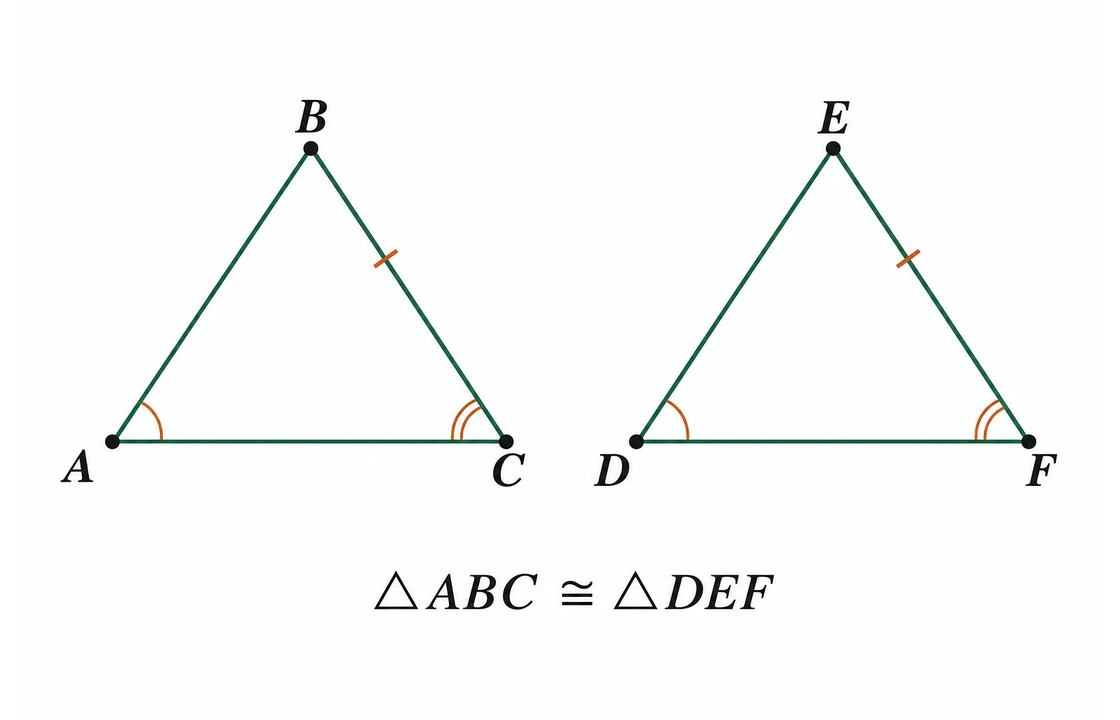
Worked Example
Problem: In triangle ABC, angle A = 50°, angle B = 60°, and side BC = 8 cm. In triangle DEF, angle D = 50°, angle E = 60°, and side EF = 8 cm. Are the two triangles congruent?
Step 1: Identify the two angles and one side given in each triangle. In triangle ABC: angle A = 50°, angle B = 60°, and side BC = 8 cm. Side BC is opposite angle A, so it is not included between the two given angles.
∠A=50°,∠B=60°,BC=8 cm
Step 2: Check the corresponding parts in triangle DEF: angle D = 50°, angle E = 60°, and side EF = 8 cm. Side EF is opposite angle D, so it is also not included between the two given angles.
∠D=50°,∠E=60°,EF=8 cm
Step 3: Match the corresponding parts. Angle A corresponds to angle D (both 50°). Angle B corresponds to angle E (both 60°). Side BC corresponds to side EF (both 8 cm). Two angles and a non-included side in one triangle match two angles and the corresponding non-included side in the other.
∠A=∠D,∠B=∠E,BC=EF
Step 4: Apply the AAS Congruence rule. Since two angles and a non-included side of triangle ABC are congruent to the corresponding parts of triangle DEF, the triangles are congruent.
△ABC≅△DEF(by AAS)
Answer: Yes, triangle ABC is congruent to triangle DEF by AAS Congruence.
Another Example
Problem: In triangle PQR, angle P = 40°, angle R = 75°, and side PQ = 10 cm. In triangle XYZ, angle X = 40°, angle Z = 75°, and side XY = 10 cm. Prove the triangles are congruent.
Step 1: List known parts. Triangle PQR has angle P = 40°, angle R = 75°, and side PQ = 10 cm. Side PQ is between angles P and Q, but angle Q is not one of the given angles. The given side PQ is adjacent to angle P but not between the two given angles (P and R), so this is a non-included side.
∠P=40°,∠R=75°,PQ=10 cm
Step 2: Check the corresponding parts. Angle X = angle P = 40°, angle Z = angle R = 75°, and side XY = side PQ = 10 cm.
∠X=∠P,∠Z=∠R,XY=PQ
Step 3: Since two angles and a non-included side of triangle PQR match the corresponding two angles and non-included side of triangle XYZ, the AAS rule applies.
△PQR≅△XYZ(by AAS)
Answer: Triangle PQR is congruent to triangle XYZ by AAS Congruence.
Frequently Asked Questions
What is the difference between AAS and ASA congruence?
In ASA, the known side is between (included by) the two known angles. In AAS, the known side is not between the two known angles — it is adjacent to only one of them. Both rules are valid for proving triangle congruence, and in fact AAS can be derived from ASA because knowing two angles automatically determines the third.
Why does AAS congruence work?
If you know two angles of a triangle, you can calculate the third angle (since all three sum to 180°). Once you have all three angles and one specific side length, the triangle's shape and size are fully determined. This effectively reduces AAS to the ASA case, which is why AAS is a valid congruence criterion.
AAS (Angle-Angle-Side) vs. ASA (Angle-Side-Angle)
Both use two angles and one side to prove congruence. The key difference is the position of the known side. In ASA, the side lies between the two known angles (included side). In AAS, the side is not between the two known angles (non-included side). Both are logically equivalent since knowing any two angles of a triangle lets you find the third, but they are stated as separate rules because the given information is arranged differently.
Why It Matters
AAS Congruence gives you flexibility when proving triangles are congruent, especially in geometry proofs where the known side is not conveniently located between the two known angles. It appears frequently in proofs involving parallel lines cut by a transversal, where pairs of alternate interior angles are equal and a shared or given side completes the congruence argument. Mastering AAS alongside the other congruence rules (SSS, SAS, ASA, HL) equips you to handle virtually any triangle congruence problem.
Common Mistakes
Mistake: Confusing AAS with AAA. Students sometimes think that knowing all three pairs of angles are equal is enough to prove congruence.
Correction: AAA (Angle-Angle-Angle) proves only that two triangles are similar (same shape), not congruent (same shape and size). You always need at least one pair of corresponding sides to be equal to establish congruence.
Mistake: Misidentifying which side is given and whether it is included or non-included, leading to mislabeling AAS as ASA or vice versa.
Correction: Check whether the known side lies between the two known angles. If it does, the rule is ASA. If the side is not between them, the rule is AAS. Drawing and labeling the triangle carefully helps avoid this error.
Related Terms
- Congruence Tests for Triangles — Overview of all triangle congruence rules
- Congruent — Meaning of same shape and size
- Triangle — The polygon to which AAS applies
- Angle — Two angles are used in AAS
- Side of a Polygon — One side is used in AAS
- Corresponding — Matching parts between congruent triangles