
Inscribed Angle Theorem: Half the Intercepted Arc (Formula)
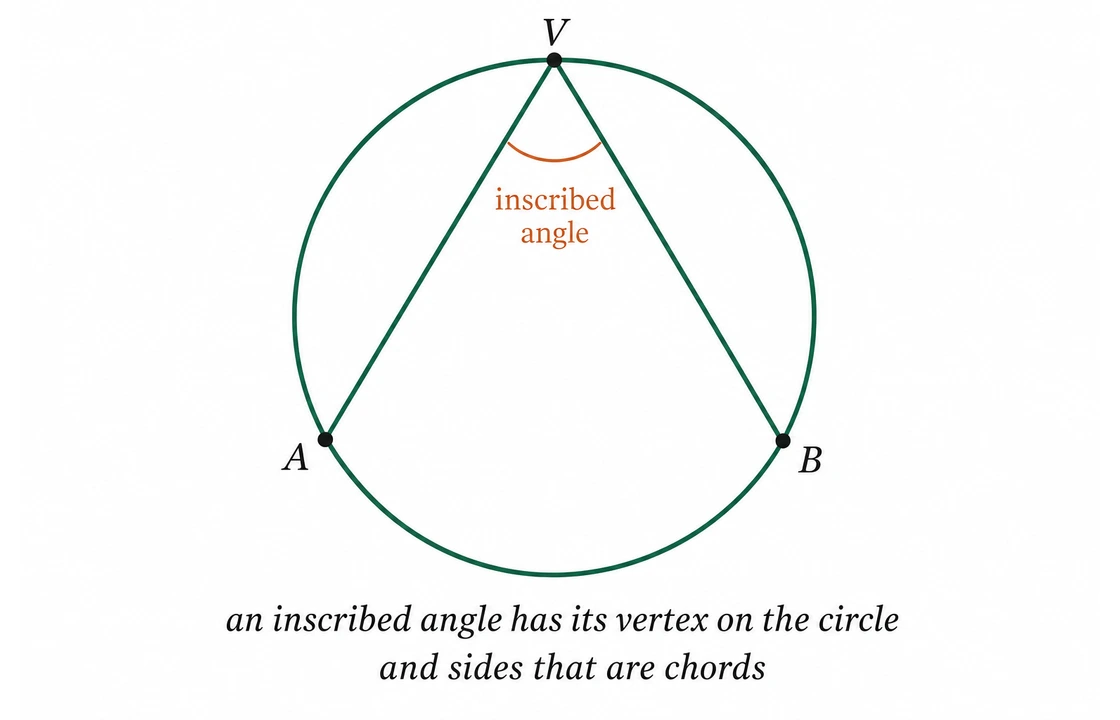
Key Formula
θ=21⋅intercepted arc
Where:
- θ = The measure of the inscribed angle (in degrees)
- intercepted arc = The degree measure of the arc that lies in the interior of the angle, cut off by the angle's two sides
Worked Example
Problem: An inscribed angle in a circle intercepts an arc that measures 140°. What is the measure of the inscribed angle?
Step 1: Identify the intercepted arc. The arc cut off by the two sides of the inscribed angle measures 140°.
intercepted arc=140°
Step 2: Apply the inscribed angle theorem: the inscribed angle equals half its intercepted arc.
θ=21⋅140°
Step 3: Calculate the result.
θ=70°
Answer: The inscribed angle measures 70°.
Another Example
This example demonstrates two key corollaries: (1) inscribed angles intercepting the same arc are congruent, and (2) you must be careful to identify which arc (minor or major) the angle actually intercepts.
Problem: Two inscribed angles in the same circle both intercept arc PQ, which measures 110°. A third inscribed angle intercepts the remaining arc (the major arc PQ). Find all three angle measures.
Step 1: Both inscribed angles intercept the same arc PQ of 110°. By the inscribed angle theorem, inscribed angles that intercept the same arc are equal.
θ1=θ2=21⋅110°=55°
Step 2: Find the major arc PQ. A full circle is 360°, so the remaining arc is:
major arc PQ=360°−110°=250°
Step 3: The third inscribed angle intercepts this major arc, so apply the formula again.
θ3=21⋅250°=125°
Answer: The first two inscribed angles each measure 55°, and the third measures 125°.
Frequently Asked Questions
What is the difference between an inscribed angle and a central angle?
A central angle has its vertex at the center of the circle, while an inscribed angle has its vertex on the circle. For the same intercepted arc, a central angle equals the arc measure, but an inscribed angle equals half the arc measure. So a central angle is always twice the inscribed angle that intercepts the same arc.
Why is an inscribed angle half the central angle?
The inscribed angle theorem can be proven by drawing a radius to the vertex of the inscribed angle and using the fact that the base angles of an isosceles triangle (formed by two radii and a chord) are equal. Through this construction, the exterior angle of the triangle equals twice the inscribed angle, and that exterior angle equals the central angle. This relationship holds for all three possible cases (the center inside the angle, on one side, or outside).
What is the inscribed angle in a semicircle?
An inscribed angle that intercepts a semicircle (an arc of 180°) always measures exactly 90°. This is known as Thales' theorem. Any triangle inscribed in a circle where one side is a diameter will have a right angle opposite that diameter.
Inscribed Angle vs. Central Angle
| Inscribed Angle | Central Angle | |
|---|---|---|
| Vertex location | On the circle | At the center of the circle |
| Formula | θ = ½ × intercepted arc | θ = intercepted arc |
| Relationship | Half the central angle for the same arc | Twice the inscribed angle for the same arc |
| Special case | 90° when intercepting a semicircle | 180° when intercepting a semicircle (a straight angle) |
Why It Matters
Inscribed angles appear throughout geometry courses, especially in problems involving cyclic quadrilaterals, tangent lines, and circle theorems on standardized tests like the SAT and ACT. Understanding the inscribed angle theorem also provides the foundation for Thales' theorem (a right angle in a semicircle), which is used in constructions and proofs. Many real-world design problems—such as determining viewing angles in architecture or optics—rely on the properties of inscribed angles.
Common Mistakes
Mistake: Confusing the inscribed angle with the central angle and using the full arc measure as the angle.
Correction: The inscribed angle is always half the intercepted arc. Only a central angle equals the arc directly. If the arc is 120°, the inscribed angle is 60°, not 120°.
Mistake: Choosing the wrong arc when an inscribed angle is obtuse.
Correction: An inscribed angle intercepts the arc in its interior. If the vertex is on the major arc, the angle intercepts the minor arc (giving an acute angle). If the vertex is on the minor arc, the angle intercepts the major arc (giving an obtuse angle). Always trace the two chords from the vertex and identify which arc lies between their other endpoints, inside the angle.
Related Terms
- Angle — General concept; inscribed angle is a specific type
- Circle — The shape on which the inscribed angle is formed
- Vertex — The point on the circle where the angle is formed
- Central Angle — Angle at center; equals twice the inscribed angle
- Chord — The two sides of an inscribed angle are chords
- Cyclic Quadrilateral — Uses inscribed angle properties; opposite angles sum to 180°