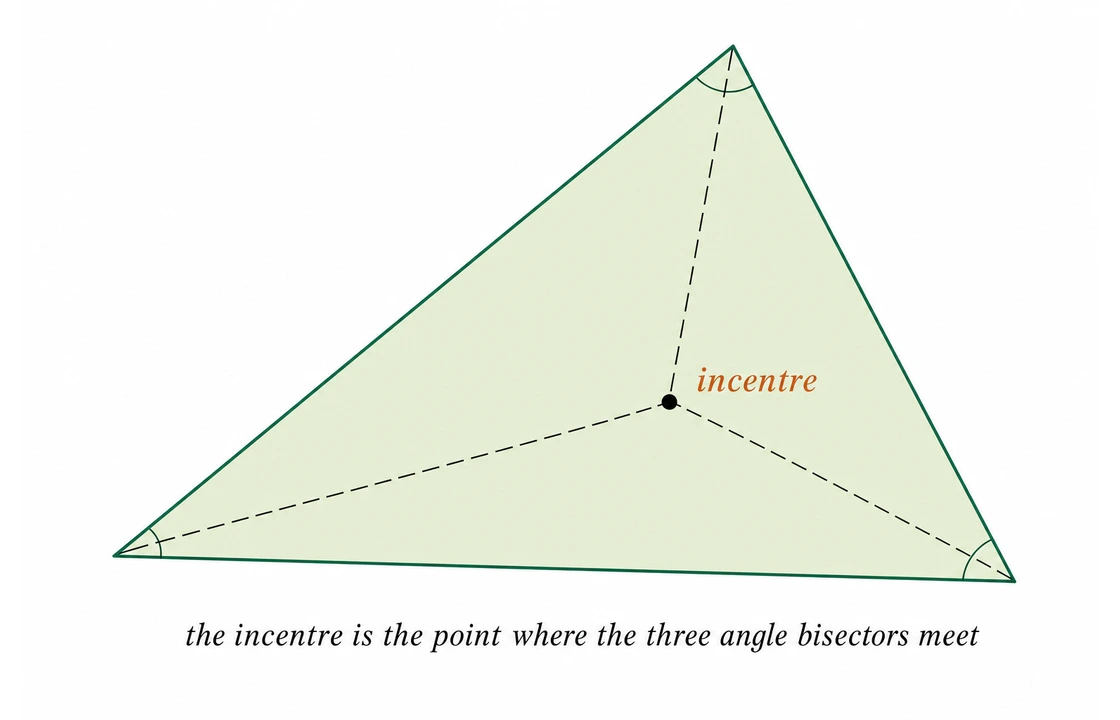
Note: Any triangle has an inscribed circle, called
the incircle. All regular
polygons have inscribed circles. Other
polygons with 4 or more sides, however, usually do not.
(xA,yA),(xB,yB),(xC,yC) = Coordinates of vertices A, B, and C
a = Length of the side opposite vertex A (i.e., side BC)
b = Length of the side opposite vertex B (i.e., side AC)
c = Length of the side opposite vertex C (i.e., side AB)
Worked Example
Problem: Find the incenter of a triangle with vertices A(0, 0), B(6, 0), and C(0, 8).
Step 1: Find the side lengths. Side a is opposite vertex A (from B to C), side b is opposite vertex B (from A to C), and side c is opposite vertex C (from A to B).
Step 4: The inradius (radius of the incircle) can be found using the area and semi-perimeter. The area of this right triangle is (1/2)(6)(8) = 24, and the semi-perimeter is s = 24/2 = 12.
r=sArea=1224=2
Answer: The incenter is at (2, 2), and the incircle has radius 2. This circle sits inside the triangle, tangent to all three sides.
Frequently Asked Questions
Is the incenter always inside the triangle?
Yes. Unlike the circumcenter or orthocenter, which can lie outside a triangle, the incenter is always located in the interior of the triangle. This is because every angle bisector passes through the interior, so their intersection point must also be interior.
What is the difference between the incenter and the centroid?
The incenter is found by intersecting the three angle bisectors, and it is equidistant from all three sides. The centroid is found by intersecting the three medians (segments from each vertex to the midpoint of the opposite side), and it is the triangle's center of mass. They are generally at different locations unless the triangle is equilateral, in which case all four classical centers coincide.
Incenter vs. Circumcenter
The incenter is the intersection of the angle bisectors and is equidistant from all three sides; it is the center of the inscribed circle. The circumcenter is the intersection of the perpendicular bisectors of the sides and is equidistant from all three vertices; it is the center of the circumscribed circle. The incenter always lies inside the triangle, while the circumcenter can lie outside for obtuse triangles.
Why It Matters
The incenter is one of the four classical triangle centers studied in geometry, alongside the centroid, circumcenter, and orthocenter. It appears in real-world problems whenever you need the largest circle that fits inside a triangular region — for example, placing a circular pool inside a triangular yard. The inradius formula r=Area/s also provides a powerful shortcut for computing a triangle's area when the perimeter and inradius are known.
Common Mistakes
Mistake: Confusing the incenter with the circumcenter.
Correction: The incenter is equidistant from the three sides (and is the center of the inscribed circle). The circumcenter is equidistant from the three vertices (and is the center of the circumscribed circle). Remember: 'in' = inside circle touching the sides.
Mistake: Using midpoints of sides instead of angle bisectors to locate the incenter.
Correction: The incenter is defined by angle bisectors, not medians or perpendicular bisectors. Drawing the bisector of each angle and finding where they meet gives the incenter.
Related Terms
Angle Bisector — Angle bisectors intersect at the incenter