
Fractal — Definition, Properties & Examples
Fractal
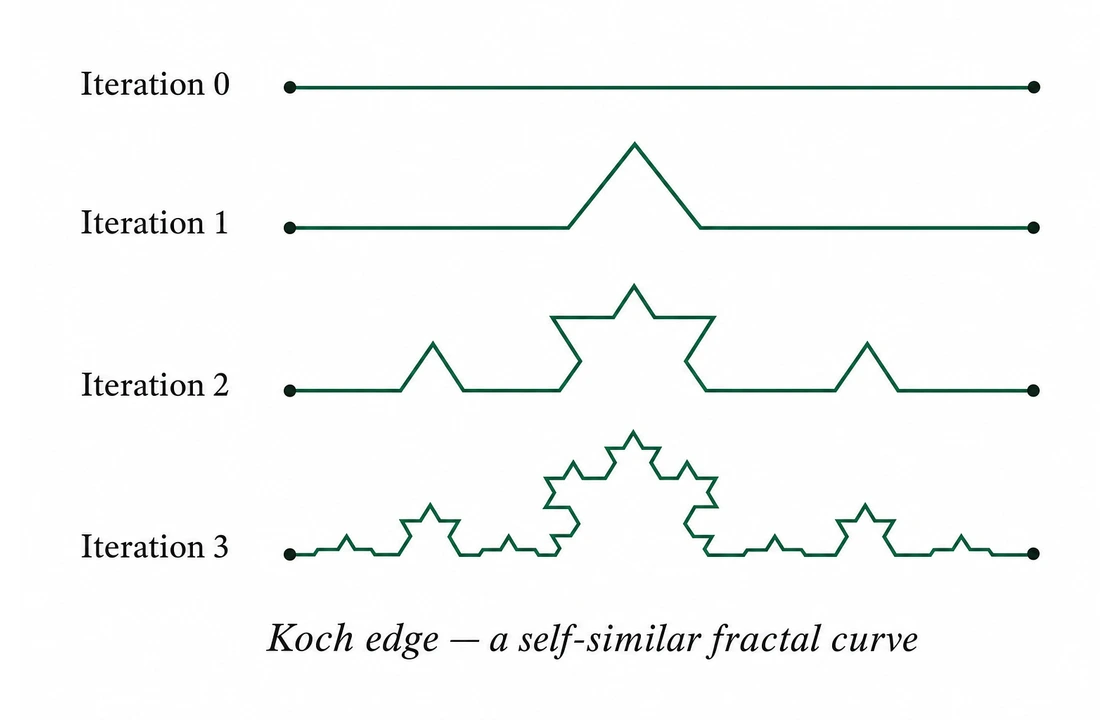
A figure that is self-similar. That is, no matter how far you zoom in on the figure, the portion you look at is similar to the original figure. The Koch edge, below, is a fractal.
Note: The word fractal is often used loosely to describe figures that do not quite meet this definition.
Example
Problem: Build the first three stages of the Koch snowflake edge. Start with a straight line segment of length 1. At each stage, replace every straight segment with four segments, each one-third the length of the segment it replaces. What is the total length of the curve after Stage 1, Stage 2, and Stage 3?
Stage 0: You begin with a single straight segment of length 1.
L0=1
Stage 1: Divide the segment into three equal parts. Remove the middle third and replace it with two sides of an equilateral triangle. You now have 4 segments, each of length 1/3.
L1=4×31=34
Stage 2: Apply the same rule to each of the 4 segments. Each one produces 4 smaller segments of length 1/9. There are now 16 segments total.
L2=42×321=16×91=916
Stage 3: Repeat once more. Each of the 16 segments produces 4 segments of length 1/27, giving 64 segments.
L3=43×331=64×271=2764
General pattern: At stage n, the total length is (4/3)^n. Because 4/3 > 1, the length grows without bound, even though the curve stays within a bounded region of the plane. This is a hallmark of fractal geometry.
Ln=(34)n→∞ as n→∞
Answer: After Stage 1 the length is 4/3, after Stage 2 it is 16/9, and after Stage 3 it is 64/27. As the process continues forever, the Koch edge has infinite length while enclosing a finite area — a key property of fractals.
Frequently Asked Questions
Are fractals found in nature?
Yes. Coastlines, fern leaves, blood vessel networks, lightning bolts, and snowflakes all exhibit approximate self-similarity. They are not perfect mathematical fractals, but their branching or irregular patterns repeat at many scales, which is why fractal geometry is used to model them.
What does it mean for a fractal to have a non-integer dimension?
Ordinary shapes have integer dimensions (a line is 1-D, a plane is 2-D). Fractals can have a 'fractal dimension' between integers. For example, the Koch curve has a fractal dimension of about 1.26, meaning it is more than a line but less than a filled surface. This dimension measures how the detail scales as you zoom in.
Fractal vs. Regular Geometric Figure
A regular geometric figure (circle, square, triangle) looks smoother as you zoom in — eventually you see straight edges or smooth curves. A fractal reveals the same level of complexity no matter how far you zoom in; its detail never simplifies. Regular figures have integer dimensions (1, 2, or 3), while fractals can have non-integer (fractional) dimensions.
Why It Matters
Fractals give mathematicians and scientists a way to describe irregular shapes that classical geometry cannot handle, such as coastlines and mountain surfaces. They appear throughout computer graphics, where recursive algorithms generate realistic landscapes and textures. Understanding fractals also deepens your grasp of sequences, geometric series, and the concept of infinity.
Common Mistakes
Mistake: Thinking every complex or irregular shape is a fractal.
Correction: A true fractal must exhibit self-similarity — parts of it resemble the whole at different scales. A crumpled piece of paper looks complex but is not self-similar, so it is not a fractal.
Mistake: Believing fractals have finite length or area like ordinary curves.
Correction: Many fractals, such as the Koch curve, have infinite length even though they fit inside a bounded region. This counterintuitive property is precisely what makes fractals different from standard geometric figures.
Related Terms
- Self-Similarity — Core property that defines a fractal
- Geometric Figure — Broad category that includes fractals
- Similar — Fractals contain similar copies of themselves
- Geometric Sequence — Fractal lengths often form geometric sequences
- Iteration — Fractals are built by repeating a process
- Recursion — Recursive rules generate fractal patterns
- Infinity — Fractal detail continues to infinite depth