
Euler Line — Definition, Properties & Examples
Euler Line
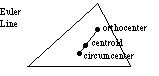
The line segment that passes through a triangle’s orthocenter, centroid, and circumcenter. These three points are collinear for any triangle. In addition, the distance from the orthocenter to the centroid is twice the distance from the circumcenter to the centroid.
Note: Euler is pronounced "Oiler".
See also
Key Formula
OG=31OHequivalently,HG=2OG
Where:
- O = Circumcenter — the center of the circle passing through all three vertices
- G = Centroid — the intersection of the three medians (always lies between O and H on the Euler line)
- H = Orthocenter — the intersection of the three altitudes
- OG = Distance from the circumcenter to the centroid
- HG = Distance from the orthocenter to the centroid
- OH = Distance from the circumcenter to the orthocenter
Worked Example
Problem: A triangle has vertices A(0, 0), B(6, 0), and C(2, 6). Find the circumcenter, centroid, and orthocenter, verify they are collinear, and check the 1:2 distance ratio.
Step 1: Find the centroid G by averaging the coordinates of the vertices.
G=(30+6+2,30+0+6)=(38,2)
Step 2: Find the circumcenter O. The perpendicular bisector of AB (midpoint (3,0), vertical direction since AB is horizontal) is x = 3. The perpendicular bisector of AC (midpoint (1,3), slope of AC = 3, so perpendicular slope = −1/3) gives y − 3 = −1/3(x − 1). Setting x = 3: y = 3 − 2/3 = 7/3.
O=(3,37)
Step 3: Find the orthocenter H. The altitude from A to BC: slope of BC = (6−0)/(2−6) = −3/2, so the altitude has slope 2/3, giving y = (2/3)x. The altitude from B to AC: slope of AC = 3, so the altitude has slope −1/3, giving y − 0 = −1/3(x − 6), i.e. y = −x/3 + 2. Setting (2/3)x = −x/3 + 2 gives x = 2, y = 4/3.
H=(2,34)
Step 4: Verify collinearity. The vector from O to G is (8/3 − 3, 2 − 7/3) = (−1/3, −1/3). The vector from O to H is (2 − 3, 4/3 − 7/3) = (−1, −1). Since (−1, −1) = 3·(−1/3, −1/3), the three points lie on the same line.
OH=3OG
Step 5: Check the distance ratio. OG = √((1/3)² + (1/3)²) = √(2)/3. HG = √((8/3−2)² + (2−4/3)²) = √((2/3)² + (2/3)²) = 2√(2)/3. Indeed HG = 2·OG.
HG=322=2×32=2OG✓
Answer: The circumcenter is O(3, 7/3), the centroid is G(8/3, 2), and the orthocenter is H(2, 4/3). All three are collinear, and HG = 2·OG, confirming the Euler line relationship.
Another Example
This example highlights the important edge case: the Euler line is only a meaningful distinct line for non-equilateral triangles.
Problem: Show that an equilateral triangle with vertices A(0, 0), B(4, 0), and C(2, 2√3) has no distinct Euler line.
Step 1: Find the centroid G.
G=(30+4+2,30+0+23)=(2,323)
Step 2: Find the circumcenter O. By symmetry, O lies on x = 2. The perpendicular bisector of AB passes through (2, 0) vertically; the perpendicular bisector of AC also passes through (2, 2√3/3). So O = (2, 2√3/3).
O=(2,323)
Step 3: Find the orthocenter H. The altitude from A to BC (slope of BC = (2√3)/(−2) = −√3, perpendicular slope = 1/√3) is y = x/√3. At x = 2, y = 2/√3 = 2√3/3. Similarly, by symmetry, H = (2, 2√3/3).
H=(2,323)=G=O
Step 4: Since O, G, and H all coincide at the same point, three distinct collinear points do not exist. A single point does not determine a unique line.
Answer: For an equilateral triangle, the orthocenter, centroid, and circumcenter are the same point, so the Euler line is undefined (or, equivalently, every line through that point could be called an Euler line).
Frequently Asked Questions
Does every triangle have an Euler line?
Every non-equilateral triangle has a well-defined Euler line. In an equilateral triangle, the orthocenter, centroid, and circumcenter all coincide at a single point, so no unique line is determined. For all other triangles, the three centers are distinct and collinear.
What other notable points lie on the Euler line?
Besides the orthocenter, centroid, and circumcenter, the nine-point center (the center of the nine-point circle) also lies on the Euler line. It sits exactly at the midpoint of the segment from the orthocenter to the circumcenter. The de Longchamps point is another example.
Why is the centroid always between the circumcenter and orthocenter?
The key relationship is the vector identity: the position of the orthocenter equals the circumcenter plus three times the vector from the circumcenter to the centroid, i.e., H = O + 3·(G − O). This forces G to lie one-third of the way from O to H, so it is always between them, dividing the segment in a 1:2 ratio.
Euler Line vs. Nine-Point Circle
| Euler Line | Nine-Point Circle | |
|---|---|---|
| What it is | A line through orthocenter, centroid, and circumcenter | A circle through the midpoints of the sides, feet of the altitudes, and midpoints of segments from vertices to orthocenter |
| Key center on it | The centroid divides OH in ratio 1:2 | The nine-point center is the midpoint of OH and lies on the Euler line |
| Exists for equilateral triangles? | Degenerates to a point (undefined line) | Yes — it coincides with the circumcircle scaled by factor 1/2 |
| Dimension | One-dimensional (a line) | One-dimensional boundary (a circle) |
Why It Matters
The Euler line appears frequently in competition mathematics and olympiad geometry, where problems ask you to prove collinearity of triangle centers or compute distances between them. It provides a powerful structural insight: that three seemingly independent constructions (altitudes, medians, perpendicular bisectors) produce centers that are locked into a single line with a fixed ratio. Understanding it deepens your grasp of how a triangle's geometry is internally connected.
Common Mistakes
Mistake: Assuming the incenter also lies on the Euler line.
Correction: The incenter (center of the inscribed circle) does NOT generally lie on the Euler line. It only coincides with the other centers for equilateral triangles. The Euler line specifically connects the orthocenter, centroid, and circumcenter.
Mistake: Getting the distance ratio backwards: saying OG = 2·HG.
Correction: The correct ratio is HG = 2·OG, meaning the centroid is closer to the circumcenter than to the orthocenter. The centroid divides the segment from O to H in the ratio 1:2 (from O), not 2:1.
Related Terms
- Orthocenter — Intersection of altitudes; lies on the Euler line
- Centroid — Intersection of medians; divides Euler line segment 1:2
- Circumcenter — Center of circumscribed circle; lies on the Euler line
- Collinear — Property that O, G, and H share on the Euler line
- Triangle — The figure whose centers define the Euler line
- Line Segment — The Euler line is a line (or segment) through centers
- Euler's Formula — Another result named after Leonhard Euler
- Point — The triangle centers are specific points