
Centroid of a Triangle: Intersection of Three Medians
Centroid
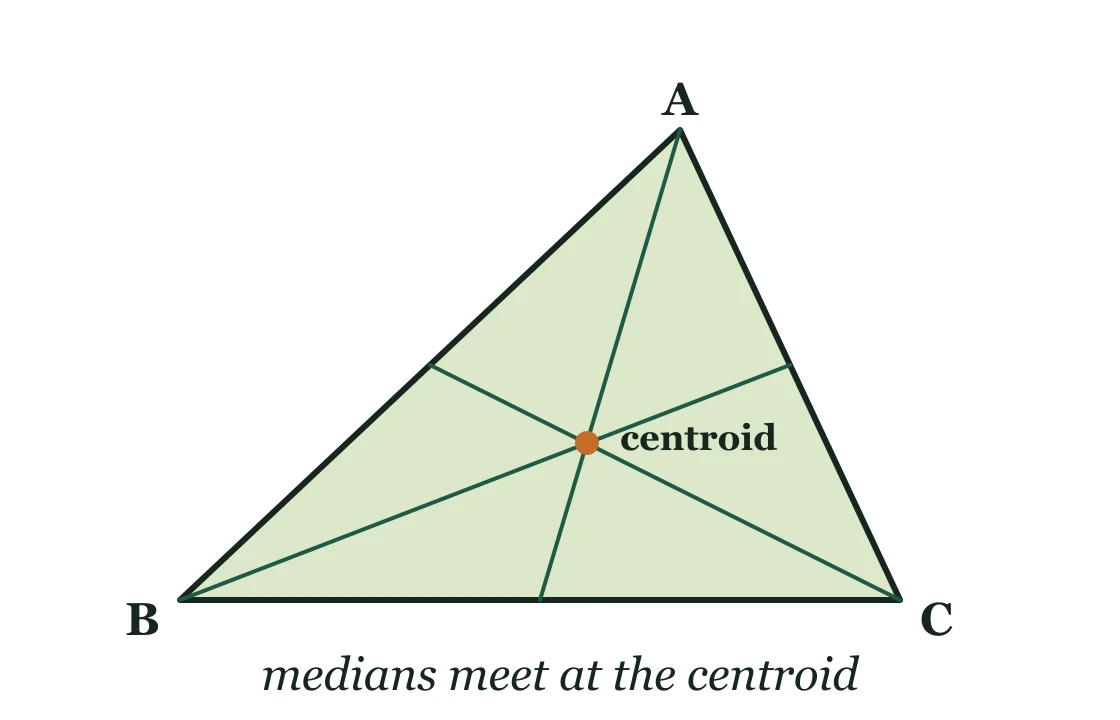
For a triangle, this is the point at which the three medians intersect. In general, the centroid is the center of mass of a figure of uniform (constant) density.
Key Formula
G=(3x1+x2+x3,3y1+y2+y3)
Where:
- G = The centroid of the triangle
- (x1,y1) = Coordinates of the first vertex
- (x2,y2) = Coordinates of the second vertex
- (x3,y3) = Coordinates of the third vertex
Worked Example
Problem: Find the centroid of a triangle with vertices A(0, 0), B(6, 0), and C(3, 9).
Step 1: Write down the centroid formula.
G=(3x1+x2+x3,3y1+y2+y3)
Step 2: Substitute the x-coordinates of the three vertices and compute the average.
xG=30+6+3=39=3
Step 3: Substitute the y-coordinates of the three vertices and compute the average.
yG=30+0+9=39=3
Step 4: Combine the results to state the centroid.
G=(3,3)
Answer: The centroid of the triangle is at (3, 3).
Another Example
This example uses non-origin vertices including a negative coordinate, and it verifies the 2:1 median property rather than just computing the formula.
Problem: A triangle has vertices P(−2, 4), Q(4, 10), and R(7, 1). Find the centroid and verify that it lies on the median from vertex P to the midpoint of QR.
Step 1: Apply the centroid formula to find G.
G=(3−2+4+7,34+10+1)=(39,315)=(3,5)
Step 2: Find the midpoint M of side QR.
M=(24+7,210+1)=(5.5,5.5)
Step 3: The median runs from P(−2, 4) to M(5.5, 5.5). Parameterize this segment: a point at parameter t is P + t(M − P). The centroid divides each median so that it is 2/3 of the way from the vertex to the opposite midpoint, so set t = 2/3.
Point=(−2,4)+32((5.5,5.5)−(−2,4))=(−2,4)+32(7.5,1.5)
Step 4: Compute the coordinates.
=(−2+5,4+1)=(3,5)
Step 5: This matches G = (3, 5), confirming the centroid lies on the median from P at exactly 2/3 of the distance from P to M.
Answer: The centroid is (3, 5), and it sits exactly two-thirds of the way along the median from P to the midpoint of QR.
Frequently Asked Questions
What is the difference between the centroid and the incenter of a triangle?
The centroid is found by averaging the vertices' coordinates and is the intersection of the three medians. The incenter is the intersection of the three angle bisectors and is equidistant from all three sides. For most triangles these are two different points; they only coincide when the triangle is equilateral.
Is the centroid always inside the triangle?
Yes. Unlike the circumcenter or orthocenter, which can fall outside the triangle for obtuse triangles, the centroid always lies in the interior. This holds for every triangle — acute, right, or obtuse.
Why does the centroid divide each median in a 2:1 ratio?
Each median connects a vertex to the midpoint of the opposite side. The centroid sits 2/3 of the way from each vertex toward the opposite midpoint. This 2:1 split is a consequence of the fact that the three medians must all pass through a single balance point, which can be proven using vectors or coordinate geometry.
Centroid vs. Circumcenter
| Centroid | Circumcenter | |
|---|---|---|
| Definition | Intersection of the three medians | Intersection of the three perpendicular bisectors |
| Formula (triangle) | Average of the three vertices' coordinates | Equidistant from all three vertices (solve system of equations) |
| Always inside the triangle? | Yes, always | No — outside for obtuse triangles, on the hypotenuse for right triangles |
| Physical meaning | Center of mass (balance point) of a uniform triangular region | Center of the circumscribed circle passing through all three vertices |
Why It Matters
The centroid appears frequently in coordinate geometry problems on standardized tests and in physics whenever you need the balance point of a triangular plate or region. It is one of the four classic triangle centers (along with the incenter, circumcenter, and orthocenter) that students are expected to know in high school geometry. Understanding the centroid also lays the groundwork for computing centers of mass in calculus and engineering courses.
Common Mistakes
Mistake: Using the midpoint formula between two vertices instead of averaging all three vertices.
Correction: The centroid requires all three vertices. You must add all three x-values and divide by 3, then do the same for the y-values. A midpoint only uses two points and gives the middle of one side, not the centroid.
Mistake: Thinking the centroid is 1/3 of the way from a vertex along the median instead of 2/3.
Correction: The centroid divides each median in a 2:1 ratio measured from the vertex. It is 2/3 of the way from the vertex to the midpoint of the opposite side, not 1/3.
Related Terms
- Triangle — The shape whose centroid is most commonly studied
- Median of a Triangle — The three medians intersect at the centroid
- Center of Mass Formula — Generalizes the centroid to non-uniform densities
- Centers of a Triangle — The centroid is one of the four classic centers
- Geometric Figure — Any figure of uniform density has a centroid
- Uniform — Constant density condition under which centroid equals center of mass
- Moment — Used in calculus-based centroid calculations