
Cube in Geometry: Definition, Volume & Surface Area
Cube
Regular Hexahedron
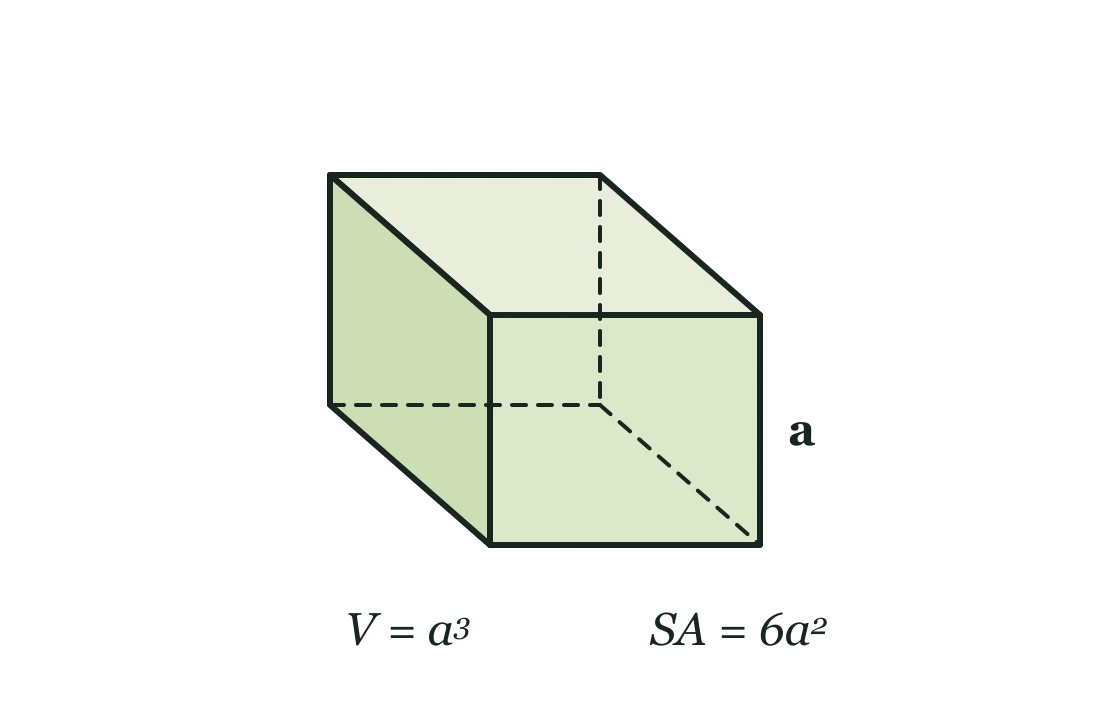
A regular polyhedron for which all faces are squares.
Note: It is one of the five platonic solids.
See also
Key Formula
V=a3andSA=6a2
Where:
- a = The length of one edge of the cube
- V = Volume — the amount of space enclosed by the cube
- SA = Surface area — the total area of all six square faces
Worked Example
Problem: A cube has an edge length of 5 cm. Find its volume and surface area.
Step 1: Identify the edge length.
a=5 cm
Step 2: Calculate the volume by cubing the edge length.
V=a3=53=125 cm3
Step 3: Calculate the surface area. A cube has 6 faces, each a square with area a2.
SA=6a2=6×52=6×25=150 cm2
Answer: The cube has a volume of 125 cm³ and a surface area of 150 cm².
Another Example
This example works in reverse — starting from a known volume and finding the edge length using cube roots, then computing surface area.
Problem: A cube has a volume of 216 in³. Find its edge length and surface area.
Step 1: Start with the volume formula and solve for the edge length by taking the cube root.
V=a3⟹a=3V=3216
Step 2: Evaluate the cube root. Since 6×6×6=216, the edge length is 6.
a=6 in
Step 3: Now find the surface area using the edge length.
SA=6a2=6×62=6×36=216 in2
Answer: The edge length is 6 in and the surface area is 216 in².
Frequently Asked Questions
What is the difference between a cube and a rectangular prism?
A cube is a special case of a rectangular prism where all three dimensions (length, width, and height) are equal. A rectangular prism can have three different edge lengths, so its faces may be rectangles rather than squares. Every cube is a rectangular prism, but not every rectangular prism is a cube.
How many faces, edges, and vertices does a cube have?
A cube has 6 faces, 12 edges, and 8 vertices. Each face is a square, three edges meet at every vertex, and these counts satisfy Euler's formula for polyhedra: V−E+F=8−12+6=2.
What is the space diagonal of a cube?
The space diagonal connects two opposite vertices of a cube, passing through its interior. For a cube with edge length a, the space diagonal has length d=a3. This comes from applying the Pythagorean theorem twice — first across a face, then from that face diagonal up to the opposite corner.
Cube vs. Rectangular Prism
| Cube | Rectangular Prism | |
|---|---|---|
| Definition | A regular polyhedron with 6 identical square faces | A polyhedron with 6 rectangular faces (opposite faces are congruent) |
| Edge lengths | All 12 edges are equal (length a) | Edges come in three groups by length (l, w, h) |
| Volume formula | V = a³ | V = l × w × h |
| Surface area formula | SA = 6a² | SA = 2(lw + lh + wh) |
| Symmetry | 48 symmetries (highest among rectangular prisms) | Fewer symmetries unless all sides are equal |
Why It Matters
Cubes appear throughout geometry courses when you first learn about volume and surface area, and they serve as the foundation for understanding more complex 3D shapes. The operation of raising a number to the third power is literally called "cubing" because it gives the volume of a cube with that edge length. In science and engineering, cubic units (cm³, m³, ft³) are standard for measuring capacity and volume.
Common Mistakes
Mistake: Confusing the volume formula with the surface area formula — for example, computing a3 when the question asks for surface area.
Correction: Remember that volume (a3) measures the space inside the cube and uses cubic units, while surface area (6a2) measures the total area of the outer faces and uses square units. The factor of 6 in the surface area formula accounts for the six faces.
Mistake: Forgetting to include all six faces when computing surface area, especially when a diagram shows only three visible faces.
Correction: A cube always has 6 faces, even though you can see at most 3 at once in a standard drawing. Always multiply a2 by 6 for total surface area.
Related Terms
- Platonic Solids — The cube is one of the five Platonic solids
- Volume — Measure of space inside the cube
- Surface Area — Total area of the cube's six faces
- Square — Each face of a cube is a square
- Right Square Prism — A cube is a special right square prism
- Face of a Polyhedron — A cube has six square faces
- Edge of a Polyhedron — A cube has twelve equal edges