
Terminal Side of an Angle — Definition, Examples & Graph
Terminal Side of an Angle
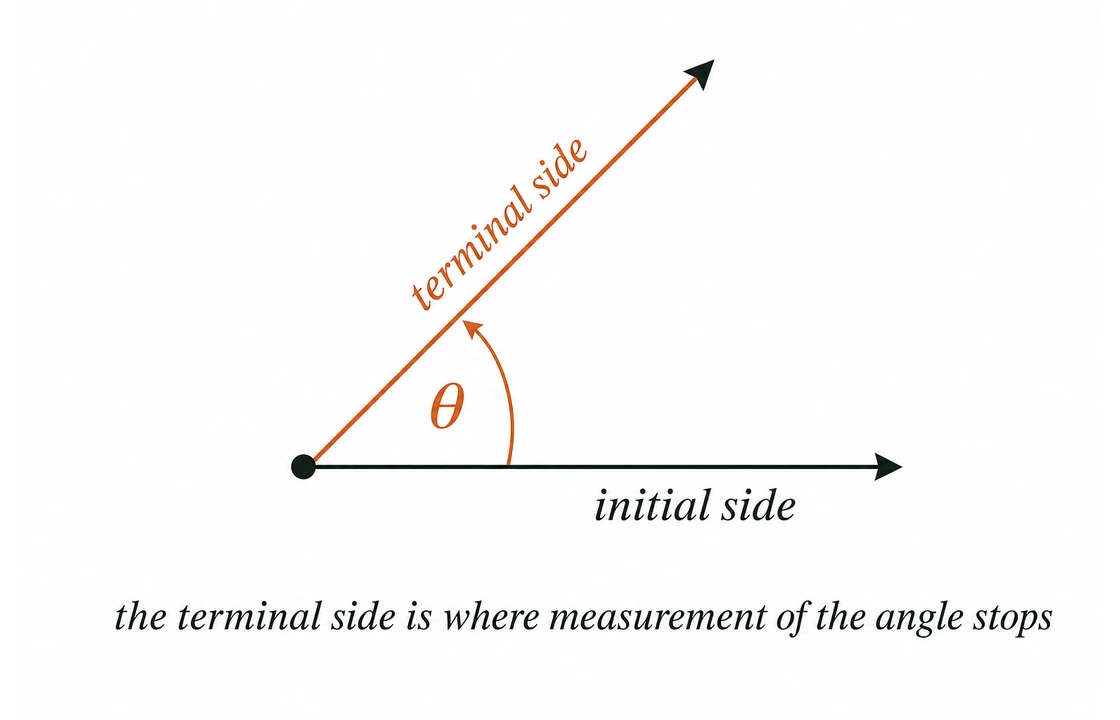
The ray where measurement of an angle stops.
See also
Key Formula
Terminal side position=Initial side+θ
Where:
- θ = The measure of the angle (in degrees or radians), where positive values indicate counterclockwise rotation and negative values indicate clockwise rotation
- Initial side = The starting ray of the angle, which lies along the positive x-axis when the angle is in standard position
Worked Example
Problem: An angle of 150° is in standard position. Determine which quadrant the terminal side lies in and find the coordinates of the point where the terminal side intersects the unit circle.
Step 1: Place the angle in standard position. The initial side lies along the positive x-axis, and the vertex is at the origin.
Initial side along +x-axis
Step 2: Rotate counterclockwise (since the angle is positive) by 150° from the initial side. Since 90° < 150° < 180°, the terminal side lands in Quadrant II.
90°<150°<180°⟹Quadrant II
Step 3: Find the reference angle. The reference angle is the acute angle between the terminal side and the x-axis.
180°−150°=30°
Step 4: Use the reference angle to find the unit circle coordinates. In Quadrant II, cosine is negative and sine is positive.
(cos150°,sin150°)=(−23,21)
Answer: The terminal side of 150° lies in Quadrant II and intersects the unit circle at (−23,21).
Another Example
This example uses a negative angle to show that the terminal side's position depends on the net rotation, and introduces the concept of coterminal angles sharing the same terminal side.
Problem: An angle of −240° is in standard position. Determine where the terminal side lies and identify a positive coterminal angle.
Step 1: A negative angle means you rotate clockwise from the positive x-axis. Start at the initial side along the positive x-axis.
θ=−240°
Step 2: Rotating 240° clockwise is the same as rotating 360° − 240° = 120° counterclockwise. Add 360° to find the positive coterminal angle.
−240°+360°=120°
Step 3: Since the coterminal angle is 120°, and 90° < 120° < 180°, the terminal side lies in Quadrant II.
90°<120°<180°⟹Quadrant II
Step 4: Both −240° and 120° share the exact same terminal side, confirming they are coterminal angles.
cos(−240°)=cos(120°)=−21
Answer: The terminal side of −240° lies in Quadrant II. A positive coterminal angle is 120°.
Frequently Asked Questions
What is the difference between the terminal side and the initial side of an angle?
The initial side is the ray where angle measurement begins, and the terminal side is the ray where it ends. When an angle is in standard position, the initial side always lies along the positive x-axis, while the terminal side can point in any direction depending on the angle's measure.
How do you find what quadrant the terminal side is in?
First, find a coterminal angle between 0° and 360° by adding or subtracting 360° as needed. Then check which range it falls in: 0°–90° is Quadrant I, 90°–180° is Quadrant II, 180°–270° is Quadrant III, and 270°–360° is Quadrant IV. Angles that land exactly on 0°, 90°, 180°, or 270° lie on an axis and are called quadrantal angles.
Can two different angles have the same terminal side?
Yes. Angles that differ by a full rotation (360° or 2π radians) share the same terminal side and are called coterminal angles. For example, 45°, 405°, and −315° all have the same terminal side because they differ by multiples of 360°.
Terminal Side vs. Initial Side
| Terminal Side | Initial Side | |
|---|---|---|
| Definition | The ray where angle measurement stops | The ray where angle measurement starts |
| Standard position | Can lie in any direction, determined by the angle measure | Always lies along the positive x-axis |
| Changes with angle size? | Yes — different angles have different terminal sides | No — the initial side is fixed in standard position |
| Role in trigonometry | Determines the signs and values of trig functions | Serves as the reference direction (0° or 0 radians) |
Why It Matters
The terminal side is central to trigonometry on the coordinate plane. When you evaluate sinθ, cosθ, or tanθ, you are working with the coordinates of a point on the terminal side. Understanding which quadrant the terminal side falls in tells you immediately whether each trigonometric function is positive or negative, which is essential for solving equations in precalculus and calculus.
Common Mistakes
Mistake: Confusing the direction of rotation: assuming all angles rotate counterclockwise.
Correction: Positive angles rotate counterclockwise, but negative angles rotate clockwise. A −90° angle has its terminal side along the negative y-axis, not the positive y-axis.
Mistake: Forgetting that angles greater than 360° wrap around past the initial side.
Correction: An angle like 450° doesn't stop at the end of one full revolution. Subtract 360° to get 90°, so the terminal side lies along the positive y-axis. Always reduce to a coterminal angle between 0° and 360° to identify the terminal side's position.
Related Terms
- Initial Side of an Angle — The starting ray paired with the terminal side
- Coterminal Angles — Different angles sharing the same terminal side
- Ray — The geometric object forming each side of an angle
- Measure of an Angle — Determines the rotation from initial to terminal side
- Standard Position — Convention placing the vertex at the origin
- Reference Angle — Acute angle between terminal side and x-axis
- Quadrantal Angle — Angle whose terminal side lies on an axis
- Unit Circle — Circle used to define trig values from terminal side