
Standard Position — Definition, Examples & Graph
Standard Position
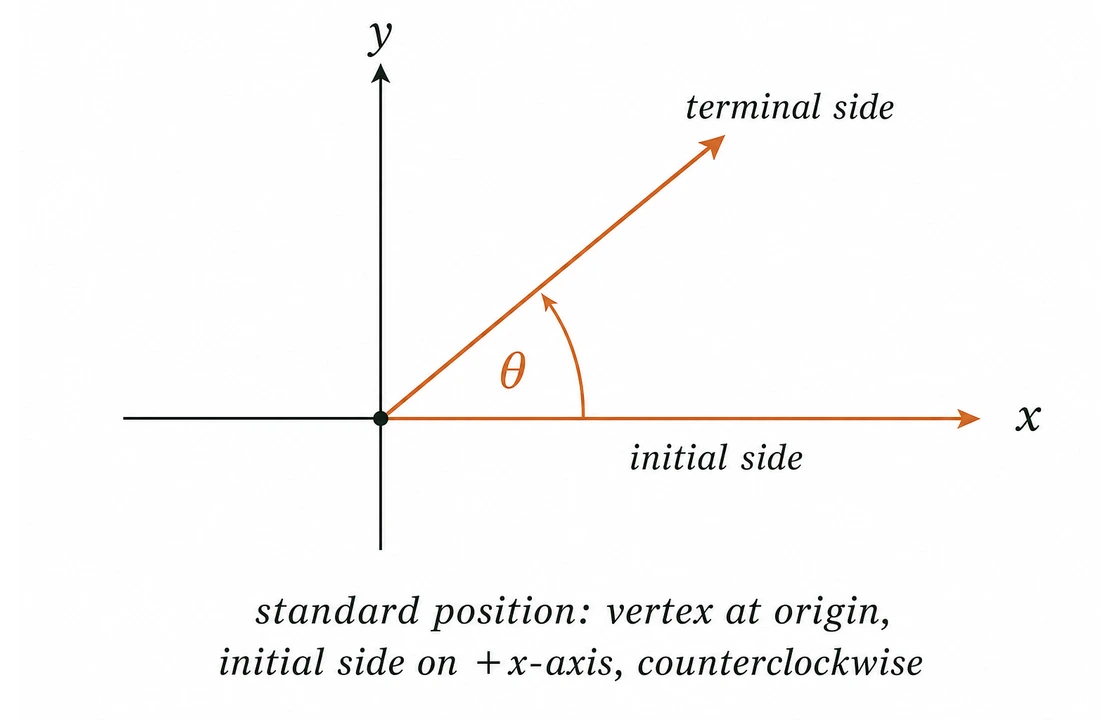
An angle drawn on the x-y plane starting on the positive x-axis and turning counterclockwise.
Key Formula
θ in standard position: vertex at (0,0),initial side along the positive x-axis
Where:
- θ = The angle measured from the initial side to the terminal side
- (0,0) = The origin of the x-y plane, where the vertex of the angle is placed
- initial side = The starting ray, which lies along the positive x-axis
- terminal side = The ending ray, whose position depends on the size and sign of the angle
Worked Example
Problem: An angle of 150° is in standard position. Determine which quadrant the terminal side falls in and find the coordinates of the point where the terminal side intersects the unit circle.
Step 1: Place the vertex at the origin and the initial side along the positive x-axis.
Vertex=(0,0),initial side along +x-axis
Step 2: Rotate counterclockwise from the positive x-axis by 150°. Since 90° < 150° < 180°, the terminal side lands in Quadrant II.
θ=150°
Step 3: Find the reference angle. The reference angle is the acute angle between the terminal side and the x-axis.
Reference angle=180°−150°=30°
Step 4: Use the unit circle. In Quadrant II, cosine is negative and sine is positive. Apply the known values for 30°.
cos150°=−cos30°=−23,sin150°=sin30°=21
Step 5: Write the coordinates of the point on the unit circle where the terminal side intersects.
(−23,21)
Answer: The terminal side of 150° in standard position lies in Quadrant II, and it intersects the unit circle at (−23,21).
Another Example
This example differs from the first by using a negative angle, which requires clockwise rotation. It also demonstrates finding a coterminal angle, a key skill related to standard position.
Problem: An angle of −225° is in standard position. Find the quadrant of the terminal side and identify a positive coterminal angle.
Step 1: Place the vertex at the origin with the initial side along the positive x-axis. A negative angle means we rotate clockwise.
θ=−225°
Step 2: Rotate 225° clockwise from the positive x-axis. Clockwise 225° passes through Quadrant IV (0° to −90°), Quadrant III (−90° to −180°), and enters Quadrant II (−180° to −225°).
−225° terminal side is in Quadrant II
Step 3: Find a positive coterminal angle by adding 360°.
−225°+360°=135°
Step 4: Verify: 135° is between 90° and 180°, confirming the terminal side is indeed in Quadrant II.
90°<135°<180°✓
Answer: The terminal side of −225° lies in Quadrant II, and a positive coterminal angle is 135°.
Frequently Asked Questions
What is the difference between standard position and any other position for an angle?
An angle in standard position must have its vertex at the origin and its initial side on the positive x-axis. An angle drawn elsewhere on the plane—say, with a vertex at (3, 2)—is not in standard position. Standard position gives every angle a consistent reference point, which is essential for defining trigonometric functions on the coordinate plane.
Can an angle in standard position be negative?
Yes. A positive angle is measured counterclockwise from the positive x-axis, while a negative angle is measured clockwise. For example, −90° in standard position has its terminal side pointing straight down along the negative y-axis. The vertex and initial side remain the same regardless of sign.
What are coterminal angles in standard position?
Coterminal angles share the same terminal side when drawn in standard position but differ by full rotations of 360° (or 2π radians). For instance, 45° and 405° are coterminal because 405°−360°=45°. You can find a coterminal angle by adding or subtracting 360° as many times as needed.
Standard Position vs. Non-Standard (General) Position
| Standard Position | Non-Standard (General) Position | |
|---|---|---|
| Vertex location | Always at the origin (0, 0) | Can be at any point in the plane |
| Initial side | Always along the positive x-axis | Can point in any direction |
| Positive direction | Counterclockwise rotation | Must be specified or context-dependent |
| Use in trigonometry | Required for defining trig functions via the unit circle | Used in geometry for measuring angles between arbitrary rays |
Why It Matters
Standard position is the foundation for nearly all of trigonometry on the coordinate plane. When you study the unit circle, reference angles, and graphs of sine and cosine, every angle is assumed to be in standard position unless stated otherwise. It also appears in physics and engineering whenever vectors are described by an angle measured from the positive x-axis.
Common Mistakes
Mistake: Measuring the angle from the y-axis instead of the positive x-axis.
Correction: In standard position, the initial side is always the positive x-axis. An angle of 90° reaches the positive y-axis—it does not start there.
Mistake: Assuming all angles rotate counterclockwise.
Correction: Positive angles rotate counterclockwise, but negative angles rotate clockwise. For example, −60° means you rotate 60° clockwise from the positive x-axis.
Related Terms
- Angle — The general concept that standard position organizes
- x-y Plane — The coordinate plane where the angle is drawn
- Counterclockwise — Direction of positive angle rotation
- Terminal Side — The ending ray that determines the angle's measure
- Reference Angle — Acute angle formed with the x-axis by the terminal side
- Unit Circle — Circle of radius 1 centered at the origin, used with standard position