
Reference Angle: How to Find It (With All-Quadrant Rules)
Reference Angle
For any given angle, its reference angle is an acute version of that angle. In standard position, the reference angle is the smallest angle between the terminal side and the x-axis. The values of the trig functions of angle θ are the same as the trig values of the reference angle for θ, give or take a minus sign.
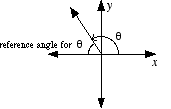
Key Formula
θref=⎩⎨⎧θ180°−θθ−180°360°−θif θ is in Quadrant Iif θ is in Quadrant IIif θ is in Quadrant IIIif θ is in Quadrant IV
Where:
- θref = The reference angle (always between 0° and 90°)
- θ = The given angle in standard position (measured from the positive x-axis), assumed to be between 0° and 360°
Worked Example
Problem: Find the reference angle for θ = 150°.
Step 1: Determine the quadrant. Since 90° < 150° < 180°, the angle is in Quadrant II.
Step 2: Apply the Quadrant II formula: subtract the angle from 180°.
θref=180°−150°
Step 3: Compute the result.
θref=30°
Step 4: Verify using trig values. We know sin(150°) = 1/2 and sin(30°) = 1/2. The sine values match (both positive, since sine is positive in Quadrant II). Also, cos(150°) = −√3/2 and cos(30°) = √3/2 — same magnitude, but negative in Quadrant II, as expected.
Answer: The reference angle for 150° is 30°.
Another Example
This example uses radians instead of degrees and works in Quadrant IV, showing students how the same concept applies across different units and quadrants.
Problem: Find the reference angle for θ = 5π/3 radians.
Step 1: Convert the angle's position. Since 3π/2 < 5π/3 < 2π, the angle lies in Quadrant IV.
Step 2: Apply the Quadrant IV formula in radians: subtract the angle from 2π.
θref=2π−35π
Step 3: Compute by finding a common denominator.
θref=36π−35π=3π
Step 4: Check: π/3 = 60°, which is acute. The reference angle is valid.
Answer: The reference angle for 5π/3 radians is π/3 radians (60°).
Frequently Asked Questions
How do you find the reference angle for a negative angle?
First, add 360° (or 2π) repeatedly until you get an equivalent angle between 0° and 360°. Then apply the standard reference angle formulas based on which quadrant that equivalent angle falls in. For example, for −210°, add 360° to get 150°, which is in Quadrant II, so the reference angle is 180° − 150° = 30°.
Is the reference angle always positive?
Yes. A reference angle is always a positive acute angle, meaning it is strictly between 0° and 90° (exclusive). It represents a magnitude — the shortest angular distance from the terminal side to the x-axis — so it cannot be negative or zero.
What is the difference between a reference angle and a coterminal angle?
A reference angle is the acute angle between the terminal side and the x-axis, and it is always between 0° and 90°. A coterminal angle is any angle that shares the same terminal side as the original, found by adding or subtracting full rotations (multiples of 360°). For instance, 150° and 510° are coterminal, but both have a reference angle of 30°.
Reference Angle vs. Coterminal Angle
| Reference Angle | Coterminal Angle | |
|---|---|---|
| Definition | The acute angle between the terminal side and the x-axis | Any angle that shares the same terminal side as the original |
| Range | Always between 0° and 90° | Can be any real number (positive, negative, or > 360°) |
| How to find | Use quadrant-based formulas to measure distance to x-axis | Add or subtract multiples of 360° (or 2π) |
| Purpose | Evaluate trig functions by reducing to a known acute angle | Simplify angle measure to a standard range |
Why It Matters
Reference angles let you evaluate trigonometric functions for any angle by relating them back to familiar acute angles (30°, 45°, 60°) from the unit circle. You will use reference angles extensively in precalculus, calculus, and physics whenever you need to find exact trig values without a calculator. They are also the foundation for understanding the symmetry of sine, cosine, and tangent across the four quadrants.
Common Mistakes
Mistake: Measuring the reference angle to the y-axis instead of the x-axis.
Correction: The reference angle is always measured to the nearest part of the x-axis, never the y-axis. For example, for 120° the reference angle is 180° − 120° = 60°, not 120° − 90° = 30°.
Mistake: Forgetting to adjust the sign of trig functions after finding the reference angle.
Correction: The reference angle gives you the magnitude of the trig value, but you must determine the correct sign using the quadrant. Use the mnemonic 'All Students Take Calculus' (ASTC) to remember which functions are positive in each quadrant.
Related Terms
- Angle — General concept that reference angle specializes
- Acute Angle — Reference angles are always acute
- Standard Position — Angle placement required to define reference angle
- Terminal Side of an Angle — Reference angle is measured from terminal side to x-axis
- Trig Functions — Reference angles simplify trig evaluation
- Unit Circle — Visual tool where reference angles are applied